
With a foreword by Tony Blair
Executive Chairman, Tony Blair Institute for Global Change
Prime Minister of the United Kingdom, 1997-2007
About Caudwell Strong Britain
This Report is the culmination of research conducted over eight months as part of Caudwell Strong Britain. Caudwell Strong Britain is a research project at the Council on Geostrategy led by Dr Mann Virdee. It was commissioned by the businessman and philanthropist John Caudwell. The project explores how the United Kingdom (UK) can build a greener, more competitive and resilient science and technology base, and unlock Britain’s potential for enhanced prosperity and security. Focusing on areas such as infrastructure, skills, education, and the wider ecosystem, it explores the strengths and weaknesses in Britain’s capacity for research and innovation in science and technology. The Council on Geostrategy maintains full intellectual independence and autonomy.
Previous work from this programme includes:
- Britain’s future is in technology and innovation (2024)
- Is Britain losing its scientific edge? (2023)
- How Britain can become a Net Zero superpower (2023)
John Caudwell is a philanthropist, business leader, and was the founder of Phones4U. Since selling the company in 2006, his primary focus has been charitable and philanthropic work, and he has founded three charities. John is passionate about tackling climate change and growing the British economy by reaching Net Zero targets.
Contents
- Foreword
- Preface
- Executive summary
- 1.0 Introduction
– 1.1 What is the UK’s science and technology ecosystem?
– 1.2 How has Britain’s science and technology ecosystem changed?
– 1.3 Rationale for this Report
– 1.4 Structure - 2.0 Vision
- 3.0 Coherence
- 4.0 Collaboration
- 5.0 Investment and financing
- 6.0 Infrastructure
- 7.0 Bureaucracy
- 8.0 People and skills
- 9.0 Conclusion and recommendations
– Recommendations - Annex 1: Survey questions
- Acknowledgments
- Notes
Foreword
Since the dawn of human civilisation, we have rarely – if ever – witnessed a scientific and technological transformation as rapid as the one we are living through right now. Its implications are profound. This transformation presents new and urgent challenges – but also exciting opportunities. As I have argued, science, technology and innovation should be the core of a new national purpose for Britain.
At the same time, the world faces the existential challenge of climate change and environmental degradation. The world has set itself hugely ambitious targets for getting to Net Zero. And it has to meet those targets as the world keeps on developing and therefore consuming more energy. The only solution is to accelerate technological innovation and Britain has a crucial role to play and opportunity to seize.
A new national purpose centred on science, technology and innovation will help to make the United Kingdom (UK) more prosperous and help Britain prepare for the economy and infrastructure of the future. In this light, the drive for Net Zero should be seen not as a burden, but rather as the best way the UK can invest in its own future prosperity.
This is why I welcome this new Caudwell Strong Britain report. The report, compiled by Dr Mann Virdee, unpacks the strengths and weaknesses of the UK’s science and technology ecosystem, and in doing so helps us to understand why Britain is falling behind in this new revolution. The government’s lack of a coherent vision for science and technology, the shortage of investment, and brain drain are serious threats to the UK’s reputation and standing as a global hub for science and technology, and a country serious about the green transition.
The twin challenges of this technical transformation and climate change should alter our thinking about Net Zero and how science and technology can be harnessed to tackle this issue while boosting prosperity across the country. The proposals in the Report will stimulate understanding of how to improve the performance of the British science and technology power base – as well as how to create the scientific and intellectual ecosystem which underpins it.
Tony Blair
Executive Chairman, Tony Blair Institute for Global Change
Prime Minister of the United Kingdom, 1997-2007
Preface
When I look at the United Kingdom today, I cannot help but feel something is not working. Whether it is our strained public services, crumbling buildings, raw sewage discharged into our rivers, or our lethargic economy, we seem to have resigned ourselves to the idea that ‘this is just how it is now’.
I do not accept this. I believe Britain can do much better. We need a bold plan based on science, technology and innovation to tackle the most pressing and intractable challenge of our time, climate change, and simultaneously boost our economy.
Britain has an important part to play in helping the world to decarbonise and to create a more prosperous future for all. We all have a duty to humanity and to future generations to ensure that we bequeath them a world that is flourishing.
Other countries have realised this. They are boosting their efforts to invest in science and technology and they are starting to reap the benefits. The UK has begun to address its failures – investment in research and development is growing – but more should be done to stay ahead.
This is why I commissioned this research project, Caudwell Strong Britain, at the Council on Geostrategy.
The study, conducted by Dr Mann Virdee, is based on a survey of the views of those at the forefront of science and technology in Britain. If we want to know what is holding back scientists and innovators, what better place to start than asking them? I know how important entrepreneurship is and I am keen to ensure the UK is in the strongest position for the green transition and the prosperity it can offer.
John Caudwell
Businessman and philanthropist
Executive summary
- Climate change is one of the greatest challenges of modern times. It threatens our environment and ecosystems, as well as human health and wellbeing through impacts on agriculture, infrastructure, and social, political, and economic institutions more broadly.
- The United Kingdom (UK) has made progress in tackling climate change, and decarbonised faster than any other Group of Seven (G7) economy between 1990 and 2021. However, further progress and the target of becoming a Net Zero economy remains a challenge.
- The transition to Net Zero is at the heart of Britain’s efforts to tackle climate change and ensure the future prosperity of the planet. It is also an opportunity for the UK to reap the benefits of a global shift towards the green economy and to compete with countries around the world for investment in green technologies, businesses, infrastructure, talent and skills.
- The green economy is growing rapidly, and Britain is losing out on the benefits of this to competitors such as the United States (US), People’s Republic of China (PRC), and many of the countries of the European Union (EU).
- Through a survey of over 60 scientists, innovators and business leaders, policymakers and policy experts, this Report investigates how Britain can build a greener, more competitive, and resilient science and technology base and unlock the nation’s potential for enhanced prosperity and security.
- According to this research, respondents believe Britain’s scientific and research base is hampered by a number of problems, such as:
- Incoherent strategy: The UK’s current approach to science and technology lacks a coherent long-term vision;
- Average business investment: While British research and development (R&D) expenditure has increased, business investment has stagnated, showing potential for improvement;
- Short-term funding: Funding mechanisms often prioritise short-term projects, stifling long-term innovation;
- Bureaucratic burden: The current application process for funding is cumbersome, particularly for small businesses;
- Risk aversion: The UK should be more comfortable with calculated risks in R&D, especially in areas critical for realising Net Zero;
- Skills Gap: Britain’s current visa system is a barrier to attracting top international talent, and risks making the country a less competitive environment internationally;
- Limited access to infrastructure: R&D infrastructure will decline without investment and maintenance, and there is inadequate access to key infrastructure, such as laboratories and data centres, which hinders research efforts in the UK.
- These findings highlight weaknesses in the British science and technology ecosystem and help to explain why the UK is lagging behind when it comes to seizing the opportunities offered by Net Zero. The weaknesses with respect to Net Zero can be summarised as follows:
- Lack of coherent vision: The lack of a clear, coherent vision and long-term commitment from HM Government makes it difficult for researchers, innovators, and investors in green technologies to plan for the future;
- Shortage of investment: The UK – and particularly British business – does not invest enough in R&D, and there is a particular shortage in funding for start-ups at a post-fundamental research stage – when they are trying to commercialise, but before they are profitable;
- Unattractive environment for skills and talent: The UK risks becoming an unattractive environment for the world’s best and brightest researchers and may lose talent to countries with more stable and supportive R&D environments for green technologies.
- Consequently, if the UK is to reach the objective of becoming a Net Zero economy by 2050, HM Government should:
- Ring-fence British science and technology R&D spending and link it by law to the countries which invest the most in R&D as a percentage of Gross Domestic Product (GDP);
- Develop a coherent cross-departmental roadmap to unlock prosperity through science and technology;
- Review its discretionary planning system and liberalise planning laws;
- Expand the foresight capacity and capabilities of the Government Office for Science, particularly with respect to the UK’s performance and how the international landscape is evolving;
- Generate a long-term plan for British science and technology skills and talent, including reform of its visa arrangements;
- Craft a Decadal Funding Plan for R&D in areas of science and technology identified as being of national importance in the UK’s long-term strategy, as well as expand trials of funding methods which are high risk, high reward;
- Investigate how public sector procurement can better support early stage businesses and cutting-edge science and technology through the Cabinet Office Public Procurement Review Service;
- Legislate to prevent businesses critical to the UK’s roadmap for science and technology from being sold off to foreign competitors, particularly if doing so would harm Britain’s strategic advantage or potential economic prosperity;
- Increase support for scale-ups through improved capacity and resources for Innovate UK;
- Improve databasing of science and technology R&D knowledge and capabilities across the UK.
1.0 Introduction
Climate change is one of the greatest threats facing Earth. 2023 was the warmest year on record,[1] and the start of this year has seen the hottest January, February, March, and April since records began.[2] Most leading climate scientists now believe the target of limiting the global temperature increase to 1.5°C above pre-industrial levels cannot be met, and expect warming of 2.5°C.[3] The scale of the challenge may seem daunting but the UK has already made significant progress. Between 1990 and 2021, Britain cut emissions by nearly 50%, decarbonising faster than any other G7 economy.[4]
Reaching Net Zero, however, will be a more difficult challenge. It will require ‘systems thinking’ – a holistic approach including a clear vision, strategic investment, political will, and public understanding. Otherwise, the UK could ultimately harm its long-term competitiveness if its actions to reach Net Zero are uncoordinated.
Science, technology and innovation will be central to reaching this target by 2050, which will require an estimated investment of 1%-2% of Gross Domestic Product (GDP) per year.[5] But tackling climate change by becoming a Net Zero economy, far from being a burden, is the economic opportunity of the 21st century.[6]
And yet, the United Kingdom (UK) has been slow to seize the benefits of this transition. Britain is trailing several countries of the European Union (EU) in developing its green economy[7] – and the United States (US) and the People’s Republic of China (PRC) have also stormed ahead in the race for green investment, skills and talent.
What this shows is that there is a contradiction at the heart of Britain: it is the best of times, it is the worst of times.
On one hand, the UK is a giant in technology. It is one of only three countries whose technology industry is worth more than US$1 trillion, and it has created more ‘unicorn’ technology start-ups (those worth US$1 billion or more) than Germany, France and Sweden combined.[8] Britain scores highly in rankings such as the Global Innovation Index[9] and the Future Possibilities Index.[10] It also has a highly complex economy – ranking eighth globally – which produces a range of sophisticated products.[11]
On the other hand, Britain’s economy is not growing as rapidly as it might. It has still not recovered from the financial crisis 16 years ago.[12] Nominal British GDP per capita today is virtually the same as it was in 2007; in 2007, UK GDP per capita was over 5% larger than the US, while today it is over 40% smaller (see: Graph 1).[13]
Graph 1: US and UK GDP per capita, 1980-2024
For all its technological strengths, the UK performs particularly poorly in some areas; for example, it has the lowest adoption rate for industrial robots in the G7,[14] and the British economy is also falling behind in the adoption of new technologies more broadly.[15] Recently, tech companies have warned that the UK is losing its business allure as it is a tough environment for start-ups; they find regulation in Britain to be ‘expensive and awkward’.[16] Moreover, British life expectancy, growing year on year from 1980 to 2010, began to stagnate during the 2010s and then started to fall – even before the Covid-19 pandemic.[17]
Part of the explanation for Britain’s uneven economic and technological performance lies with His Majesty’s (HM) Government’s chronic short-term policymaking.[18] This incoherent and adhoc approach is stifling innovation and hampering progress. The consequences are evident in the UK’s crumbling infrastructure and stagnant economy.
Investment, infrastructure, and talent are crucial for national success in the global race for green technology. The scale of ambition in other parts of the world is clear to see. The US Inflation Reduction Act and the EU Green Deal promise hundreds of thousands to millions of green jobs.[19] At the same time, the PRC is pioneering – and dominating – exciting technologies such as sodium-ion batteries, which could be transformative in offering more environmentally friendly forms of energy storage and in facilitating the green transition.20 As such, the UK will need to exercise caution in the transition to Net Zero; Britain should not be reliant on unfriendly nations for technology such as batteries, and thereby support their economies through demand for their exports.
Net Zero targets should propel the UK forward, not hold it back. They should be a driver for innovation and Britain should enthusiastically join this race to innovate, create sustainable jobs, and invest in the future.
The UK’s short-termism plagues other areas too. In order to deal with the impact of climate change and the energy transition, the UK will need to build larger, and – in some cases – more complex infrastructure, but HM Government has underinvested in infrastructure for decades, even as the population has grown substantially.[21] Indeed, in the four decades up to 2019, UK average Gross Fixed Capital Formation was the lowest in the G7.[22]
British cities have connectivity and infrastructure issues compared to those in many similar countries. Poor transport hinders access to jobs and education, costing the UK an estimated £23 billion annually in lost economic activity.[23] British infrastructure projects are also significantly more expensive than those in Europe – even in similarly developed European countries (see: Graph 2). For example, the cost of a flat road in the UK is around £7.7 million per kilometre, compared to an average of £4.2 million per kilometre in France, and a European average of around £5.9 million per kilometre.[24] This means that an average new road of 20 kilometres costs about £154 million to lay in the UK, but only £84 million in France – making it 83% more expensive.
Graph 2: Median cost of road and rail infrastructure projects in selected countries[25]
To tackle these problems and revitalise the British economy, HM Government needs a bold strategy centred on science and green technology.
1.1 What is the UK’s science and technology ecosystem?
The UK has a strong history in science and technology. Britain pioneered the Industrial Revolution.[26] It sparked a paradigm shift – a technological and engineering revolution which has touched every part of the world and is a core component of the tapestry of human progress. Since then, the UK has developed an R&D ecosystem founded on universities, public sector research establishments, and industrial laboratories.
Britain is currently home to many of the world’s top universities – including four of the top ten: Cambridge, Oxford, Imperial, and University College London.[27] This is level with the US, which is also home to four of the top ten – the Massachusetts Institute of Technology (MIT), Harvard, Stanford, and California Berkeley. Innovation is central to combat climate change, and UK universities are uniquely well placed to lead on climate solutions.[28]
Public sector research organisations such as the Defence Science and Technology Laboratory (DSTL) and the National Physical Laboratory support HM Government by providing scientific and technological advice to policymakers. They also aid strategic capability in policy delivery and by delivering important science services for government, industry, and society more broadly.[29]
Yet, the UK is facing increasing global competition. Countries such as the PRC, the US and Germany are increasing their investment and efforts in science and technology. This means Britain is under pressure to keep pace in attracting talent and investment in order to retain its competitive advantage.
Recent research finds that the UK is very good, but not outstanding, in areas of science and technology identified as a priority in HM Government’s Integrated Review Refresh (IRR). For example, Britain’s share of citations in the top 100 recent artificial intelligence (AI) papers is 7.8%. However, once a single company, DeepMind, is removed from this statistic, the UK’s performance in AI is shown to be far weaker, and its share of citations drops to just 1.9%.[30] This is also the case in other key areas of science and technology, such as synthetic biology and quantum.
The UK is outperformed by some countries with lower R&D spending, such as Switzerland and Denmark, which seem to be funding research more effectively and generating higher quality outputs. Rankings show the UK’s share of research in areas such as the natural sciences is falling. The scientific journal Nature’s 2023 Index shows that free and open nations such as the UK are losing ground as the PRC is on the rise (see: Graph 3).[31]
Graph 3: Share of world publications for the UK and selected comparator countries, for the period 1996-2020[32]
According to this index, the UK has no academic or government institutions in the global top 10 by share of research output (see: Graph 4 and Graph 5), although it does have one corporate institution, AstraZeneca, in the top 10 – using the same methodology (see: Graph 6).
Graph 4: 15 global top-performing academic institutions by share of research output (UK shown in orange)[33]
Graph 5: 15 global top-performing government institutions by share of research output (UK shown in orange)[34]
Graph 6: 15 global top-performing corporate institutions by share of research output (UK shown in orange)[35]
Weaknesses can also be seen in other parts of Britain’s ecosystem. The UK appears to be falling behind the US and the PRC in the creation of biotech firms.[36] Britain’s computational power is lagging behind, with the nation’s most powerful commercially available computer system – ARCHER2 – at the University of Edinburgh, being ranked 49th – well below the performance of countries such as the US, PRC, Italy, Japan, and France.[37] As a result, some UK tech companies are relying on EU supercomputers.[38]
1.2 How has Britain’s science and technology ecosystem changed?
The idea that the UK is falling behind in science and technology is not new. Nearly 200 years ago, Charles Babbage – also known as the ‘father of the computer’ – published a book entitled Reflections on the Decline of Science in England, and on Some of Its Causes. In this book, he put forward the argument that:
…in England, particularly with respect to the more difficult and abstract sciences, we are much below other nations, not merely of equal rank, but below several even of inferior power.[39]
Looking back, Babbage’s concern seems misplaced; the UK was in fact at the forefront of the Industrial Revolution when he was writing and his own calculating machines were at the cutting-edge. Since then, this concern has been raised time and again.
In the early 20th century, research in areas such as electronics and food was funded directly through government ministries. Then, in 1916, the Department of Scientific and Industrial Research was established after Britain realised during the First World War that it was ‘dangerously dependent on enemy industries’.[40] The department was created to channel the UK’s scientific resources more effectively as it dealt with shortages of materials previously provided by German firms.[41] Its stated aim was to ‘finance worthy research proposals, to award research fellowships and studentships [in universities]’, and ‘to encourage the development of research associations in private industry and research facilities in university science departments’.[42]
After the Second World War, in 1949, Vannevar Bush, Head of the US Office of Scientific Research and Development, released an influential publication entitled Science – The Endless Frontier. In this, he put forward the case that government should actively support research in areas which private sources could not or would not fund, including military problems, agriculture, housing, and public health.[43] In doing so, this publication marked the beginning of modern science policy.
The role of the UK Government Chief Scientific Advisor was established in 1964, although specific government departments had Chief Scientific Advisors as early as the 1920s.[44] After the Cold War, and until the 1990s, R&D in the UK was largely funded by government but conducted by industry, and of this, about half was oriented towards military applications.[45] During this period, particularly in the 1970s and 1980s, there was concern about the decline of science in the UK as a result of spending cuts[46] – which led to the creation of the organisation ‘Save British Science’.[47]
In 1997, the New Labour government sought to address declining R&D intensity with its Science Investment Framework 2004-2014. This framework set a target to achieve investment of 2.5% of GDP on R&D by 2014. The means of achieving this included a period of real-terms increase in government R&D spending, tax incentives for business R&D, and a new agency for nearer term research in collaboration with business, the Technology Strategy Board.[48]
However, from 1991 to 2017, UK investment in R&D was below the Organisation for Economic Cooperation and Development (OECD) average.[49] While this figure has since increased, Britain still spends less than countries such as Israel, the US, Japan and Germany (see: Graph 7).[50]
Graph 7: Gross domestic spending on R&D as a percentage of GDP
Another turn in UK science policy has been the rise of ‘challenge-led’ and ‘mission-oriented’ research. Missions have been part of science policy for decades. For example, in 1961, US President John F. Kennedy set out the mission to put a person on the moon. He said: ‘I believe that this nation should commit itself to achieving the goal, before this decade isout, of landing a man on the moon and returning him safely to the Earth’.[51] The Manhattan Project during the Second World War achieved the mission of producing the first nuclear weapons.
Mission-oriented innovation encompasses ‘any new or improved technological, social and organisational solution (product, process or service) that aims to respond to one or several of the grand societal challenges (missions) and create public value to society’.[52] This concept has become a key part of the UK’s research and innovation approach. This has led to a variety of British challenge-led or mission-oriented funds and programmes through UK Research and Innovation, including the Industrial Strategy Challenge Fund,[53] the Global Challenges Research Fund,[54] and Strategic Priorities Fund.[55]
1.2.1 Placing science and technology at the heart of national strategy
Over the past few years, HM Government has sought to address some of the nation’s shortcomings by putting science and technology at the heart of national strategy.
In 2020, the Council for Science and Technology advised the prime minister that greater emphasis was needed on the R&D required to deploy and remove barriers to market-ready technologies which could help to mitigate climate change, and to accelerate those that were in advanced stages of development.[56]
The UK’s 2021 Integrated Review (IR) identified one of four overarching objectives as: ‘sustaining strategic advantage through science and technology’, not least by ‘incorporating it as an integral element of national security and international policy’.[57]
In 2023, the Department for Science, Innovation and Technology (DSIT) was established, taking on responsibilities from the former Department for Business, Energy and Industrial Strategy and the Department for Digital, Culture, Media and Sport. The aim of DSIT is to ‘focus on positioning the UK at the forefront of global scientific and technological advancement [by building on the UK’s] strong foundations of world-class research, thriving technology scene and global networks of collaboration to create a golden thread from outstanding basic science to innovations that change lives and sustain economic growth’.[58]
In 2023, HM Government also published the IRR and the UK Science and Technology Framework. These documents identified artificial intelligence (AI), quantum computing, engineering biology, semiconductors and future telecoms as priority areas for UK science and technology, with data being a crucial enabler.[59]
Such areas of technology have been reflected in practical efforts to multiply the effort with international partners, such as through the AUKUS trilateral defence and security arrangement. Pillar 2 of this agreement seeks to foster deeper integration of security and defence-related science, technology, industrial bases, and supply chains. This includes areas such as artificial intelligence, hypersonic missiles and quantum technologies.[60]
While science and technology has been placed at the heart of national strategy, there is still more to be done. With this in mind, this Report aims to appraise the country’s scientific and technological power base. As such, it is structured around themes that emerged from this research: the UK’s vision for science and technology; its coherence; collaborative environment; investment and financing; infrastructure; bureaucracy; and people and skills.
1.3 Rationale for this Report
In order to appraise the UK’s scientific and technological power base, this Report addresses three primary research questions:
- What are the strengths and weaknesses of the UK’s science and technology ecosystem?
- How and to what extent can the UK’s science and technology base help HM Government to achieve its Net Zero ambitions?
- What steps should the UK take to improve its capabilities in science and technology, and thereby enhance Britain’s ability to tackle climate change and grow its economy?
In order to address these research questions, this Report used a survey to gather the views of British innovators. The survey underpinning this report was completed by 64 scientists, innovators and business leaders, policymakers and policy experts. The survey was open for two months from 6th February 2024 to 6th April 2024. As Annex 1 shows, the survey focused on six dimensions of the UK’s research and innovation system:
- The clarity of the UK’s vision for science and technology;
- The research and innovation ecosystem itself (such as its supportiveness, reputation…);
- Availability of investment and finance;
- Availability of education, talent, and skills;
- Access to Research and Development (R&D) infrastructure; and,
- Collaboration and connectivity.
Respondents came from different parts of the science and technology ecosystem – including scientists, innovators, policy researchers, policymakers and government analysts, and those with expertise in areas such as law and regulation (see: Graph 8). These respondents came from 50 organisations (Table 1).
Graph 8: 64 respondents to the survey underpinning this report
Most of these experts were approached to complete the survey because of their relevant expertise, but the link to the survey was also shared widely on X (formerly Twitter) and LinkedIn, and some respondents found it through these platforms. 63 survey respondents shared their names, and all shared their affiliated institution. This allowed responses to be checked to ensure they had knowledge of, and expertise in, the UK’s science and technology ecosystem (see: Table 1).
Table 1: Institutions represented in the survey for this study.[61]
| The Academy of Medical Sciences | Intio News Inc |
| AI and Partners | London Politica |
| Artemis Defence Technologies | LumiSpace |
| Biolawgy Consulting | M&G |
| BloombergNEF | Ministry of Defence |
| British Science Association | National Centre for Universities and Business |
| Campaign for Science and Engineering | Niparo |
| Charles Sturt University | Noble Endeavours Ltd |
| Competition and Markets Authority | Queen Mary University of London |
| Council on Geostrategy | RAND Europe |
| Deutsche Bank | Royal Academy of Engineering |
| Different Angles | Small Robot Company |
| Department for Science, Innovation and Technology | Startup Coalition |
| EarthSet | Tony Blair Institute for Global Change |
| Everna Ltd | The Russell Group |
| Fast Track Bio | UK Industrial Fusion Solutions |
| Foundervine | UK Day One |
| Freeman Air and Space Institute | UKRI |
| Gemserv | Unicorn Biotechnologies |
| Harvard University | University of Birmingham |
| HelloBio Ltd | University of Cambridge |
| Imperial College London | University of Cumbria |
| Innovate UK | University of Warwick |
| Institute of Physics | Wellcome Sanger Institute |
These scientists and innovators’ responses have been complemented by three case studies. These were selected for their illustration of particular strengths and weaknesses of the UK’s science and technology ecosystem raised in the Report. These case studies represent different parts of the UK’s science and technology ecosystem, covering agritech, zero emission transport, and biotechnology. They represent small and medium-sized enterprises because this study is primarily concerned with how the UK can provide a better ecosystem to allow these enterprises to flourish and contribute to the British economy and in providing sustainable and complex jobs, as well as tackle climate change.
1.4 Structure
In accordance with responses gathered through the survey, this Report deals with seven areas. It starts with the UK’s vision for science and technology, and the coherence of that vision. It then moves on to look at the collaborative environment for researchers. The Report addresses the investment and finance situation in the UK, before looking at Britain’s infrastructure. The challenge of bureaucracy within the UK is highlighted, before addressing the skills and talent gap.
2.0 Vision
In 2021, HM Government set out a vision to make the UK a science and technology ‘superpower’ by 2030. This vision was set out in the Treasury policy document ‘Build Back Better: our plan for growth’.[62] It has since been reiterated in numerous statements and documents, including the 2021 IR, the 2023 IRR and the 2023 Science and Technology Framework.[63]
This vision rested, in part, on the ‘own-collaborate-access’ framework. In this framework, the UK would seek to own and have leadership of some new developments, from discovery to large-scale manufacture and commercialisation. Britain would collaborate where it could provide unique contributions to work with partners towards collective goals, and the UK would seek access to critical science and technology.[64] However, in a report, the House of Lords’ Science and Technology Committee concluded that HM Government still needs to explain in more detail what the ‘own-collaborate-access’ framework means for key areas of technology, and how it will be applied.[65]
That HM Government had been so focused on this agenda, to become a science superpower by the end of the decade, implied it acknowledged shortcomings in the British ecosystem and that it understood that Britain is at risk of losing its scientific and technological edge unless there is a change of approach and a redoubling of efforts. Indeed, HM Government established DSIT with this very purpose.
Yet, in March 2024, HM Government claimed the mantle of science and technology superpower anyway as part of an effort to inspire confidence in and encourage investment into British scale-ups.[66]
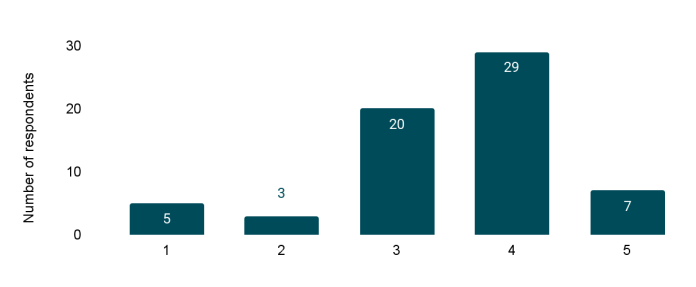
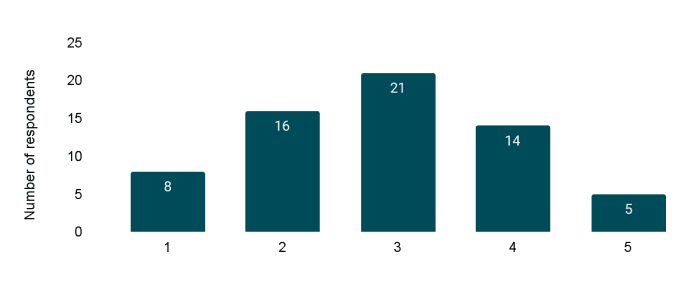
According to the survey undertaken for this report, scientists, innovators and policy experts believe that HM Government’s vision for science and technology is ambitious but not realistic (see: Graph 9 and 10). Although the slogan of ‘science and tech superpower’ is designed to drive investment into scale-ups, it also brings with it some challenges.
Scientists and innovators are largely sceptical about HM Government’s rhetoric of being a ‘science superpower’ – and felt that this is a slogan which is not grounded in the realities of the UK’s current capabilities or investment (Box 2). This echoes the findings of the House of Lords Select Committee, which concluded: ‘the ambition to become a science and technology superpower by 2030 risks not being realised, as there are few details about how this will be defined or delivered’.[67] The committee went on to recommend that HM Government needed to develop an implementation plan for its science and technology ambitions, otherwise they risk becoming empty slogans.[68] Specifically, the Committee recommended that HM Government should better define its science and technology strategy and consolidate existing strategies.[69]
Box 2: British researchers’ views on HM Government’s vision for science and technology
‘Vision? There’s a vision? I have seen some slogans.’ – Innovator
‘To be world beating (whatever that means).’ – Policy researcher
‘There is no vision. The conscious decision, excused by the Haldane Principle, is not to have one. This is one of the reasons why the connective tissue between the research and industry is so weak.’ – Innovator
‘I understand that Ministers have previously discussed a “vision” for the UK to be a “science superpower” – this has always been empty rhetoric. While investment in research has increased, the overall UK university sector is deeply financially unstable.’ – Consultant
‘The notion of being a “science nation” is overstated and not met by reality of actual capabilities and investment.’ – Innovator
‘I see [the UK’s] vision as quite grandiose but lacking substance and the financial stakeholder backing.’ – Innovator
‘The rhetoric is ambitious, albeit often somewhat vague. The actual activity does not match the rhetoric. Phrases such as “science and technology superpower” are vastly out of step with the behaviour of providing some globally small grants to universities and businesses.’ – Policymaker
‘The vision is unclear and when clarity seems to be on the horizon, policy changes tend to quash initiatives.’ – Innovator
‘Buzzwords like “science superpower”.’ – Innovator
As Graphs 9 and 10 show, British scientists and innovators broadly endorse the ambition of HM Government but believe that it is not necessarily realistic. When HM Government makes bold claims of being a ‘science superpower’, it makes it appear detached and as if it does not understand the ecosystem and its concerns. In these graphs, a score of 3 indicates a neutral response, whereas 1 and 2 convey a negative response, and 4 and 5 a positive response.
Graph 9: How ambitious is the UK’s vision for science and technology research and innovation? [64 responses] (1=not at all, 5=very)
Graph 10: How realistic is the UK’s vision for science and technology research and innovation? [64 responses] (1=not at all, 5=very)
Some respondents to the survey were more optimistic about HM Government’s vision for science and technology, but they represent only a minority of responses. One policymaker, for example, responded: ‘The S&T Framework sets out the UK’s vision to be a science superpower […] I think the vision is completely achievable’.
There are signs of progress towards this vision, such as the establishment of the Advanced Research and Invention Agency (ARIA), the creation of a dedicated Department for Science, Innovation and Technology, and the centrality of science and technology in numerous policy documents. However, as respondents highlighted, there remain numerous barriers to achieving it, including coherence of vision, investment and funding, and retention of skills and talent.
3.0 Coherence
The lack of coherence in the UK’s science and technology ambitions has been noted for some time. Efforts have been taken to address this. For example, in 2018, UK Research and Innovation (UKRI) was established to bring seven research councils,[70] Innovate UK, and Research England into one non-departmental public body operating at arm’s length from government. The document making the case for the creation of UKRI argued that it would deliver: ‘a strengthened, unified voice for the UK’s research and innovation funding system, facilitating the dialogue with Government and partners on the global stage’.[71] This document went on to say that the creation of UKRI would ‘help to maximise the effectiveness of the system, improving value for money. In addition, this reform will remove unnecessary duplication across the research funding landscape, enabling clear governance and resulting in a simple, easier and more agile system that will benefit researchers while generating increased efficiency in the medium term’.[72]
Yet there is still incoherence in the UK’s research and innovation approach. The Royal Society, for example, notes that the UK’s desire to be a ‘global leader in science’ is hampered by the ‘lack of a long-term vision, and by short-termism in political priorities and funding cycles’.[73] Similarly, the Productivity Institute highlights the absence of joined-up policy-making as one of three key challenges to UK productivity growth.[74] Much of the explanation for this incoherence lies with the fact that there have been frequent changes of ministers and changes in strategic priorities.
Since 2010, there have been 12 ‘science ministers’, a role which has been reshaped several times and has changed departments. This includes the Minister of State for Universities, Science and Cities (2010-2015), which then became the Minister of State for Universities, Science, Research and Innovation (2015-2020) in the Department for Education. This role then became Parliamentary Under-Secretary of State for Science, Research and Innovation (2020-2022), the Minister of State for Science and Investment Security (2022), and the Minister of State for Science, Research and Innovation at the Department for Business, Energy and Industrial Strategy (2022-). Since 2023, the role has been in the newly created DSIT.
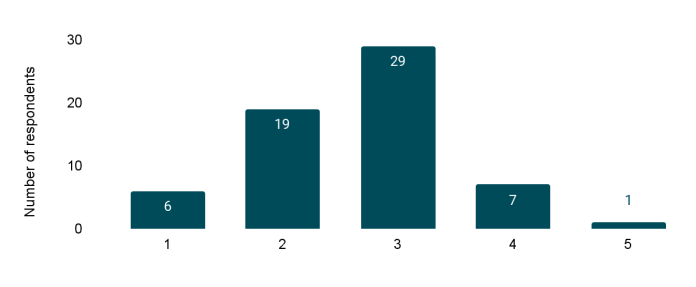
The rapid churn of ministerial positions means that priorities have changed frequently, often based on political considerations rather than being evidence-driven, and there is no time to assess if these strategies bear fruit.[75] It may be that DSIT will help to solve some of these issues around coherence but at present it is too early to tell. Respondents to the survey from all stakeholder groups were frank in their criticism about the siloed approach and lack of coherence in UK science and technology R&D (see: Box 3 and Graph 11).
Box 3: British researchers’ views on the coherence of the UK science and technology ecosystem
‘[The UK] has some of the world’s most fertile fields (universities and industry base), and [Britain] makes a decent fist of preparing them for the next season of crops (innovation and start-up ecosystem). However, the UK puts little thought into what to actually plant – [it] might scatter a few seeds, but in general [it] waits to see what the wind blows in. And [Britain] makes no effort at all to nurture and support anything that does amazingly manage to take root. And [then the UK] wonders why the harvest is so poor…’ – Innovator
‘The UK tends to work in silos across sectors and disciplines. This has improved with the formation of UKRI but is still pervasive across the R&I community.’ – Policymaker
‘The lack of a coordinated broader industrial strategy means that the impact of the UK’s science and technology agenda is going to be limited.’ – Policy researcher
‘[The UK] suffers from fast change, changing strategic priorities between prime ministers, across governments, and between departments. UKRI’s strategic priorities and critical technologies differ from DSIT’s, as do the Go Science “10 Big Things”.’ – Policy researcher
‘Even within areas of strength, [the UK’s] funding can fall behind other nations and is generally poorly-targeted due to a fear of government expressing any firm steer on technology direction or prioritisation (below the very high-level selection of critical technologies). […] The focus is too much on copying trends in other countries or following public discourse, rather than a hard-nosed assessment of UK capabilities, strengths, weaknesses and opportunities in different technology areas. Coupled with short-termism and a lack of commitment to real delivery of technology (e.g., nuclear build-out, mass-scale electricity grid expansion).’ – Policymaker
‘It is not clear how all the parts are supposed to work together, and the incentives are misaligned for maximal coordination and collaboration.’ – Policy researcher
Graph 11: Responses to the survey question: ‘How coherent is the UK’s science and technology research and innovation ecosystem? (Do different parts of the ecosystem work together towards a common vision, make use of synergies, and avoid duplication?)’ [62 responses] (1=not at all, 5=very)
Britain is the only major economy without a proper industrial strategy.[76] Make UK, the organisation representing manufacturers in the UK has stated ‘we have had six plans for growth but now find ourselves without [an industrial strategy]’.[77] The sector has called for the UK to develop one. The Royal Society, in its manifesto for science, outlined how the next government can build a more resilient and prosperous future. Its first recommendation is for Britain to ‘develop a long-term plan for UK science’.[78] Similarly, the Aldersgate Group has also stated that one of the priorities for the next government should be to develop ‘a long-term industrial strategy placing decarbonisation at its heart, with joined-up policy including skills, tax and a blueprint for deep decarbonisation of infrastructure’.[79]
4.0 Collaboration
There is tension between collaboration and competition in the UK’s research and innovation ecosystem. In this landscape, many organisations compete for funding, which can drive excellence but can also discourage or inhibit collaboration.[80]
For domestic collaboration between industry, academia, and other organisations, there are several steps HM Government has taken to improve the ability of industry and academia to work together. For example, it has been working to position the Ministry of Defence as the partner of choice for small and medium-sized enterprises and academia working on defence-related research.[81] It is also investing in ways to test how to spur co-investment in science from the private sector and philanthropists.[82]
As highlighted in section 2, for UK collaboration internationally, the 2021 Integrated Review set out the concept of the ‘own-collaborate-access’ framework in an attempt to guide HM Government’s approach to science and technology beyond the UK.[83]
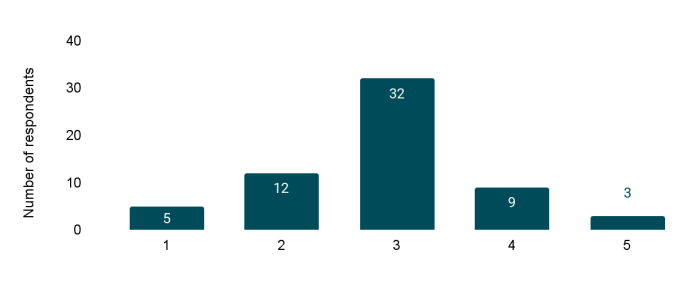
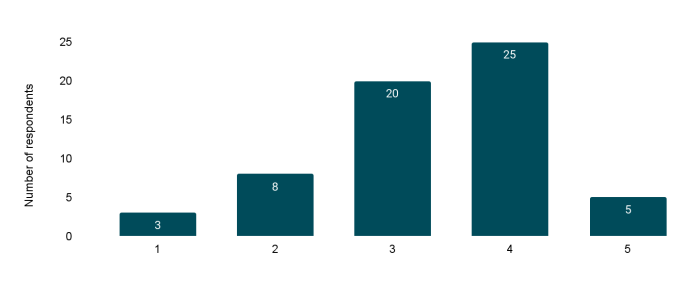
In the survey undertaken for this study, scientists, innovators and policy experts were asked about their views on collaboration between academia and industry within the UK, and collaboration between Britain and other countries. This survey shows that scientists and innovators do not have strong views about how easy it is for the public, private, and third sector organisations to work together, suggesting that it is not a major barrier to UK research and innovation in science and technology (see: Graph 12). Survey respondents were positive about the ability of the UK to cooperate internationally on research and innovation (see: Graph 13).
Graph 12: How easy is it for the public, private, and third sector organisations to work together? [61 responses] (1=not at all, 5=very)
Graph 13: How would you rate the ability of the UK to cooperate on science and technology internationally? [61 responses] (1=not at all, 5=very)
Some respondents felt there is room for improvement in collaboration, but these responses are not expressed as strongly as barriers in other areas of the UK’s science and technology ecosystem (see: Box 4).
Box 4: British researchers’ views on the collaborative environment for research and innovation in science and technology in the UK
‘Co-operation is mainly complicated by legal tussles around IP [intellectual property], and much of this stems from conditions set down by the bodies funding research at university, which can put constraints on the terms the universities can accept.’ – Chief Executive Officer
‘University attitudes on IP are still an annoying friction on public-private interaction. There’s some good practice and improvement, but needs to be consolidated e.g. by implementing the government spin-out review.’ – Programme director
‘The territorial, funding-motivated, ego driven approach to university research, the poor support for non-university research, and the complete lack of understanding around post research innovation mean that most of the talent and opportunity in the UK is wasted.’ – Innovator
‘There is too much red tape at the university and funding body (UKRI) level, making industrial and private collaboration much more difficult than it needs to be.’ – Scientist
‘Clearer rules of engagement between public, private, and third-sector organisations need to be set up.’ – Scientist
The collaboration environment in the UK is shown positively in the case study below. This example was chosen to demonstrate the UK’s collaborative environment for small and medium-sized businesses, and their ability to work with other organisations towards Britain’s Net Zero goals. In this case study, a large German company, Siemens, worked with a small UK business to support it in its attempt to develop the next generation of zero emission vehicles using hydrogen. In this case, Siemens supported the company in areas such as product design, supply chain management, support for skills and learning, and financing. Siemens has a record of supporting technical innovation and has expertise in areas planning and simulation software for manufacturing operations, which can greatly benefit start-ups.
Case study 1: Riversimple
| Name | Riversimple |
| Sector | Automotive |
| Location | Llandrindod Wells |
| Status | Founded in 2001 |
| Employees | 26 |
| Mission | Pioneering the next generation of zero emission vehicles using hydrogen. The company’s aim is mobility at zero cost to the planet. |
| Story | The company was founded in 2001 and has been working on fuel-cell vehicles since 2009. However, Riversimple has not sold any, and it has yet to make a production car. Instead of selling cars, Riversimple intends to lease them under a subscription model in which all running costs (including fuel, tax, insurance, servicing, repairs, components, and breakdown and recovery) will be covered by a fixed monthly fee and a variable mileage rate. |
| Support received | The company obtained a £2 million grant from the Welsh Government for its research and development, and €2 million matched funding from the EU for a public 12-month trial of 20 Rasa vehicle prototypes. |
| What worked? | The company found support through collaboration with Siemens, as well as with the public sector – notably the Welsh Government and the EU. A hackathon involving Siemens’ engineers helped Riversimple reduce the size of its future hydrogen car factory by 20%. In this exercise, engineers collaborated to accelerate and optimised esign for volume production of Riversimple’s hydrogen electric vehicle. |
| What is the impact for the UK? | Britain is lagging behind in the development of fuel cell power, but Riversimple aims to change that. HM Government has published its hydrogen strategy, committing to investment in hydrogen technology and production infrastructure. The potential for hydrogen as a fuel for transport to replace petrol and diesel is promising. |
| What needs improving? | Current hydrogen infrastructure is sparse, meaning hydrogen car sales are low. As hydrogen car sales are low, retailers are reluctant to make the investment into hydrogen infrastructure. Riversimple is focusing on an approach that concentrates demand for local hydrogen refuelling. |
5.0 Investment and financing
For every pound the public sector invests in R&D, the private sector invests around double.[84] This positive return is even higher in science-intensive fields, such as biomedical research.[85] As previously shown in Graph 7, the UK’s R&D spending was short of the OECD average as a percentage of GDP from 1991 to 2017.[86] Although the UK managed to surpass the average in 2018, it still lags behind leading countries such as Israel, South Korea, Japan, Germany, and the US.[87]
In 2021, HM Government invested around £14.5 billion in R&D.[88] Of the research funded by the public sector in 2021, around a third was invested in the general advancement of knowledge, while about a fifth was spent on health and around 12.5% was spent on defence. Despite HM Government’s Net Zero goals, only 2% is spent on the environment (see: Graph 14). 2021 total expenditure within the UK on research and development – including government and business spending – was around £66 billion.[89]
Graph 14: HM Government net expenditure on R&D by selected socio-economic objectives, percentage share, 2011 to 2022 (current prices)[90]

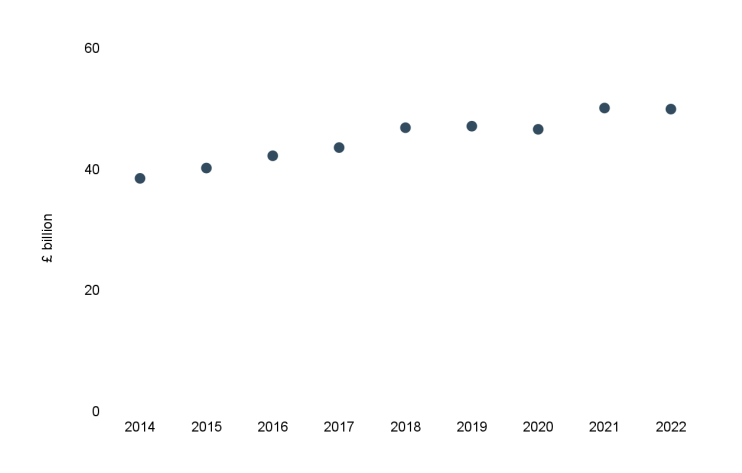
While gross spending within the UK on R&D as a percentage of GDP has increased, business spending has remained relatively constant (see: Graph 15). Despite annual increases in recent years, high inflation has meant that business R&D investment in real terms has largely stagnated since 2018.[91] Growing private R&D investment is critical to realising HM Government’s ambitions in science and technology. Policies and initiatives – such as increased public sector R&D spending – encourage business R&D investment, which in turn drive productivity gains and future economic growth and prosperity. As the Campaign for Science and Engineering put it: ‘There is a strong case for Government intervention to support R&D across the economy, with analysis showing that public investment crowds in significant levels of private sector investment in R&D’.[92] Such investment is crucial in solving societal challenges, such as climate change and energy security.
Graph 15: Expenditure on R&D performed in UK businesses: 2014 to 2022 (constant prices)[93]
At the same time, the funding environment is tight. The UK tax burden is at a 70-year high,[94] and there are demands from all areas of public spending – from defence to education. As a result, it is a difficult time to make the case for increased spending in any area – but this means it is even more vital that the case for increased R&D spending is made (see: Box 5).
Box 5: British researchers’ views on access to funding for science and technology R&D in the UK
‘Despiterecord levels of investment in UK R&D there are also challenges with funding […] we know that competitor nations continue to invest in R&D at a rate unmatched by the UK.’– Science and innovation policy professional
‘Public finances are stretched. […]. UKRI spends around £7 billion-£8 billion a year on R&D, record levels against GDP. We would always like it to be more, but when you consider the state of schools, hospitals, local councils, etc., I think we need to reflect that we need to work smarter with the money we have.’ – Policy professional
‘Currently, [finance is] very poor in research (UKRI, EPSRC) and slightly better in terms of government grants (for start-ups, but worse than France, Germany).’ – Scientist
‘Funding is balanced far too much in favour of science over innovation. We need to allocate much more to innovation, and we need to be less subjective and risk averse over its allocation.’ – Innovator
‘Public finance is available but comes in small drops and drabs and is extremely competitive. Innovate UK is oversubscribed, and [UK Space Agency] funding is too little. [The European Space Agency] (ESA) is great but the UK contribution isn’t georeturned (much of our money going into ESA is spent abroad).’ – Innovator
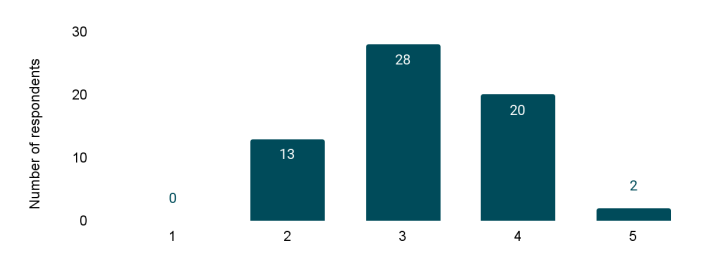
Respondents to the survey broadly felt that there was adequate availability of finance (see: Graph 16). However, respondents felt that UK funding for science and technology is short-term. HM Government’s R&D roadmap acknowledges this, stating:
…short-term spending settlements can limit people’s ability to develop long-term plans. Working with funding agencies and the devolved administrations, we accept the need to reverse the decline in funding for the long-term, fundamental research on which the entire system depends.[95]
There has been progress on this issue, with the Labour Party pledging 10-year research budgets for science if elected – a commitment which has gathered support across the political divide.[96]
Graph 16: Overall, how would you rate the availability of finance for science and technology research and innovation? [63 responses] (1=not available, 5=readily available)
The issue of finance and investment is expanded on in the case study below. In this case study, the Small Robot Company felt that – from their experience – the UK’s science and technology funding only covers development to prototype, and that beyond this point companies should receive more support to help the company scale up. The lack of investment in Britain for scaling is an often-cited problem and that they fail to cross the ‘valley of death’. Ultimately, this means that initial UK investment and support in such companies is often squandered as such companies either close or relocate to more supportive environments, such as the US.
Case study 2: Small Robot Company
| Name | Small Robot Company |
| Sector | Agri-tech |
| Location | Salisbury |
| Status | Operated from 2017 – 2024. Liquidated. |
| Employees | 53 |
| Mission | To make farming more financially and environmentally sustainable by providing field-scale insights at a plant level in order to optimise spray technology to reduce chemicals and waste. |
| Story | Founded in 2017, by Ben Scott-Robinson and Sam Watson Jones. The Small Robot Company delivered value at a profit and had customers waiting, but could not secure the investment to scale. |
| Support received | The company raised a total of £13.18 million over 6 funding rounds. Innovate UK proved helpful for early stage fundamental R&D. |
| What is the impact for the UK? | Britain lags other economies behind when it comes to automation, even those that are heavily in the service sector.[97] This problem has been noted for years.[98] The UK has missed an opportunity to develop a domestic solution to this problem, and may eventually import similar technology from other countries, whose solutions are not as well suited to the size and scale of British farms. |
| What needs improving? | The company had signed a term sheet but the investment did not materialise in time, meaning the company had to shut down. The company said they were victims of the valley of death, and that the UK’s science and technology ecosystem does not have the funding for hardware, or indeed any tech, that companies have in the US. Based on their experience, they found that UK funding tends to only cover development to prototype. The company believes that Innovate UK support helped for early stage fundamental R&D, however they felt that coupling Innovate UK to UKRI meant that too much of it was sucked up by universities working on projects that they viewed as a pure income stream, and had no real interest in commercialising. According to the company, there is too little support for start-ups in a post fundamental research stage, when they are trying to commercialise, but before they are profitable. HM Government could review the success of Innovate UK projects in order to understand how many achieved ‘escape velocity’ (made it to sale or became a profitable organisation), and how many of those were university-based. |
6.0 Infrastructure
R&D infrastructure, such as laboratories and research facilities, are essential for an innovation economy. The broader infrastructure landscape, such as housing and transportation, are also an essential part of the UK’s vision for science and technology; researchers and innovators need to be able to live near such R&D infrastructure and research centres, and to be able to travel and collaborate with others.
Scientists and innovators need access to a range of specialised equipment and facilities to prototype and test novel technologies, products and services in real environments.[99] To be a leader in R&D and the partner of choice for overseas researchers, innovators and businesses, the UK needs cutting-edge domestic infrastructure and access to major international facilities and collaborations.[100] Such infrastructure helps innovators to solve technical challenges, such as manufacturing at commercial scale, meeting regulatory requirements, and demonstrating an innovative solution to potential customers.[101]
This requires investment in new R&D infrastructure, and in upgrading, maintaining and improving access to existing infrastructure. Access to such infrastructure not only strengthens the UK’s capability to undertake excellent science and innovation, it also attracts international talent, collaborators and investment.[102] According to the UK’s R&D roadmap, Britain has over 500 ‘nationally and internationally significant research and innovation infrastructures’, almost all of which work with international partners and have an international user base, highlighting their role in attracting researchers and innovators from around the world.[103]
Cutting-edge British infrastructure includes: the National Environmental Isotope Facility, which provides isotope and organic geochemistry analytical capabilities; Diamond Light Source, the UK’s national synchrotron light source science facility; the Medical Research Council (MRC) Laboratory of Molecular Biology (LMB); and ISIS Neutron and Muon Source, whose neutron and muon instruments provide unique insights into the properties of materials on an atomic scale.
In the Science and Technology Framework, HM Government announced its aim to ensure that the UK
…strategically invests in relevant and important international infrastructure which sustains the UK’s scientific edge (such as CERN, European Molecular Biology Laboratory), aligns with critical technologies, or facilitates knowledge exchange.[104]
However, HM Government’s roadmap acknowledges that there is more the UK can do to give researchers and innovators the capabilities they need to do their ground-breaking work.
In responding to this study, researchers believe that the UK has strong infrastructure, but it is poorly maintained, can be hard to access, and is at risk of declining without investment (see: Box 6).
Box 6: British researchers’ views on R&D infrastructure in the UK
‘The UK has a well developed network of R&D facilities and infrastructures and this is being added with increasing investment, pace and focus. However, some business users (or potential users) of facilities and infrastructure […] have trouble accessing these assets. […] The UK would benefit from hosting a major international research infrastructure because it would act as a magnet for talent, spur skills development, support significant additional private and inward investment, catalyse cutting-edge science and innovation and would strengthen any claims the UK has to be a science and technology superpower.’ – Science and innovation policy professional
‘Universities struggle to meet lab space needs and recruitment to use/upkeep is not great.’ – Scientist
‘[UK infrastructure is] declining – I find myself reflecting on the late 1990s and the Joint Infrastructure Fund.[105] It seems to me that we are getting to a position where we are in that situation again [where we are in need of such investment].’ – Policy researcher
‘University infrastructure is often poorly maintained and funded, and there is little shared infrastructure available to the private sector – except that now being established through the catapults. […] Other countries (e.g. US, Denmark) use their universities and research centres (like Aerospace Corporation in the US) to become early adopters of technology and infrastructure coming out of the industry base, so that they can develop expertise in how to use it, and support adoption in wider industry. Some Catapults are now doing this, but it need to be much more systematic.’ – Innovator
‘It is often very difficult for SMEs to access infrastructure with the exception of Catapults and some [Research and Technology Organisations]. Universities are very difficult to penetrate if you are a business unless you are the size and scope of Siemens or Rolls Royce or AstraZeneca, GSK…’ – Policymaker
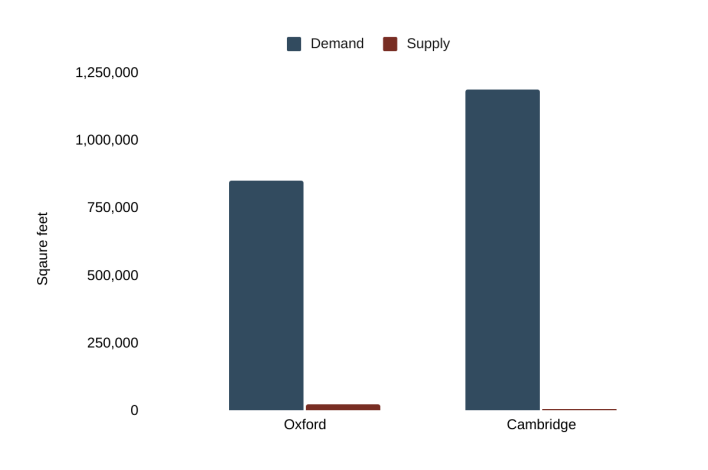
More generally, the UK suffers from poor access to infrastructure such as housing, laboratory spaces, and high performance computing facilities. Britain’s ‘expensive, cramped and ageing housing stock offers the worst value for money of any advanced economy’.[106] British house prices relative to earnings have not been this high since 1876.[107] It is therefore unsurprising that England is the most difficult place to find a home in the developed world.[108] In addition, the UK has a shortage of laboratory space – and this is holding back progress in the life sciences (see: Graph 17). Companies in areas such as cell and gene therapies, genomics, and synthetic biology are failing to reach their full potential as a result, and many spin-outs are sold to US companies or relocate outside the UK.[109]
Graph 17: Supply and demand for laboratory space in Oxford and Cambridge[110]
7.0 Bureaucracy
Unnecessary bureaucracy hampers research and diminishes the returns from research funding. This problem has been on HM Government’s radar for some time, with prime minister Boris Johnson stating in 2019 that he wanted to ‘ensure brilliant scientists are able to spend as much time as possible creating new ideas, not filling in unnecessary forms’.[111]
There has been limited research assessing the impact of bureaucracy, but a few studies have tried to quantify the scale of this issue. A 2006 HM Government report looked at the cost of preparing proposals, peer review, preparing end of grant reports, and the administrative cost to Research Councils. This study concluded that bureaucracy was equivalent to around £200 million annually (in 2006 terms), or about 13% of total funding awarded.[112] Meanwhile, the Australian National Health and Medical Research Council (NHMRC) estimated that the applicant burden was equivalent to 14% of total funding.[113]
This indicates that while the British bureaucracy burden may not be high by international standards, it is still a barrier that UK entrepreneurs frequently cite as hampering their ability to innovate. If Britain is able to address this challenge, it would provide a comparative advantage. Applications often require extensive documentation, detailed financial projections, and a proven track record in research – areas where small businesses tend to struggle due to lack of capacity.
Efforts have been made to trial streamlined application processes and alternative methods of evaluation. In 2020, the UK’s Engineering and Physical Sciences Research Council ran a pilot for a streamlined application process for the New Horizons scheme. In the first stage of this pilot, applicants were only required to submit an anonymised case for support. This reduced the amount of work needed to develop the application while also simplifying the assessment by asking reviewers to focus solely on the research idea and the methodology.[114]
In 2022, the HM Government published an independent review it had commissioned on UK research bureaucracy, which found that there are too many requirements relating to assurance bureaucracy and they are often complex and duplicative.[115] This review also found that there has been an incremental growth of bureaucracy; changing priorities have meant that while new assurance requirements have been introduced, few attempts have been made to remove or reduce redundant assurance requirements.[116]
As per the survey, innovators reported that the time and resources needed to compile a competitive application is excessively burdensome for small teams engaged in cutting-edge research and innovation (see: Box 7). This creates a barrier to entry, potentially excluding innovative ideas from smaller businesses which have the potential to disrupt the market or develop groundbreaking solutions.
Box 7: British researchers’ views on bureaucracy in the research and innovation ecosystem in science and technology in the UK
‘[Funding is] locked behind excessive bureaucracy. When an entire middle-man industry springs up that offers to make funding requests to government grants on behalf of start-ups in exchange for a cut, it should show the excessive complexity of that application process.’ – Technician
‘[Opportunities] are limited and highly competitive. They are also extremely slow. EPSRC, for example, offers postdoctoral fellowships in 3 very narrow research fields. Typically these grants are awarded around 1 year after the submission date. With many postdoctoral contracts 2 years long, this is highly impractical and leaves people in precarious positions.’ – Scientist
‘[Public finance is] unfit for purpose – too much time spent on writing proposals with few successes to actually do the work.’ – Scientist
‘The bureaucracy around innovation funding is horrendous, and the delays in payments regularly cause cash flow problems for start-ups.’– Innovator
‘It’s generally good – but the system is so complicated that many start-ups feel they have to jump through lots of hoops and spend money on bid writers to have a chance – that cannot be good. Some start-ups who are very deep tech also complain that awarding bodies often don’t understand their technologies [and therefore they are unfairly penalised for a lack of technical expertise in awarding bodies assessing applications].’ – Policy expert
These bureaucratic problems are highlighted in the case study below on Unicorn Biotechnologies. This company highlighted public sector bureaucracy and the burdensome nature of grant applications as one of the key barriers they have faced as a small company. This case study was chosen as it is indicative of the bureaucratic burden faced by many small businesses.
Case study 3: Unicorn Biotechnologies
| Name | Unicorn Biotechnologies |
| Sector | Biotechnology |
| Location | Sheffield |
| Status | Founded in 2021 |
| Employees | 10 |
| Mission | To develop a next generation biomanufacturing platform to power the cell-based manufacturing revolution, starting with manufacturing lab-grown meat at scale. By providing a clear path to affordably and rapidly scale cultivated meat, the company aims to improve human and planetary health and drive the transition to animal free agriculture. |
| Story | Unicorn Biotechnologies was founded in 2021 by Jack Reid and Adam Glen. By using automation, software, and analytics, their system automates animal cell-based manufacturing. This reduces costs by 10x, and speeds up process development timelines by over 90 percent, moving from years to just months. |
| Support received | The company raised US$3.2 million to turn its prototype bioreactor into a commercial product. |
| What worked? | Unicorn Biotechnologies has found the Innovate UK process pre-award to be straightforward and helpful for start-ups. |
| What is the impact for the UK? | The UK is seeking to lead the way in novel low-emission food production. Alternative proteins, such as plant-based and lab-grown options, place less demand on land and water resources than conventional proteins. With innovative approaches, they may also produce less greenhouse gas emissions. This is one of the ways in which the UK maybe able to lead the way on reducing the environmental impact of farming when compared to traditional agriculture production processes. |
| What needs improving? | Unicorn Biotechnologies have found the level of bureaucracy in the UK’s science and technology ecosystem is hampering startups from growing and innovating, particularly areas such as the post-award process from Innovate UK. The company has also highlighted issues with the lack of innovation experience in the UK. Universities, which are often central to science and technology startups, are – in the experience of this company – not always well placed to innovate, and academics are better suited to describing problems rather than solving them. |
8.0 People and skills
The UK has tried to boost its competitive advantage by attracting international talent to the country. Britain intends for its offer to be attractive to the world’s best talent across all career stages, with easy access through its high-skilled visa system, and for British researchers to participate in exchanges which deliver international links and establish new collaborations.[117]
Survey respondents were divided about how adequate the education, talent, and skills base in the UK is for R&D in science and technology (see: Graph 18). They highlighted that challenges remain (see: Box 8).
Graph 18: To what extent is the education, talent, and skills base in the UK adequate for research and innovation in science and technology? [63 responses] (1=not at all, 5=to a great extent)

Box 8: British researchers’ views on the education, skills and talent base in the research and innovation ecosystem in science and technology in the UK
‘One of the big challenges to the effectiveness and impact of the UK’s research and innovation system is lack of access to skills. This is a major challenge to innovators but also in terms of teaching’. – Science and Innovation Policy Professional
‘There are major skills challenges at every part of the pipeline (for physics). There is a serious and long-term shortage of physics teachers which limits the number of people choosing to study physics and the quality of education received by those that do. There is a shortage of physics skills in the workforce and, at the same time, demand for these skills is growing meaning that the gap will get bigger in the short term. Two-thirds of physics innovators have stopped or slowed R&D or innovation activity in the past five years because of skills shortages with only 11% reporting that they had no difficulty with recruitment. This is a major brake on UK physics innovation activity and investment’. – Science and Policy Professional
‘Ensuring that the UK has the skills to meet the requirements of a more R&D-intensive economy is a vital component of the UK Government’s ambitions to make the UK more research-intensive. Wider skills provision will be needed to meet the requirements of an expanding R&D sector, and ensure that everyone can participate in and benefit from a more innovative UK. There is a need to develop a greater number of people with STEM skills, as well as develop new skills in the existing R&D workforce and ensure that qualifications remain relevant to changing labour market demands. The UK Government and devolved administrations must coordinate and support an integrated skills system to deliver a more innovative and research intensive UK’. – Science policy/public affairs professional
‘This is a major issue. It’s not just availability of talent, it’s the shocking and persistent lack of diversity, which the Government are determined to ignore (dispite recent reports and recommendations). Retention is a huge issue. […] It needs to be looked at as a whole system. There’s no coordination of efforts and initiatives’. – Policy researcher
Many science graduates end up in jobs which are not in scientific or technical industries. Holders of physical science degrees tend to be highly numerate, and some are attracted to jobs with high salaries in sectors such as finance.[118] For example, one-fifth of physics graduates start work in the financial sector – which is more than the number of physics graduates who start their career in ‘science and technical industries’.[119] In addition, the way in which science is taught in schools has been found to be a significant factor in whether students continue to study science post-16.[120] Yet, in schools, over a quarter of teaching hours in physics in 2021-2022 were taught by teachers with no relevant post-A level qualifications.[121]
In 2021, HM Government estimated that the UK needed 150,000 more researchers and technicians by 2030 to capitalise on planned increases in R&D investment effectively.[122] The Institution of Engineering and Technology (IET) has estimated a shortfall of over 173,000 workers in the STEM sector.[123]
However, the UK’s visa system is one of the most expensive in the world, and the upfront costs of visas are substantially higher in Britain compared to other research intensive countries (see: Graph 19).[124]
Graph 19: The upfront costs (to individuals and sponsors) of UK visas compared with other leading science nations[125]
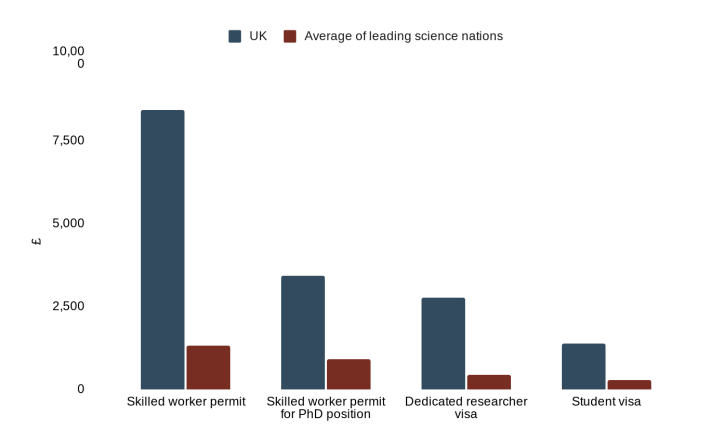
The UK’s current visa arrangements risk making the UK less attractive to global talent compared to competitors. Recently, HM Government announced a significant increase in the minimum salary that a skilled migrant must earn in order to qualify for a work visa, from £26,200 to £38,000. This increase means that the threshold is higher than the salary of most early career researchers, which could damage the UK’s science ambitions.[126] At the same time, the UK’s net migration figure for 2022 was at a record of around 745,000.[127] The gap between Britain’s talent shortages and this figure indicates that migrants arriving in the UK do not have the right skills to ease labour shortages, and that Britain should be doing more to close the skills gap.[128]
9.0 Conclusion and recommendations
The world faces the existential challenge of climate change and environmental degradation. To meet this challenge, countries around the world have set ambitious targets for getting to Net Zero. Collectively, humanity must meet those targets as the world keeps on developing and consuming more energy. The only way humanity can do this is through science, technology, and innovation. The UK has an important part to play in this and an economic opportunity to seize.
This report highlights British researchers’ perceptions of the UK’s science and technology ecosystem, and their views of its strengths and weaknesses. In doing so, this Report helps to explain why Britain is falling behind when it comes to seizing the opportunities offered by Net Zero. HM Government has a clear ambition to be a science and technology superpower. However, according to this research, it lacks a clear, coherent strategy and long-term commitment for Net Zero. Although HM Government has released numerous policy documents on science and technology recently, the mixed policy signals in areas such as the green transition makes it difficult for researchers, innovators and investors to plan for the future. UK businesses do not invest enough in R&D, and there is a particular shortage in funding for start-ups that are trying to commercialise, but are not yet profitable. And the UK risks becoming an unattractive environment for the world’s best and brightest researchers and may lose talent to countries with more stable and supportive R&D environments for green technologies.
While HM Government has adopted the mantle of a ‘science superpower’, there are still significant gaps between rhetoric and reality. The international environment is rapidly changing – and countries around the world have ambitions to grow their R&D activities in science and technology. The study identifies several key shortcomings the UK will need to address if it is serious about maintaining or increasing its capabilities in science and technology.
- Incoherent strategy: The UK’s current approach to science and technology lacks a coherent long-term vision. Frequent policy changes have created an unstable environment, discouraging investment, and hindering long-term planning for researchers.
- Average business investment: While UK R&D expenditure has increased, business investment has stagnated, showing potential for improvement.
- Short term funding: Funding mechanisms often prioritise short-term projects, stifling long-term innovation.
- Bureaucratic burden: The current application process for funding is cumbersome, particularly for small businesses. Streamlining this process and offering lighter-touch funding options would be beneficial to small businesses.
- Risk aversion: The UK should be more comfortable with calculated risks in research and development, especially in areas critical for realising Net Zero.
- Skills Gap: The UK’s current visa system is a barrier to attracting top international talent, and risks making the UK a less competitive environment internationally.
- Limited access infrastructure: R&D infrastructure will decline without investment and maintenance, and there is inadequate access to key infrastructure, such as labs and data centres, which hinders research efforts in the UK.
These weaknesses have serious implications for the UK’s future prosperity, strategic advantage, and ability to achieve its Net Zero ambitions.
Recommendations
To address these shortcomings and propel Britain forward as a science and technology nation, HM Government should:
- Ring-fence British science and technology R&D spending and link it by law to the countries which invest the most in R&D as a percentage of GDP. Science and technology are foundational to national power and wellbeing; they underpin all other national priorities, not least HM Government’s ambition to reach Net Zero. Low R&D spending comprises the dynamism of the British science and technological ecosystem, and the economy more broadly. Britain’s future prosperity, strategic advantage, defence, and environmental security are directly dependent on its scientific and technological capabilities. A sustained increase in government R&D investment creates the stability to pursue big ideas, discoveries, and innovations which would improve UK public services and spur innovation. Such investment will instil confidence in the UK as a place to do business, drive growth, prosperity, and allow the country to lead on the transition to Net Zero while tackling threats to health, wellbeing and quality of life across the UK. As such, R&D spending should be prioritised above and beyond other areas of government spending. Therefore, R&D investment should be enshrined in law so that it is tied to an average of the five countries which spent the most on R&D in the previous year, unless that average is lower than the UK’s expenditure. For example, in 2021, the top five countries by R&D spending (as a percentage of GDP) were Israel, South Korea, Taiwan, the US, and Belgium.[129] Taking an average of their spending on R&D would set a target of 4.2% for that year for the UK, well above the present British investment of 2.9%.
- Develop a coherent cross-departmental roadmap to unlock prosperity through science and technology; this should be led by the Secretary of State for Science, Innovation and Technology and the Secretary of State for Business and Trade, with oversight from the prime minister. While there have been many recent strategies and roadmaps, the current approach has been too piecemeal and suffered from frequent churn. HM Government cannot continue to hedge its bets. It should take bold but calculated risks based on an honest assessment of the nation’s comparative advantages and where it can gain strategic advantage. Joint responsibility would help the strategy to survive changes in government departments or in ministers, which has hampered UK efforts for too long. In particular, the UK is the only major economy without a proper industrial strategy.[130] HM Government should develop one. Importantly, any strategy needs to be long term, so that it has time to bear fruit. The UK should also stick to its strategy, even if there is change at the ministerial level, as the high level of uncertainty and policy churn in recent years has stifled progress. That is not to say that the strategy should not change as more evidence is gathered about what works and which areas of funding are most promising, but that there is no need for an overhaul if there are changes at the ministerial level. Such a roadmap should also map out and provide greater clarity about responsibility for different parts of the British scientific and technological ecosystem, and how different organisations can work together more effectively. In order to aid this, HM Government should improve linkages between different parts of the science and technology ecosystem to ensure they complement one another, such as ensuring ARIA, Public Sector Research Establishments (PSREs) and UKRI all support a shared vision even if their activities and approaches are different. HM Government should also coordinate efforts between roadmaps which already exist – such as for space exploration technology and smart data.[131]
- Review its discretionary planning system and liberalise planning laws. In particular, HM Government should review the Town and Country Planning Act. Doing so will enable the UK to build scientific infrastructure faster, such as energy storage facilities and laboratory spaces – of which there is a current shortage, and which is holding back R&D. In addition, Britain has a housing crisis, which prevents talented scientists and innovators from living comfortably in some of the country’s most entrepreneurial hubs. The National Infrastructure Commission should provide advice to government on where this infrastructure should be built to make best use of existing expertise and hubs, as well as to spread prosperity across the country. In doing so, HM Government can help provide the environment for the private sector to build such infrastructure.
- Expand the foresight capacity and capabilities of the Government Office for Science, particularly with respect to the UK’s performance in next-generation technologies and how the international landscape is evolving. With this information, Britain will be better equipped proactively to address weaknesses. Expanding the Government Office for Science’s foresight capacity and capabilities will ensure that the UK is closely monitoring areas in which it risks becoming dependent on unfriendly nations or risks losing out on potential drivers of prosperity and growth. This could be, for example, through ineffectively targeted funding, through early stage companies being bought out by other countries, from lack of infrastructure or skills, or through international competition. The Government Office for Science should work closely with organisations such as the National Infrastructure Commission and the Department for Education on this endeavour.
- Generate a long-term plan for British science and technology skills and talent, including reform of its visa arrangements, through a collaborative effort from the Home Office, the Department for Education, and the Department for Science, Innovation and Technology. In particular, this long-term plan should encompass early years, primary, and secondary education to ensure that the British workforce is equipped with the numerical, data, and soft skills necessary to thrive in the future economy, and to help encourage young people to pursue scientific careers through non-traditional pathways (such as apprenticeships). HM Government should improve domestic skills and talent through funded scholarships, research exchanges, secondments, internship and fellowships. In particular, the UK should develop training and career paths for people doing translational R&D and production – that is, converting the outputs of basic scientific research into research that has tangible benefits for society – not just invention. As part of this long-term plan for skills and talent, HM Government would do well to explore ways to retain institutional knowledge, which is frequently lost when ministers and civil servants move. HM Government urgently ought to review its visa offer, as this is a barrier to attracting some of the world’s most talented researchers. The current cost to individuals and sponsors is far higher in Britain compared to other leading nations. Such visa arrangements also risk economic damage to the UK and its higher education sector.
- Craft a Decadal Funding Plan for R&D in areas of science and technology identified as being of national importance in the UK’s long-term strategy, as well as expand trials of funding methods which are high risk, high reward. A Decadal Funding Plan would help to provide the stability critical to transformative innovation. More durable funding agreements support investments in projects that will have the greatest long-term impact on growth. Such 10-year funding cycles would help provide the stability British science has been lacking. In particular, the UK should provide greater long term support for infrastructure at higher technology readiness levels (TRLs). In particular, HM Government should explore new funding models for research both in and outside of universities which cover a greater proportion of the full economic cost of research. Britain should offer increased support through a greater variety of funding mechanisms (e.g., tax breaks, tax credits, and other tax incentives, as well as grants to offset start-up cash flow burn). HM Government ought to improve the availability of high risk funding. To fully harness its scientific talent and compete on the world stage, the UK ought to adopt a more adventurous approach which balances calculated risks with responsible research practices. This includes expanding funding for ARIA, reviewing the framework agreements and the barriers to entry for small and medium sized businesses, and trialling a greater variety of streamlined funding mechanisms that are not so burdensome for small businesses.
- Investigate how public sector procurement can better support early stage businesses and cutting-edge science and technology through the Cabinet Office Public Procurement Review Service. Such measures could include direct support, such as the Ministry of Defence being a customer for products created by British small businesses, but it could also include incentives for businesses which support early stage businesses, or provide memoranda of understanding and expressions of interest.
- Legislate to prevent businesses critical to the UK’s roadmap for science and technology from being sold off to foreign competitors, particularly if doing so would harm Britain’s strategic advantage or potential economic prosperity. The Competition and Markets Authority should work more closely with the Government Office for Science, the Ministry of Defence, and other parts of government to ensure that businesses critical to the UK’s roadmap for science and technology are not sold off to foreign competitors, particularly if doing so would harm Britain’s strategic advantage or potential economic prosperity. Currently, too many British businesses are bought in their growth phase, and they go on to become US$1 billion plus companies based in other parts of the world. This is counterproductive for companies in sectors HM Government has identified as being critical to national prosperity and future growth.
- Increase support for scale-ups to cross the ‘valley of death’ through improved capacity and resources for Innovate UK. These scale-ups have a disproportionately large economic benefit for the UK, create skilled jobs, drive productivity and maintain British competitiveness – but too many businesses do not reach this size. Increasing Innovate UK’s capacity and resourcing will help scale-ups to access to markets and resources, form connections, and attract growth capital.
- Improve databasing of science and technology R&D knowledge and capabilities across UK bodies on science, technology and innovation. This should include UKRI, Innovate UK, the Department for Science, Innovation and Technology, and the Government Office for Science. This comprehensive database of science and technology R&D knowledge and capabilities across the UK and partner countries should be easily accessible by scientists and innovators, and should be searchable by areas such as field, sector, and expertise. In doing so, this would facilitate matchmaking in research and collaboration.
Annex 1: Survey questions
The survey questions underpinning this study are provided below.
Dimension 1: The clarity of the UK’s vision for science and technology
- What is your understanding of the UK’s vision for science and technology?
- How ambitious is the UK’s vision for science and technology research and innovation? (Likert scale)
- How realistic is the UK’s vision for science and technology research and innovation? (Likert scale)
- Do you have any comments on how ambitious and realistic the UK’s vision for science and technology research and innovation is?
- Do you have any other comments on the UK’s vision for science and technology research and innovation?
Dimension 2: The UK’s Research and Innovation system
- How connected is the UK’s science and technology research and innovation ecosystem? (Likert scale)
- Do you have any comments about the connectedness of the UK’s science and technology research and innovation ecosystem? What are the key barriers and facilitators of connectedness (e.g. transport infrastructure, digital infrastructure)?
- How coherent is the UK’s science and technology research and innovation ecosystem? (Do different parts of the ecosystem work together towards a common vision, make use of synergies, and avoid duplication?) (Likert scale)
- Do you have any comments about the coherence of the UK’s science and technology research and innovation ecosystem? Are there areas where different parts of the ecosystem do not work towards a common vision or duplicate efforts?
- How supportive is the UK’s science and technology research and innovation ecosystem? (Is advice/support readily available?) (Likert scale)
- Do you have any comments about the supportiveness of the UK’s science and technology research and innovation ecosystem? (Are there areas where advice is not available, or areas of best practice that others should learn from?)
- How would you rate the UK’s research and innovation system broadly? (Likert scale)
- Do you have any other comments about the strengths and weaknesses of the UK’s research and innovation system?
Dimension 3: Investment and Finance
- What are your views on the availability of and access to public finance for science and technology research and innovation?
- What are your views on the availability of and access to private finance for science and technology research and innovation?
- Overall, how would you rate the availability of finance for science and technology research and innovation? (Likert scale)
- What funding mechanisms or approaches do you believe best incentivise research and innovation in science and technology?
- Do you have any other comments on the financing of the UK’s science and technology research and innovation ecosystem? (e.g. overhead, availability of funding at different stages of TRL…)
Dimension 4: Education, talent, and skills
- To what extent is the education, talent, and skills base in the UK adequate for research and innovation in science and technology? (Likert scale)
- What is your view on science and technology education, talent, and skills in the UK? (e.g. quality, availability, and retention of new UK graduates, overseas graduates, mid-senior researchers, technicians…)
- Are current visa and immigration arrangements suitable for the needs of UK research and innovation in science and technology? Why, or why not?
- Are there mechanisms available to develop early career stage science and technology talent in the UK?
Dimension 5: R&D infrastructure
- How would you describe the presence of, access to, and quality of physical R&D infrastructure in the UK?
- How would you describe the presence of, access to, and quality of digital R&D infrastructure in the UK?
- What infrastructure do other countries have that the UK would benefit from?
Dimension 6: Collaboration and connectivity
- How would you rate the ability to cooperate on science and technology within the UK? (Likert scale)
- How would you rate the ability to cooperate on science and technology internationally? (Likert scale)
- To what extent is proximity or co-location to other researchers is important for research and innovation? (Likert scale)
- To what extent is transport infrastructure critical to research and innovation in science and technology? (Likert scale)
- How easy is it for the public, private, and third sector organisations to work together? (Likert scale)
- Do you have any other comments on the connectivity of the research and innovation ecosystem in science and technology in the UK?
Additional questions
- What three policies do you believe should be a priority for the government for the UK to improve the quality and competitiveness of its science and technology ecosystem?
- Is Britain effectively harnessing its science and technology base to achieve its Net Zero ambitions? If not, what should it do differently?
Acknowledgments
The author would like to thank James Rogers, Stephen Booth, Tony McBride, Terri Paddock, Stuart Martin, and Matt Burnett for their comments and feedback on earlier drafts of this paper. Any errors or omissions remain with the author.
ISBN: 978-1-914441-70-7
Address: 14 Old Queen Street, Westminster, London, SW1H 9HP
Phone: 020 3915 5625
Email: [email protected]
© 2024 Council on Geostrategy
Disclaimer: This publication should not be considered in any way to constitute advice. It is for knowledge and educational purposes only. The views expressed in this publication are those of the authors and do not necessarily reflect the views of the Council on Geostrategy or the views of its Advisory Council.
Please do not print this document; protect the environment by reading it online.
Geostrategy Ltd., trading as Council on Geostrategy, is a company limited by guarantee in England and Wales. Registration no. 13132479. Registered address: Geostrategy Ltd., Lower Ground Floor Office, 231 Shoreditch High Street, London, E1 6PJ.
Notes
[1] ‘2023 was the world’s warmest year on record, by far’, National Oceanic and Atmospheric Administration, 12/01/2024, https://www.noaa.gov/ (checked: 29/05/2024).
[2] See: ‘World had warmest January on record’, World Meteorological Organisation, 15/02/2024, https://wmo.int/ (checked: 29/05/2024); ‘Earth just had its warmest February on record’, National Oceanic and Atmospheric Administration, 14/03/2024, https://www.noaa.gov/ (checked: 29/05/2024); ‘Copernicus: March 2024 is the tenth month in a row to be the hottest on record’, Copernicus Climate Change Service, 09/04/2024, https://climate.copernicus.eu/ (checked: 29/05/2024); and, ‘Globe records its hottest April on record, with subtle signs of a shift’, Axios, 06/05/2024, https://www.axios.com/ (checked: 29/05/2024).
[3] Damian Carrington, ‘World’s top climate scientists expect global heating to blast past 1.5C target’, The Guardian , 08/05/2024, https://www.theguardian.com/ (checked: 29/05/2024).
[4] ‘How Britain decarbonised faster than any other rich country’, The Economist , 15/02/2021, https://www.economist.com/ (checked: 29/05/2024).
[5] See: ‘The fiscal cost of net zero in the UK in an international context’, Office for Budget Responsibility, 07/2023, https://obr.uk/ (checked: 29/05/2024) and ‘Costs and benefits of the UK reaching net zero emissions by 2050: the evidence’, Grantham Research Institute on Climate Change and the Environment, 03/08/2023, https://www.lse.ac.uk/ (checked: 29/05/2024).
[6] Chris Skidmore, ‘Mission zero: Independent review of net zero’, Department for Energy Security and Net Zero, 26/09/2022, https://gov.uk/ (checked: 29/05/2024).
[7] ‘UK Trails Europe in Developing Green Economy, Study Shows’, Bloomberg , 05/10/2023, https://www.bloomberg.com/ (checked: 29/05/2024).
[8] ‘Kemi Badenoch heralds thriving $1 trillion UK tech sector’, Department for Business and Trade, 13/06/2023, https://www.gov.uk/ (checked: 29/05/2024).
[9] The Global Innovation Index is an annual ranking of countries by their capacity for, and success in, innovation, published by the World Intellectual Property Organisation. See: ‘United Kingdom ranking in the Global Innovation Index 2023’, World Intellectual Property Organisation, 2023, https://www.wipo.int/ (checked: 29/05/2024).
[10] The Future Possibilities Index (FPI) is a future trends study by Newsweek Vantage and Horizon Group. It measures the capacity of countries to leverage possibilities emerging from six transformational trends for their future economic growth and societal wellbeing. See: ‘Future Possibilities Index’, Horizon Group and Vantage Research, 2024, https://www.futurepossibilitiesindex.com/ (checked: 29/05/2024).
[11] ‘Country & Product Complexity Rankings’, Harvard Kennedy School Growth Lab, 2023, https://atlas.cid.harvard.edu/rankings, (checked 29/05/2024).
[12] Valentina Romei, ‘Official data confirms UK economy slipped into recession last year’, Financial Times , 23/08/2024, https://www.ft.com/ (checked: 29/05/2024).
[13] In 2007, UK GDP per capita was US$50,420, while US GDP per capita was US$47,943. In 2024, UK GDP per capita is US$51,075, while in the US, this is US$85,373. See ‘GDP, current prices Billions of US dollars’, International Monetary Fund, 2024, https://www.imf.org/ (checked: 29/05/2024).
[14] ‘Where are all the British robots?’, The Economist , 16/04/2024, https://www.economist.com/ (checked: 29/05/2024).
[15] ‘UK falling behind rest of the world on realising value from new technology’, Deloitte, 23/11/2023, https://www2.deloitte.com (checked: 29/05/2024).
[16] Thomas Seal, ‘Tech Companies Warn That UK Is Losing Business Allure’, Bloomberg, 06/06/2023, https://www.bloomberg.com/ (checked: 29/05/2024).
[17] Emily Head, ‘Life expectancy declining in many English communities even before pandemic’, Imperial College London, 12/10/2021, https://www.imperial.ac.uk/ (checked: 29/05/2024).
[18] See: Stuart Hoddinott, ‘Short-term policymaking has trapped public services in a “doom loop”’, Institute for Government, 30/10/2023, https://www.instituteforgovernment.org.uk/ (checked: 29/05/2024) and Andrew Sentance, ‘A short-term approach from government is harming the economy’, The Times , 21/08/2023, https://www.thetimes.co.uk/ (checked: 29/05/2024).
[19] See: Isabella O’Malley, ‘Business group estimates several hundred thousand clean energy jobs in EV, battery storage and solar’, The Independent , 01/11/2023, https://www.independent.co.uk/ (checked: 29/05/2024) and Antonio De Rose, Alessandro Cenderello and Alexis Gazzo, ‘How the new era of green growth in Europe is impacting jobs’, EY , 25/05/2021, https://www.ey.com/ (checked: 29/05/2024).
[20] Keith Bradsher, ‘Why China Could Dominate the Next Big Advance in Batteries’, The New York Times , 12/04/2023, https://www.nytimes.com/ (checked: 29/05/2024).
[21] Raoul Ruparel, Patrick Roche, Dale Williams, James Hollingsworth, Stuart Westgate, Tim Chapman, Edward Zaayman, Helena Fox and Anja Johnson, ‘Reshaping British Infrastructure: Global Lessons to Improve Project Delivery’, Boston Consulting Group, 07/02/2024, https://www.bcg.com/ (checked: 29/05/2024).
[22] Ibid.
[23] Caitlin Rollison, ‘Improving transport connectivity in UK cities: three key takeaways’, Centre for Cities, No date, https://www.centreforcities.org/ (checked: 29/05/2024).
[24] Raoul Ruparel, Patrick Roche, Dale Williams, James Hollingsworth, Stuart Westgate, Tim Chapman, Edward Zaayman, Helena Fox and Anja Johnson, ‘Reshaping British Infrastructure: Global Lessons to Improve Project Delivery’, Boston Consulting Group, 07/02/2024, https://www.bcg.com/ (checked: 29/05/2024).
[25] Ibid.
[26] Mann Virdee, ‘Britain’s future is in technology and innovation’, Council on Geostrategy, 07/03/2024, https://www.geostrategy.org.uk/ (checked: 29/05/2024).
[27] ‘QS World University Rankings 2024: Top global universities’, QS World University Rankings, 2024, https://www.topuniversities.com/ (checked: 29/05/2024).
[28] See: Anna Ford, ‘On climate, UK universities are leading where the government is trailing’, Wonkhe, 05/02/2024, https://wonkhe.com/ (checked: 29/05/2024) and Universities UK, ‘Climate crisis: what progress have universities made?’, Universities UK, 07/08/2023, https://www.universitiesuk.ac.uk/ (checked: 29/05/2024).
[29] ‘Guidance on assessing performance and value of Public Sector Research Establishments’, Government Office for Science, 25/01/2022, https://www.gov.uk/ (checked: 29/05/2024).
[30] Anjana Ahujia, ‘World-leading? Britain’s science sector has some way to go’, Financial Times , 15/03/2023, https://www.ft.com/ (checked: 29/05/2024).
[31] Chris Woolston, ‘Nature Index Annual Tables 2023: China tops natural-science table’, Nature , 15/06/2023, https://www.nature.com/ (checked: 29/05/2024).
[32] ‘International comparison of the UK research base, 2022’, Department for Science, Innovation and Technology, 25/05/2022, https://www.gov.uk/ (checked: 29/05/2024).
[33] For Graphs 4, 5 and 6, ‘Share’ refers to a fractional count for an article allocated to an institution, city or country/region, that takes into account the proportion of authors on the article whose institutional affiliation is with that institution or location. See: ‘Institution tables’, Nature , 2024, https://www.nature.com/ (checked: 29/05/2024).
[34] ‘Institution tables’, Nature , 2024, https://www.nature.com/ (checked: 29/05/2024).
[35] ‘Institution tables’, Nature , 2024, https://www.nature.com/ (checked: 29/05/2024).
[36] Julia Kollewe, ‘UK and Europe are falling behind US and China in biotech, says AstraZeneca boss’, The Guardian , 27/04/2023, https://www.theguardian.com/ (checked: 29/05/2024).
[37] ‘Top 500 List–June 2024’, Top500, 05/2024, https://top500.org/ (checked: 29/05/2024).
[38] James Titcomb, ‘British tech companies to use EU’s powerful supercomputers as UK falls behind’, The Telegraph , 13/05/2024, https://www.telegraph.co.uk/ (checked: 29/05/2024).
[39] Charles Babbage, Reflections on the Decline of Science in England, and on Some of Its Causes (London: R. Clay Bread-Street-Hill, Cheapside, 1830).
[40] Malcolm Longair, Maxwell’s Enduring Legacy: A Scientific History of the Cavendish Laboratory (Cambridge: Cambridge University Press, 2016).
[41] Sabine Clarke, ‘What can be learned from government industrial development and research policy in the United Kingdom, 1914-1965’, British Academy, Lessons from the History of UK Science Policy (London: British Academy, 2019).
[42] Malcolm Longair, Maxwell’s Enduring Legacy: A Scientific History of the Cavendish Laboratory (Cambridge: Cambridge University Press, 2016).
[43] Sabine Clarke, ‘What can be learned from government industrial development and research policy in the United Kingdom, 1914-1965’, British Academy, Lessons from the History of UK Science Policy (London: British Academy, 2019).
[44] Claire Craig, ‘Policy towards science and science in policy: questions and answers?’, British Academy, in Lessons from the History of UK Science Policy (London: British Academy, 2019).
[45] Jon Agar, ‘Science policy since the 1960s’, British Academy, in Lessons from the History of UK Science Policy (London: British Academy, 2019).
[46] See: John Irvine, Ben Martin, Tim Peacock and Roy Turner, ‘Charting the decline in British science’, Nature , 316 (1985); Ben R. Martin, John Irvine, Francis Narin and Chris Sterritt, ‘The continuing decline of British science’, Nature , 330 (1987); Roger Williams, ‘The decline of the British science empire’, Bulletin of Atomic Scientists , 43:8 (2015); Ben R. Martin, ‘British science in the 1980s–Has the relative decline continued?’, Scientometrics , 29:1 (2005); and, Roger Dettmer, ‘Saving British science’, Electronics and Power , 33:1 (1987).
[47] ‘About’, Campaign for Science and Engineering, 2022, https://www.sciencecampaign.org.uk/ (checked: 29/05/2024).
[48] Richard Jones, ‘The UK’s thirty year experiment in innovation policy’, London School of Economics, 06/16/2012, https://lse.ac.uk/ (checked: 29/05/2024).
[49] ‘Gross domestic spending on R&D’, Organisation for Economic Cooperation and Development, 2023, https://oecd.org/ (checked: 29/05/2024).
[50] Ibid.
[51] John F. Kennedy, Speech: ‘Address to Join Session of Congress May 25, 1961’, John F. Kennedy Presidential Library and Museum, 25/05/1961, https://www.jfklibrary.org/ (checked: 29/05/2024).
[52] ‘Setting clear outcomes for ambitious missions’, Observatory of Public Sector Innovation, No date, https://oecd-opsi.org/ (checked: 29/05/2024).
[53] The Industrial Strategy Challenge Fund (ISCF) focuses on research and innovation to tackle the UK’s primary industrial and societal challenges. ISCF aligns with the key themes of the 2017 Industrial Strategy, which are: ageing society; artificial intelligence and data; clean growth; and the future of mobility. See: ‘Industrial Strategy Challenge Fund: process evaluation report’, UK Research and Innovation, 15/09/2023, https://www.ukri.org/ (checked: 16/05/2024).
[54] The Global Challenges Research Fund (GCRF) supports cutting-edge research to address challenges faced by developing countries. The fund addresses the UN sustainable development goals. It aims to maximise the impact of research and innovation to improve lives and opportunity in the developing world. See: ‘Global Challenges Research Fund’, UK Research and Innovation, 24/03/2023, https://www.ukri.org/ (checked: 16/05/2024).
[55] The Strategic Priorities Fund (SPF) aims to increase high-quality multidisciplinary and interdisciplinary research and innovation, ensure UKRI investment links up effectively with government research and innovation priorities, and respond to strategic priorities and opportunities. See: ‘Strategic Priorities Fund’, UK Research and Innovation, 05/01/2024, https://www.ukri.org/ (checked: 16/05/2024).
[56] Patrick Vallance and Nancy Rothwell, ‘Achieving net zero through a whole systems approach’, Council for Science and Technology, 30/01/2020, https://gov.uk/ (checked: 08/05/2024).
[57] ‘Global Britain in a Competitive Age: the Integrated Review of Security, Defence, Development and Foreign Policy’, Cabinet Office, 07/03/2021, https://www.gov.uk/ (checked: 08/05/2024).
[58] ‘Making Government Deliver for the British People’, Cabinet Office, 07/02/2023, https://gov.uk/ (checked: 29/05/2024).
[59] See: ‘Integrated Review Refresh 2023: Responding to a more contested and volatile world’, Cabinet Office, 13/03/2023, https://www.gov.uk/ (checked: 29/05/2024) and ‘UK Science and Technology Framework’, Department for Science, Innovation and Technology, 06/03/2023, https://www.gov.uk/ (checked: 29/05/2024).
[60] Louisa Brooke-Holland, ‘AUKUS pillar 2: Advanced capabilities’, House of Commons Library, 08/03/2024, https://parliament.uk/ (checked: 29/05/2024).
[61] The views in this survey do not necessarily represent the views of these institutions.
[62] ‘Build Back Better: our plan for growth’, HM Treasury, 03/01/2021, https://www.gov.uk/ (checked: 29/05/2024).
[63] ‘UK Science and Technology Framework’, Department for Science, Innovation and Technology, 06/03/2023, https://www.gov.uk/ (checked: 29/05/2024).
[64] Ibid.
[65] ‘“Science and technology superpower”: more than a slogan?’, House of Lords Science and Technology Committee, 04/08/2022, https://parliament.uk/ (checked: 29/05/2024).
[66] Scale-ups are companies that have moved beyond the initial startup phase and have established a viable product-market fit and a stable customer base. See: Jo Bentham, ‘Weekly Briefing: Government launched campaign to encourage tech investment, British ISA delayed & UK economy grows’, Growth Capital Ventures, 14/03/2024, https://www.growthcapitalventures.co.uk/ (checked: 29/05/2024).
[67] ‘“Science and technology superpower”: more than a slogan?’, House of Lords Science and Technology Committee, 04/08/2022, https://parliament.uk/ (checked: 29/05/2024).
[68] ‘Unfocused UK science and technology strategy risks “science superpower” becoming an empty slogan’, House of Lords Science and Technology Committee, 04/08/2022, https://parliament.uk/ (checked: 29/05/2024).
[69] Ibid.
[70] These seven research councils are: Arts and Humanities Research Council, Biotechnology and Biological Sciences Research Council, Engineering and Physical Sciences Research Council, Economic and Social Research Council, Medical Research Council, Natural Environment Research Council, and Science and Technology Facilities Council.
[71] ‘Case for the creation of UK Research and Innovation’, Department for Business, Innovation and Skills, 06/2016, https://gov.uk/ (checked: 29/05/2024).
[72] Ibid.
[73] ‘The Royal Society–Written evidence’, UK Parliament, 01/04/2022, https://parliament.uk/ (checked: 29/05/2024).
[74] Bart van Ark and Mary O’Mahony, ‘What explains the UK’s productivity problem?’, The Productivity Institute, 21/02/2024, https://www.productivity.ac.uk/ (checked: 29/05/2024).
[75] Thomas Pope and Peter Hourston, ‘Churn in ‘levelling up’ policies in the UK’, Institute for Government, 24/03/2022, https://www.instituteforgovernment.org.uk/ (checked: 29/05/2024).
[76] ‘Industrial Strategy: A Manufacturing Ambition’, Make UK, No date, https://www.makeuk.org/ (checked: 29/05/2024).
[77] Ibid.
[78] ‘A manifesto for science: building a more resilient and prosperous future’, The Royal Society, 30/11/2023, https://royalsociety.org/ (checked: 29/05/2024).
[79] ‘Catalysing investment in climate and nature: priorities for the next government’, Aldersgate Group, No date, https://www.aldersgategroup.org.uk/ (checked: 29/05/2024).
[80] ‘Science and Technology Framework’, Hansard, 07/03/2023, https://hansard.parliament.uk/ (checked: 29/05/2024).
[81] ‘Science and Technology Collaboration and Engagement Strategy–Accessing More UK Talent’, Ministry of Defence and Defence Science and Technology Laboratory, 13/02/2023, https://www.gov.uk/ (checked: 29/05/2024).
[82] ‘Science and Technology Framework’, Hansard, 07/03/2023, https://hansard.parliament.uk/ (checked: 29/05/2024).
[83] ‘Global Britain in a Competitive Age: the Integrated Review of Security, Defence, Development and Foreign Policy’, Cabinet Office, 07/03/2021, https://www.gov.uk/ (checked: 29/05/2024).
[84] Adrian Smith, Speech: ‘Anniversary Day Address 2023 from President of the Royal Society, Adrian Smith’, 30/11/2023, The Royal Society, https://royalsociety.org/ (checked: 29/05/2024).
[85] Ibid.
[86] ‘Gross domestic spending on R&D’, Organisation for Economic Cooperation and Development, 2023, https://oecd.org/ (checked: 29/05/2024).
[87] Ibid.
[88] ‘Fall in UK Government R&D spending in 2021’, Campaign for Science and Engineering, 04/04/2023, https://www.sciencecampaign.org.uk/ (checked: 29/05/2024).
[89] ‘Gross domestic expenditure on research and development, UK: 2021’, Office for National Statistics, 17/07/2023, https://www.ons.gov.uk/ (checked: 29/05/2024).
[90] R&D for the general advancement of knowledge accounts for about a third of net R&D expenditure. See: ‘Gross domestic expenditure on research and development, UK: 2021’, Office for National Statistics, 17/07/2023, https://www.ons.gov.uk/ (checked: 29/05/2024).
[91] Camilla d’Angelo and Florence Young, ‘Backing Business R&D: Incentivising Continued Investment in UK innovation’, Campaign for Science and Engineering, 05/2024, https://www.sciencecampaign.org.uk/ (checked 29/05/2024).
[92] Ibid.
[93] Jorge Velez Ospina, ‘UK Business Investment in R&D: what the latest figures tell us’, National Centre for Universities and Business, 29/02/2024, https://www.ncub.co.uk/ (checked 29/05/2024).
[94] Delphine Strauss, ‘UK tax burden to hit record high regardless of Budget, analysis finds’, Financial Times , 27/02/2024, https://www.ft.com/ (checked: 29/05/2024).
[95] ‘UK Research and Development Roadmap’, Department for Science, Innovation and Technology, 01/07/2020, https://www.gov.uk/ (checked: 29/05/2024).
[96] Robin Bisson, ‘George Freeman backs Labour’s plan for long-term R&D funding’, Research Professional News, 14/03/2024, https://www.researchprofessionalnews.com/ (checked: 29/05/2024).
[97] ‘Where are all the British robots?’, The Economist , 16/04/2024, https://www.economist.com/ (checked: 29/05/2024).
[98] Sean Farrell, ‘UK economy has “too few robots”, warn MPs’, The Guardian , 18/09/2019, https://www.theguardian.com/ (checked: 29/05/2024).
[99] ‘Physics: investing in our future’, Institute of Physics, 09/2022, https://www.iop.org/ (checked: 29/05/2024).
[100] Ibid.
[101] ‘Late-stage R&D: business perspectives’, Royal Academy of Engineering, No date, https://raeng.org.uk/ (checked: 29/05/2024).
[102] ‘Infrastructure’, Institute of Physics, No date, https://www.iop.org/ (checked: 29/05/2024).
[103] ‘UK Research and Development Roadmap’, Department for Science, Innovation and Technology, 01/07/2020, https://www.gov.uk/ (checked: 29/05/2024).
[104] ‘UK Science and Technology Framework’, Department for Science, Innovation and Technology, 06/03/2023, https://www.gov.uk/ (checked: 29/05/2024).
[105] The Joint Infrastructure Fund (JIF) was established in 1998. The Fund was £600m (£300m from Government and £300m from the Wellcome Trust), and was augmented the following year by £100m of funds from the Higher Education Funding Council for England. The Fund covered all elements of research infrastructure for science and engineering, including research equipment and infrastructural research facilities, new scientific research buildings, and the refurbishment of laboratory or research-related space.
[106] Resolution Foundation, X, 25/03/2024, https://twitter.com/ (checked: 29/05/2024).
[107] John Burn-Murdoch, ‘The housing crisis is still being underplayed’, Financial Times , 13/01/2024, https://www.ft.com/ (checked: 29/05/2024).
[108] Robert Booth, ‘England worst place in developed world to find housing, says report’, 05/10/2023, The Guardian , https://www.theguardian.com/ (checked: 29/05/2024).
[109] Kate Holton, ‘Insight: Lab crunch: British science has nowhere to go’, Reuters , 20/06/2023, https://www.reuters.com/ (checked: 29/05/2024).
[110] Ibid.
[111] Hannah Boland, ‘Inside Innovate UK, the Government’s “innovation agency”’, The Telegraph , 19/11/2019, https://www.telegraph.co.uk/ (checked: 29/05/2024).
[112] Jonathan Grant and Alexandra Pollitt, ‘Understanding the benefits and burdens of funding processes, from idea to award’, UK Research and Innovation, https://ukri.org/ (checked: 29/05/2024).
[113] Ibid.
[114] ‘Independent review of research bureaucracy’, Department for Business, Energy and Industrial Strategy, 28/07/2022, https://www.gov.uk/ (checked: 08/05/2024).
[115] Ibid.
[116] Ibid.
[117] ‘UK Science and Technology Framework’, Department for Science, Innovation and Technology, 06/03/2023, https://www.gov.uk/ (checked: 29/05/2024).
[118] ‘The Supply of and Demand for High-Level STEM Skills’, UK Commission for Employment and Skills, 11/2013, https://gov.uk/ (checked: 29/05/2024).
[119] Jeff Forshaw, ‘Why do physicists gravitate towards jobs in finance?’, The Guardian , 21/07/2013, https://www.theguardian.com/ (checked: 29/05/2024).
[120] ‘Reducing the barriers to science participation for young people globally’, University College London, 12/04/2022, https://www.ucl.ac.uk/ (checked: 29/05/2024).
[121] ‘School workforce in England’, Office for National Statistics, 08/06/2023, https://gov.uk/ (checked: 29/05/2024).
[122] ‘Research and development (R&D) people and culture strategy’, Department for Science, Innovation and Technology, 22/07/2021, https://www.gov.uk/ (checked: 29/05/2024).
[123] ‘Addressing the STEM skills shortage challenge’, The Institution of Engineering and Technology, 19/05/2021, https://www.theiet.org/ (checked: 29/05/2024).
[124] ‘Summary of visa costs analysis (2021)’, The Royal Society, 23/11/2022, https://royalsociety.org/ (checked: 29/05/2024).
[125] The other leading science nations covered in this comparison are: the US, PRC, Germany, Japan, France, Canada, Switzerland, South Korea, Spain, Australia, Italy, India, Netherlands, Singapore, and Sweden. See: ‘UK science and immigration: why the UK needs an internationally competitive visa offer’, The Royal Society, https://royalsociety.org/ (checked: 29/05/2024).
[126] Benjamin Plackett, ‘UK scientists fear impact of new immigration rules’, Chemical Engineers News , https://cen.acs.org/ (checked: 29/05/2024).
[127] Marie Jackson, ‘UK net migration in 2022 revised up to record 745,000’, BBC News , 23/11/2023, https://www.bbc.co.uk/ (checked: 29/05/2024).
[128] Lucy White, ‘High Migration Failing to Ease Tight UK Labor Market, Says S&P’, Bloomberg , https://www.bloomberg.com/ (checked: 29/05/2024).
[129] ‘Gross domestic spending on R&D’, Organisation for Economic Cooperation and Development, https://oecd.org/ (checked: 29/05/2024).
[130] ‘Industrial Strategy: A Manufacturing Ambition’, Make UK, No date, https://www.makeuk.org/ (checked: 29/05/2024).
[131] See: ‘Space Exploration Technology Roadmap’, UK Space Agency, 11/09/2023, https://www.gov.uk/ (checked: 08/05/2024) and ‘The Smart Data Roadmap’, Department for Business and Trade, 04/2024, https://gov.uk/ (checked: 08/05/2024).