
Executive summary
- The era of uncontested maritime logistics has ended. The North Atlantic Treaty Organisation’s (NATO) secure access to the maritime communication lines and sealift necessary to sustain large-scale reinforcement of frontline members is no longer assured.
- Current methods to secure commercial shipping (ad hoc chartering or legal requisitioning) may prove insufficient for operational realities. These reactive approaches cannot guarantee timely access in a crisis.
- NATO should adopt proactive assurance through pre-negotiated public-private partnerships to guarantee crisis capacity. Commercial maritime expertise should be incentivised and formally embedded into military planning and exercises from the outset.
Introduction
For much of the post-Cold War period, the North Atlantic Treaty Organisation (NATO) benefited from a largely permissive maritime logistics environment.[1] Maritime communication lines remained largely secure within a global supply chain network operating under the protection of the naval supremacy of free and open countries. Recent disruptions amid the backdrop of proliferating threats (from both state and non-state actors) and military technology developments, including threats to freedom of navigation, demonstrate that the logistics tail is no longer secure. Attacks on shipping, conflicts, critical infrastructure sabotage, sub-threshold actions, and the emergence of a ‘shadow fleet’ have all exposed the vulnerability of the global maritime trading system.
NATO’s ability to reinforce and sustain forces effectively in the event of a crisis cannot be separated from the ability to access ships, crew, ports, and the surrounding networks that support them. Yet, across the alliance, there has been an overall fall in sealift capacity through a decline in seafarer numbers and a reduced availability of militarily useful shipping. In the United Kingdom (UK) alone, the number of vessels fitting this category almost halved between 2009 and 2023.[2]
Ship numbers and qualified people to crew them are only part of the challenge. While NATO depends on commercial shipping, many of the assumptions underpinning this relationship – including access – were developed during a time of relative stability and, for a time, undisputed naval supremacy. In a future conflict scenario, increased operational risks, insurance concerns, market disruptions, and crew shortages will combine to restrict access to the ships required.
This Primer examines the strategic importance of sealift to national security and military logistics and the key challenges facing NATO countries, and presents potential solutions to ensure a resilient and readily accessible sealift capacity.
Why sealift matters
Operational realities have long required governments to use civilian ships to augment sealift capacity. The Falklands conflict, for example, saw 45 vessels chartered or requisitioned to complement government-controlled capacity, while at the beginning of Operation TELIC in 2003, more than 60 merchant vessels were needed to transport military equipment.[3] However, the role of shipping in national security and military logistics – in no small part due to the ‘peace dividend’ and globalisation mindset of the post-Cold War era – has been greatly undervalued in recent years, jeopardising the ability to deploy and sustain force at scale and over time.
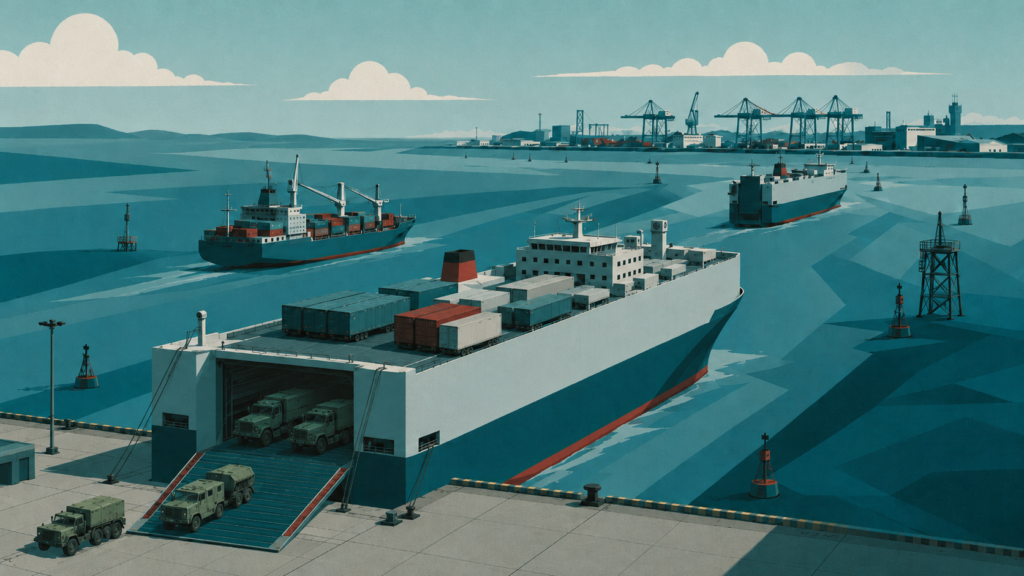
Although shipping is by no means the only contributor to logistics – airlift, for example, provides speed – it enables unmatched scale and mass, especially when transporting heavy equipment and materiel. To put the difference into perspective, a C-17 Globemaster, the workhorse of NATO’s airlift capabilities, can carry a single main battle tank, while a large Roll-on, Roll-off (Ro-Ro) vessel can carry around 1,000 vehicles.[4]
Securing strategic shipping is a core consideration to military mobility planning, where any failure could cause significant delays to deployment and reinforcement. Any future NATO operation will require substantial volumes of materiel over an extended period against concerted interdiction efforts, and failing to secure the logistics capacity needed to support such operations would be detrimental to operational credibility. A single vessel could carry the equipment of an entire brigade, and any losses would significantly impact allied combat effectiveness.
The sealift challenge
The strategic sealift challenge can be broken down into four broad categories:
- Access to militarily useful shipping;
- A declining pool of skilled seafarers;
- Limited civil-military integration; and
- The erosion of the national maritime fabric.
The most immediate challenge is access to the ships themselves. For decades, there has been an assumption that commercial markets, through levers such as ‘Ships Taken Up From Trade’ (STUFT), will provide capacity in times of need.[5] Through STUFT, His Majesty’s (HM) Government can legally compel shipowners to hand over their vessels to the state, but crucially can only requisition ships that are registered under the British flag. The UK relies heavily on market mechanisms to access complementary ship capacity, which presents significant risk in a crisis when competition for assets intensifies and ships might be committed elsewhere, subject to restrictions, or insufficiently crewed. Here, the issue is not one of a lacking global capacity, but rather the uncertainty accompanying the availability of desired vessel types: namely those capable of supporting military operations. In Britain, there are few existing options between STUFT and the dedicated sealift fleet of four Ro-Ro vessels.[6]
While requisitioning or utilising STUFT is legally possible to enforce, the maritime industry is international by design. Despite HM Government being able to access the required ship type, the requisitioned vessels could still end up without crew, necessary competence, or the operational organisation supporting them – potentially including the need for emergency refits to enable handling military cargo or taking onboard defences for contested environments. Requisitioning also often ends up being more expensive than commercial charter options. What this means is that STUFT, while a useful tool, cannot guarantee practical access. From a national preparedness and resilience perspective, pre-negotiated access through framework contracts and long-term agreements with shipping companies are more effective. In the absence of such agreements established in peacetime, ships may be unavailable in a crisis due to competitive pricing, sanctions, or insurance withdrawal. Assumed capacity disappears quickly in such scenarios.
The second challenge concerns crew availability and access to qualified personnel, aggravated by the fact that there is a decline in overall numbers as well as an increasing reliance on multinational crews.[7] While this trend is reflected across the global shipping community, factors including nationality restrictions, security risks, and labour shortages – not the least because of current ongoing conflicts – introduce vulnerabilities during times of crisis. Across the European Union (EU), for example, only 38% of seafarers are EU nationals.[8]
Conflict scenarios will impose restrictions relating to the nationalities of crews handling military equipment. Ensuring a cadre of trained and trusted crew are available to operate ships sent into conflict zones is a vital aspect of making surge sealift capacity a reality. This not only needs the maritime workforce to be rebuilt after too many years of a laissez-faire approach across NATO members to it, but also for reserve mariner models to be explored and activated. Crew availability is not solely a commercial consideration, but also a strategic one.
Tied into all of these factors is the issue of civil-military integration and public-private partnerships. Shipping companies possess valuable expertise, which should be better incorporated into defence planning to test assumptions against commercial realities and timelines. Significant logistics capacity and expertise advantages sit with the shipping sector across European NATO, including end-to-end supply chain solutions and support functions: European shipping companies account for roughly 35% of the world’s shipping in terms of global tonnage.[9] Closer collaboration across exercises, planning, and capacity building is essential to allow for a scaling of capacity that is aligned with national security objectives. Building and testing this muscle memory, the interpersonal relationships, and the experience of working with each other will make or break NATO’s ability to surge sealift capacity and operate under contested conditions.
Despite the role of shipping as the backbone of global trade, it has long been neglected in national security discussions.[10] This has been accompanied by a broader decline of the maritime ecosystem, reflecting the phenomenon of ‘sea blindness’ in a society that, despite being so dependent upon it, struggles to understand and appreciate the importance of the industry that enables seagoing trade.[11]
While 95% of the UK’s trade is transported by sea, British-flagged militarily useful shipping capacity has continuously declined in recent years.[12] As an enabler of military and civilian mobility, supply, and sustainment, maintaining a fleet of suitable British-flagged vessels is a critical component of a resilient sealift strategy. However, due to a lack of incentives to operate a nationally affiliated fleet, numerous shipping companies have opted to register their vessels under foreign flags or ‘flags of convenience’ in recent decades.[13]
Unfavourable taxation, unsustainable obligations, and liabilities deriving from pension schemes and unions have also served to place pressure on national fleets. Parallel to a shift in defence policy, there should be a complete reboot of where this issue sits in national, industrial, and taxation policy, as well as a closer alignment of commercial fleets and mariner capacity to meet national security requirements.
What can be done?
Although the age of uncontested logistics has drawn to an end, and some steps have been taken to rebuild a more resilient logistics network – demonstrated in April 2026 when, for the first time in 20 years, the British Army chartered a ferry to take personnel to a military exercise in Europe – much work remains to be done.[14] One of the most impactful approaches would be the exploration of strategic partnerships with commercial shipowners and operators to guarantee access to shipping: moving from reactive chartering models to proactive assurance. To assume a government can engage with the market on regular terms is a risky approach, not least due to the activation timelines that come with operational realities, when vessels could be spread around the world undertaking day-to-day commercial activities.
There is currently a disconnect between industry, which points to pre-negotiated access through preparedness contracts, and defence, which continues to lean on the belief that requisitioning is sufficient. This represents a knowledge gap, built on a failure to consider fully the commercial realities facing the shipping industry.
Assured and timely access should be brought to the fore. This begins with supportive laws (including cargo preference), policies, and programmes that generate predictable cargo, stable funding, and contractual certainty. Some countries are already practising such approaches, and it is worth taking stock of notable examples where pre-negotiated frameworks are in use and the lessons that can be learned from them.
A framework for sealift support in crisis
The United States (US) has several programmes aimed at ensuring sealift capacity that provide good examples for European NATO countries. This most notably includes the Maritime Security Programme (MSP), established in 1996, and the Voluntary Intermodal Sealift Agreement (VISA). The MSP ensures access to 60 ships and over 2,400 trained mariners, and provides compensation to militarily useful US-registered vessels in return for their guaranteed access and availability.[15] Through VISA, American-flagged vessels offer their capacity in exchange for priority access to defence cargoes in peacetime.[16] This provides capacity, scalability, and flexibility without relying on an expensive government-owned, controlled or leased fleet. These arrangements ensure commercial viability for shipowners as well as access to surge capacity for defence.
The adoption or support of public-private partnerships and related laws and programmes like VISA, the MSP, and cargo preference laws are critical enablers of military mobility.[17] These programmes are in no small part enabled by the vast quantity of military equipment that the US moves around the globe in ‘peacetime’, making priority access to defence cargo a commercially viable incentive.
While it might be the case that no single European NATO member moves equipment at the same scale, this is not the case across NATO as a whole. At the alliance level, in addition to the national level, there is a need for new contracting models and deeper integration with commercial carriers alongside a more unified operating picture across NATO covering vessels, port status, and cargo readiness. Efforts to bolster this are already underway through the Joint Support and Enabling Command (JSEC), established in 2019, and the Defence Enablement and Logistics Section of NATO’s Defence Policy and Planning Division. To reinforce these steps, the alliance should explore a sealift assurance programme modelled loosely on the MSP to provide industry with the confidence required to maintain capacity that can be scaled in crisis.
Not only does the MSP remain the cornerstone of both the US-flagged global fleet and assured sealift in its support of an actively trading, privately owned, US-flagged, American‑crewed fleet of 60 militarily useful vessels, it does so for an annual readiness retainer of US$6.5 million (£4.8 million) per ship. This model demonstrates the cost-effectiveness of assured sealift. Through the MSP, the annual cost – US$390 million (£287.6 million) in 2026 – guarantees access to 60 vessels.
Considering the US$83 million (£61.2 million) flyaway cost for a single F-35A Lightning II Joint Combat Aircraft,[18] the US secures an entire global sealift capability and access to commercial logistics networks for the cost of less than five airframes. It is worth noting that between them, NATO allies have committed to ordering over 3,000 F-35s, including almost 600 by European NATO countries.[19]
Future solutions
A NATO Assured Sealift Access Programme (‘NASAP’) could potentially provide an alliance-level framework or contractual mechanism for activating and ensuring access to a readily available network or pool of strategically important shipping. It would also provide a valuable avenue for the central identification of militarily useful vessels according to NATO standards. With a NASAP solution, there is the possibility of creating a ‘readiness’ pool of shipping capacity deeply integrated in alliance planning, and regularly exercising and operating alongside NATO forces to facilitate harmonisation.
In most cases, this strategic assessment of fleet requirements already takes place at the national level first, after which coordination via the NATO Defence Enablement and Logistics Team is conducted to create an alliance-wide picture. Yet, given the fragmented nature of European NATO, most countries – perhaps with the exception of Britain and France – may struggle to find sufficient military cargo to justify introducing paid retainers linked to priority access to defence cargo. Therefore, a pooled coalition of funding, similar to the approach taken on procuring and managing NATO’s Airborne Early Warning and Control aircraft fleet, offers a potential route forward.
There are also more deep-rooted issues in need of addressing, such as seafarer shortages, flagging, and the decline of the maritime fabric. Here, there is a need for creativity regarding models. By engaging with shipowners, nations could find ways within shipping networks to produce the necessary crews.
Across European NATO, the maritime base should be elevated and national shipping incentivised to address the decline in militarily useful commercial vessels and seafarer shortages. The use of national flagging should be enhanced for targeted capacity, encompassing crew and a long-term predictable flagging framework including tax breaks or subsidies for companies that commit to maintaining a portion of their fleet under that flag.
The current threat landscape also underscores the need for increased civil-military coordination and integration. This includes proactive planning, regular exercises, and training. By increasing commercial involvement in military planning, and including industry in the planning cycle and regular discussions to foster alignment and trust, governments can ensure operational efficiency and minimal disruption to operations. This could include work and planning groups, alongside advisory boards.
Commercial carriers should also be integrated into NATO planning and exercises to ensure efficient sealift. In some countries this has started to happen: during the POLARIS 25 naval exercise, the French Navy involved the French merchant fleet in its large-scale operational scenarios for the first time.[20]
By incorporating maritime logistics providers into major exercises, NATO countries can test access arrangements and availability to vessels and crews. Real-world exercises remain critical to stress-testing military logistics and identifying vulnerabilities, from the activation and access phase to protecting vessels and ensuring safe passage. Beyond being included in the planning stage, commercial shipping should be represented at exercises and in wargames to establish the necessary procedures and trust before the crisis. Regular engagement between shipowners, operators, insurers, and defence also ensures that operational realities are reflected. A pool of trusted and experienced sealift vessels able to be activated immediately is of far greater utility than an on-paper list of vessels with potential military use. As the adage has it, failure to plan is planning to fail.
Civil capabilities should be formally embedded into the operational design. Industry and civilian operators must be involved in the planning process from the outset, not after plans have already been finalised. Government and military officials should meet regularly with shipping and maritime logistics providers to discuss the issues of the day and practise together. Too often, involvement and coordination occur only at this stage, limiting the ability to influence capacity, routing, and port selection. Greater visibility across military and civilian networks – combined with expanded coordination and planning forums including industry, port authorities, and national logistics agencies as full partners – will ensure more realistic plans and an earlier identification of bottlenecks. In the US, one such mechanism for this that could be adapted is the National Defence Transportation Association (NDTA).[21]
Although beyond the scope of this Primer, the broader end-to-end supply chain is worth referencing. Ensuring the logistical depth required to project and sustain force and maintaining end-to-end supply chains capable of withstanding significant disruption will depend on multi-domain, cross-sector collaboration underpinned by integrated planning. Commercially operated enablers such as maintenance, repair, processing and support centres, inland distribution networks, and terminals will all form part of successful sustainment and reinforcement.
Conclusion
There has long been an assumption that commercial shipping will be available as and when required. The return of contested logistics and the nature of global shipping have rendered this assumption obsolete. While strategic sealift and shipping remain indispensable to military and civilian supply and sustainment, access has become less certain as seafarer numbers and militarily useful national fleets continue to decline.
To rectify this gap, NATO nations’ governments should look towards pre‑negotiated access to commercial capacity. In a crisis, the alliance will not have time to build new lift networks. Instead, it should focus on building a suite of standing contracts, pre‑cleared operators, and integrated exercises as part of an established and exercised maritime logistics system.
Maritime resilience is a condition for NATO credibility in reinforcing its frontline members, as well as its ability to fight and sustain operations at scale. Ultimately, the sealift capacity challenge is civil-military in nature, and requires extensive collaboration and innovative solutions. In the absence of scalable and credible frameworks already established in peacetime, readiness and response timelines will remain uncertain. An alliance unable to reinforce its frontline members at speed, at scale, and over a prolonged period is not ready for the return of peer conflict.
Notes
[1] William Freer and Charlotte Kleberg, ‘“Are we there yet?”: The return of contested logistics’, Britain’s World, 01/07/2025, https://www.britainsworld.org.uk/ (checked: 01/09/2026).
[2] George Allison, ‘Drastic Drop in “Militarily Useful” British Vessels from 841 in 2009 to 495 in 2023’, UK Defence Journal, 19/11/2023, https://ukdefencejournal.org.uk/ (checked: 01/09/2026).
[3] Liam Nawara, ‘Lessons for a Wartime Navy: STUFT Vessels in the Falklands War’, United States Naval Institute, 03/2024, https://www.usni.org/ (checked: 01/09/2026); and David Snelson and Sir James Dutton, ‘Sunset for the Royal Marines? The Royal Marines and UK amphibious capability’, Defence Select Committee, 19/12/2017, https://committees.parliament.uk/ (checked: 01/09/2026).
[4] ‘C-17 Globemaster III’, United States Air Force, No date, https://www.af.mil/ (checked: 01/09/2026); and ‘Large, Medium-speed, Roll-on/Roll-off Ships T-AKR, America’s Navy, 13/10/2021, https://www.navy.mil/ (checked: 01/09/2026).
[5] Charlotte Kleberg, ‘Sealift: Commercial shipping’s potential in military logistics’, Council on Geostrategy, 18/11/2024, https://www.geostrategy.org.uk/ (checked: 01/09/2026).
[6] ‘Transporting military hardware around the world – UK strategic sealift’, Navy Lookout, 09/03/2022, https://www.navylookout.com/ (checked: 01/09/2026).
[7] ‘NATO Member States’ National Merchant Fleet and Seafarers’, Nautilus International, 27/05/2022 https://nautilusint.org/ (checked: 01/09/2026).
[8] Ibid.
[9] ‘Study: The economic value of European shipping’, European Community Shipowners Association, 05/05/2026, https://ecsa.eu/ (checked: 01/09/2026).
[10] Charlotte Kleberg, ‘Sealift: Commercial shipping’s potential in military logistics’, Council on Geostrategy, 18/11/2024, https://www.geostrategy.org.uk/ (checked: 01/09/2026).
[11] Richard Harding and Agustín Guimerá, ‘Politicians and Naval Strategy: On the “Sea Blindness” of Statesmen’, Boydell and Brewer, 05/10/2024, https://boydellandbrewer.com/ (checked: 01/09/2026).
[12] ‘UK Ports Industry’, British Ports Association, No date, https://www.britishports.org.uk/ (checked: 01/09/2026).
[13] ‘Flag of Convenience’, Windward, No date, https://windward.ai/ (checked: 01/09/2026).
[14] ‘British Army charters civilian ferry to boost warfighting readiness in major exercise’, British Army, 27/04/2026, https://www.army.mod.uk/ (checked: 01/09/2026).
[15] ‘Maritime Security Programme (MSP)’, United States Department of Transportation: Maritime Administration, No date, https://www.maritime.dot.gov/ (checked: 01/09/2026).
[16] ‘Voluntary Intermodal Sealift Agreement (VISA)’, United States Department of Transportation: Maritime Administration, No date, https://www.maritime.dot.gov/ (checked: 01/09/2026).
[17] Eric Ebeling, ‘Steps Congress Can Take to Address the National Maritime Security Gap, The Defence Post, 30/09/2024, https://thedefensepost.com/ (checked: 01/09/2026).
[18] ‘The Most Economically Significant Defence Programme in History, Contributing Over $79 Billion Annually’, F-35 Lightning II, No date, https://www.f35.com/ (checked: 01/09/2026).
[19] ‘F-35 Lightning II Fast Facts’, Lockheed Martin, 05/08/2026, https://www.f35.com/ (checked: 01/09/2026).
[20] Martin Manaranche, ‘POLARIS 25: Feedback on the French Navy’s largest exercise – Part 1’, Naval News, 16/07/2025, https://www.navalnews.com/ (checked: 01/09/2026).
[21] ‘About Us’, National Defence Transportation Association, No date, https://www.ndtahq.com/ (checked: 01/09/2026).
Editorial policy
Our publications are guided by our editorial policy and quality assurance processes. To view these, please click here.
DISCLOSURE ON ARTIFICIAL INTELLIGENCE (AI)
This research involved the use of Artificial Intelligence (AI) as a tool to assist with copyediting, restructuring text, checking for errors and fallacies, and generating images. The author(s) and the editorial team at the Council on Geostrategy maintained full oversight throughout the drafting, copyediting, and formatting process, and assume complete responsibility for the final published content.
Disclaimer: This publication should not be considered in any way to constitute advice. It is for knowledge and educational purposes only. The views expressed in this publication are those of the author and do not necessarily reflect the views of the Council on Geostrategy or the views of its Advisory Board.
ISBN: 978-1-917893-30-5