

Executive summary
CONTEXT
- His Majesty’s (HM) Government has announced that ‘control of space’ is a national requirement. Recent speeches by Wes Streeting, Secretary of State for Defence, and Air Chf. Mshl. Sir Harv Smyth, Chief of Staff of the Royal Air Force (RAF), as well as official documents such as the recently published UK Space Strategy, have all made clear that the United Kingdom (UK) views space as a de facto warfighting domain. These announcements have been accompanied by the creation of the RAF’s No. III Space Effects Squadron, lending organisational shape to a nascent space control capability architecture.
- The space control requirement emerges from a growing British dependence on space systems for its ability to defend the UK and wage wars in the coming decades. The Defence Investment Plan (DIP), published in June 2026, notes that ‘space is the central nervous system of modern, high-intensity warfare, rather than just a supporting domain.’
- The challenge is Britain’s space dependencies on allies, specifically the United States (US), and commercial space services. This dependency also applies to space control – the ability to assure friendly access to space as and when required, while denying an adversary access to space. The UK’s dependency on the US and commercial satellites is unique, and would be unlikely to be politically tolerated in any other domain. Sovereign satellites and space control capabilities are therefore required.
- Britain’s space dependencies are compounded by a worsening space security environment due to geopolitical competition and tensions. Countries such as Russia and the People’s Republic of China (PRC) are developing and testing counterspace weapons that target space systems – both in orbit and their supporting infrastructure on the ground – as well as in cyberspace and the electromagnetic spectrum. The UK must prepare to face these threats and act offensively in all domains to defend its space systems alongside those of its allies, and deny an adversary the use of its own space systems.
- Space control can be best understood as the suppression of enemy space systems. It requires cross-domain defensive and offensive capabilities and operations. Many of these capabilities can be drawn from existing conventional and special operations forces, but specialised capabilities must be developed and procured for defensive and offensive space operations.
- Space control also requires support from diplomatic, legal, and financial instruments to maintain space coalitions, defend against ‘lawfare’, and ensure that commercial companies are solvent and under friendly control. Ultimately, even though space control requires cross-domain and non-military capabilities, Britain needs an offensive space-based option to ensure that its forces, as well as those of its allies, can fight and win in other domains and prevent on-orbit coercion against the UK’s satellites.
KEY FINDINGS
- Despite encouraging announcements and statements on space control by senior officials and in public documents, Britain is a long way from fielding a credible space control architecture. Critical gaps exist between rhetoric and capability. Operational concepts and thorny policy positions should be developed and resolved. Investment should be specifically earmarked for capability development. Specific capability requirements should be identified and folded into a programme of record to which industry can then respond. Importantly, given geopolitical trends and risks, HM Government should rigorously identify which capabilities must be sovereign and what can be safely left to allies and commercial providers.
- A credible space control capability architecture requires definition and purpose, as well as an operational architecture that should be integrated under unified governance and command – all based on design principles that ensure robustness, readiness, and sustainment. A British space control capability architecture should be mission-led, layered and graduated to provide kinetic and non-kinetic capabilities as needed, and should provide core sovereign capabilities that are federated to cooperate with allies, but able to be operated independently on a national basis as necessary. Credible space control should be capable of regenerating forces after combat losses and should operate within a wider resilient and protected space enterprise to achieve maximum strategic benefit.
- Space control comprises a sequence of discrete capabilities: firstly, comprehensive Space Domain Awareness (SDA) for understanding, custody, and attribution of activities, including space battle damage assessment; secondly, command, control, targeting, and authorities for decision-making – including Artificial Intelligence (AI) capabilities to cope with the speed of space operations; thirdly, defensive and offensive effects to protect and defend space systems, disrupt and complicate adversary space operations, and deny and defeat adversary space systems; and finally, resilient space services and fallback capabilities to endure long, attritional conflicts.
- Delivery and capability architecture governance for such a programme requires a senior space control owner within the Ministry of Defence (MOD) to cohere policy, stakeholder management, and allied relationships, with a corresponding acquisition and capability development owner within the National Armaments Director Group (NAD) to manage development and testing, funding, and capability delivery. A space control industrial strategy component is also required, given that capabilities will be provided by commercial companies. However, the only customer for space control is HM Government.
RECOMMENDATIONS
To expand the UK’s capacity to control space, HM Government should:
- Establish a British space control programme office, with an accountable senior owner, in the MOD within the next 12 months, followed by a capability portfolio owner within NAD Space, as the focal point for space control acquisition, experimentation, and demonstration.
- Expand UK Space Command’s existing remit as the operational owner of the space control mission, ensuring that it can command supporting joint forces for the space control mission across different domains as required.
- At the earliest opportunity, the MOD should publish an unclassified force design framework for space control, approve a classified operational space control concept study, and conduct a mission area dependency assessment.
- Provide UK Space Command and No. III Space Effects Squadron with the personnel, authorities, doctrine, and exercise programme to operate the space control chain.
- Develop, build, and sustain nationally separable Command and Control (C2) and a graduated set of defensive and offensive space control effects and capabilities, to include orbital kinetic options.
- Treat space replenishment, repair, and regeneration as a core future strategic requirement through measures such as launch, rapid replenishment of lost space capabilities, industrial surge, and allied integration.
STRATEGIC OUTLOOK
- The changing character of war combined with increased geopolitical volatility have elevated the space domain from playing a supporting role in military operations to a more central and critically important role in how the UK and its allies, as well as its adversaries, defend and fight and win wars. This importance is becoming more akin to sea and air power with each passing decade. A British space control requirement is also a tacit acknowledgement that the UK sees space as a warfighting domain. It can therefore be posited that an independent military space service might be required in the coming years.
Foreword
Like never before, space is the central nervous system of high-intensity warfare rather than merely a supporting domain. With competitors, notably Russia and the People’s Republic of China (PRC), fielding broad and sophisticated counterspace capabilities, the assumption that the United Kingdom (UK), along with its allies and partners, can rely on uninterrupted, uncontested access to orbit is no longer viable.
For military commanders, maintaining Britain’s military operational edge requires confronting these realities directly. For many years, if not decades, the UK has not afforded space the attention that it demands. Control of space, now vital to operations on Earth, requires the ability to suppress rival space systems. This makes a sovereign, offensive, on-orbit option to prevent the coercion of British satellites necessary.
In this timely Report for the Council on Geostrategy’s Space Power Enterprise, Gabriel Elefteriu and Dr John B. Sheldon offer a thought-provoking contribution to that national debate. They propose a new space control framework that is mission-led, layered, and able to operate independently but also with allies, while being capable of regeneration after losses.
How His Majesty’s (HM) Government and the Ministry of Defence (MOD) ultimately approach these capability choices will be guided by evolving policy and resource priorities. Nonetheless, analysis of this calibre is indispensable for testing assumptions and refining military thought. This study serves as a highly valuable resource for strategic planners in the MOD and across Whitehall.
James Rogers
Co-President (Research), Council on Geostrategy
1.0 INTRODUCTION
Space is now central to how modern states wage war in the 21st century, and the United Kingdom (UK) is no exception. While the British Armed Forces have long used satellites to enhance and enable military operations on land, sea, air, and cyberspace, they have largely done so using American military and commercial satellites. The exception to this is the UK’s Skynet military satellite communications programme that has provided a capability for over six decades. This arrangement with the United States (US) has served the UK well over the past several decades, but will no longer suffice moving forward, as access to space has gone from a ‘nice to have’ capability that the military could ultimately fight without to a critical and indispensable enabler of contemporary and future warfare.
The conflict in Ukraine, especially since the beginning of Russia’s full-scale invasion in February 2022, has amply demonstrated the role of space in modern warfare, both in what it enables and demonstrates about the character of contemporary warfare, but also in what happens when access to space is denied or reduced.1 Similar lessons are being drawn from recent military operations in the Persian Gulf, where all belligerents, to some extent or another, have relied on access to space to conduct operations, and where space infrastructure on the ground has been routinely targeted by all sides. As these conflicts continue, there is little doubt that further lessons will be revealed about the centrality of spacepower – the ability in peace, crisis, and war to exert prompt and material influence to, in, and from space2 – in modern war and the rise of space warfare in support of wider strategic and military objectives.
As modern states derive increasing military, diplomatic, and economic power and influence from space, satellites have become legitimate targets for counterspace activities. As a result, space has become a warfighting domain. This trend has been compounded by the worsening geopolitical environment and growing tensions among great powers.3 Far from being a domain reserved exclusively for peaceful exploration and international cooperation, space has become – to borrow from Nicholas Spykman, the mid-20th century Dutch-American geopolitical thinker – a kind of vertical ‘rimland’ that is simultaneously a place of intense competition, even combat, and of cooperation and economic development.4
The US, the world’s pre-eminent space power and the UK’s closest ally, has long recognised this duality, and acknowledged that space is an operational domain. The North Atlantic Treaty Organisation (NATO) followed suit in 2019, and Britain finally did the same in 2021.5 What is perhaps remarkable is that, to an outside observer, the rise of space as a domain central to geopolitics and warfare has taken place in such a short period of time. In large part, this is the result of the mass dissemination of inexpensive yet highly capable satellite technologies.
In a few short years, the UK’s official perspectives on space power and the strategic importance of space have been transformed to the point where the domain is now – at least rhetorically – ranked alongside other top-tier national security priorities. Most recently, in the 2026 UK Space Strategy, His Majesty’s (HM) Government has acknowledged space control as a national requirement to ensure the success of contemporary and future military operations.6
In this light, the purpose of this Report is to examine what space control is, why it is needed, what is required to do it, and what – in a British context – it should look like. Before examining these questions, however, it is necessary to understand the growing reliance that the UK has on space systems to defend the country and wage its wars.
2.0 BRITAIN’S GROWING DEPENDENCY ON SPACE
The Defence Investment Plan (DIP), published in June 2026, states unequivocally that ‘space is the central nervous system of modern, high-intensity warfare, rather than just a supporting domain.’7 Until only a few years ago, the role of space systems was largely seen as one of supporting and enhancing British military capabilities in the three classical domains, and critically enabling them in some niche areas. However, for the most part, until the full advent of autonomous warfare in Ukraine in particular, the technological character of modern warfare in recent decades contained the assumption that the UK could fight without space systems if it had to, albeit at some cost in manpower and materiel.
This is no longer the case, and many of the defence programmes outlined in the DIP make abundantly clear that space is no longer just ‘nice to have’, but the critical enabler of how Britain intends to defend and fight in the coming decades. From autonomous systems on land, air, and sea, and air and missile defence, through to intelligence collection and the Digital Targeting Web (DTW), satellites are more than just a part of the defence technology stack.8
While the UK’s nuclear deterrent is intentionally designed not to be operationally reliant on satellites in its launch phase, Command and Control (C2) and decision-making for nuclear weapons release are almost entirely dependent on assured access to space.9 The Skynet military satellite communications systems in geostationary orbit are a critical node in British and allied nuclear C2,10 while American ballistic missile early warning satellites are essential for detecting enemy nuclear-armed ballistic missiles within seconds of their launch.11 Pre-targeting of locations to be attacked is conducted through satellite reconnaissance, while the same systems provide decision support to political leaders during crises, and as long as these systems can operate under attack during a conflict.12
In the coming few years, the British Armed Forces will see Skynet 6 military communication satellites come into service and, in 2028, two Oberon Synthetic Aperture Radar (SAR) Earth observation satellites.13 As demands for space systems grow, thanks in large part to increasing automation of military force structures, more satellite capabilities may well be required.
While the UK has long enjoyed unique access to the US’ space systems, it should not assume that this will be the case forever. Firstly, the changing character of the transatlantic relationship means that some American administrations will be more transactional in their dealings with Britain, potentially restricting or even denying the UK’s access to valuable space systems in certain contingencies. Second, even though the US is the world’s pre-eminent space power, its space capabilities are in great demand by American users, and some capabilities are actually scarce. This means that in a contingency where the US is engaged in combat operations in the Indo-Pacific theatre, the UK might find it is unable to access American space systems for its own contingencies reliably.14 While the ‘special relationship’ should be maintained as long as possible, there are growing opportunities for the UK to cooperate with other allies in Europe – as well as with Australia, Canada, and Japan – on military space operations, including space control.
This reliance on the US’ space systems also extends to space control. Should a UK satellite be threatened today, requiring some form of active space-based support and intervention, Britain would have little choice but to request American assistance. While countries such as France have tested offensive space capabilities,15 the US is the only liberal, democratic power today capable of conducting defensive and offensive space control operations in orbit. This was recently confirmed by Troy Meink, Secretary of the US Air Force, when he announced the existence of American space-based space control weapon systems.16 The UK, along with Germany, is now starting to take on space control and its implications, including the possibility of offensive capabilities in space.17
Lastly, the British Armed Forces supplement their own capabilities with the procurement of space services from commercial space companies. The UK relies on commercial space companies for a wide range of services, including launch, satellite communications (including SpaceX’s Starshield), Earth observation, ground station services, and Space Domain Awareness (SDA).
What is increasingly apparent is that the UK is in a position where its dependence on space systems in general is growing with each passing year, while that dependence relies largely on access to US military and intelligence space systems and to commercial space systems, most of which are foreign-owned and controlled. While it would be impractical to suggest that Britain should develop and possess its own, sovereign full-spectrum space capabilities, the current level of national dependency on American and commercial space capabilities would never be politically tolerated in any other domain.
3.0 SPACE THREATS
British, allied, and commercial space systems, and the UK’s access to them, are increasingly vulnerable to expanding adversary counterspace threats. The majority of these threats emanate from Russia and the People’s Republic of China (PRC), and there is mounting evidence that these two entities cannot always be treated as separate threat actors in the space domain.
These threats are summarised in Table 1 by threat category, intended effects, Chinese and Russian capabilities, and the likely implications for the UK.
TABLE 1: TAXONOMY OF SPACE THREATS TO BRITAIN18
| Capability type | Intended effect | PRC | Russia | Implications for the UK |
|---|---|---|---|---|
| Direct-ascent Anti-Satellite (ASAT) weaponry | Physically destroy satellites, principally in Low-Earth Orbit (LEO). | Destroyed FY-1C satellite in 2007 test. SC-19 and Dong Nen (DN) missiles with kill vehicles. | Destroyed COSMOS 1408 in 2021 test. Nudol (PL-19/14Ts033) road-mobile interceptor. | Catastrophic but high-threshold option. Requires resilience against debris, replenishment of capability, Concept of Operations (CONOPS) for degraded space operations. |
| Co-orbital counterspace, Rendezvous and Proximity Operations (RPO) | Inspect, shadow, interfere, manipulate, immobilise, or potentially destroy satellites. | Co-orbital: Shiyan-24C, TJS-3, TJS-10, and Shijian-17; RPO: Shijian-21, Shijian-25, tested in 2022 and 2025. | Nivelir and Burevestnik programmes, tested as recently as October 2026 with uncooperative RPO against ICEYE-X36. | Threat develops gradually with surveillance, ambiguous manoeuvres, fuel depletion, coercive proximity, and potential kinetic/non-kinetic effectors, rather than sudden attack. Requires persistent custody and pre-crisis decision-making. |
| Electronic Warfare (EW) | Deny, degrade, deceive, geolocate Satellite Communications (SATCOM), Position, Navigation, and Timing (PNT), radar, and data links. | The People’s Liberation Army (PLA) maintains a range of fixed and mobile EW capabilities designed for SATCOM, PNT, and space-based Intelligence, Surveillance, and Reconnaissance (ISR). | Russian Global Positioning System (GPS)/Galileo jamming and spoofing extensive, fixed, and mobile jammers, used extensively in Ukraine, the Baltic states, and the High North. | Requires spectrum control, protected waveforms, alternative PNT, emissions control, and the ability to operate through interference as a core space control requirement. |
| Cyber operations against space systems | Compromise satellite computers/payloads, mission planning, C2, ground networks, terminals, and supply chains. | The PRC possesses substantial cyber capabilities within the PLA, the Ministry of State Security, and non-state cyber entities. | Russia possesses substantial cyber capabilities in the Main Directorate of the General Staff of the Armed Forces (GRU), the Foreign Intelligence Service (SVR) and Federal Security Service (FSB), and non-state cyber entities. Demonstrated capability in February 2022 cyber attack on ViaSat/KA-SAT. | Space systems may remain physically unharmed while services are denied. Space resilience must include cybersecurity, recovery, segmentation, trusted software, and ground architecture/infrastructure. |
| Ground segment and infrastructure attacks | Degrade, deplete, and destroy gateways, terminals, teleports, ground stations, launch facilities, cables, and data centres. | The PRC possesses the cyber, covert, and conventional means to carry out such attacks. | Russia possesses the cyber, covert, and conventional means to carry out such attacks. Alleged to be behind attempted Starlink ground station arsons in Europe in 2026; cyber attack against ViaSat/KA-SAT in February 2022. | Ground segments of British space systems should be treated as Critical National Infrastructure (CNI), emphasising physical and cyber security, redundancy and fallback capabilities, regeneration capacity, and intelligence support. |
| Directed energy counterspace | Dazzle, blind, degrade, or destroy satellite sensors; potential disruption of optical links. | The PRC is believed to be developing and testing ground-based and space-based lasers for counterspace applications. | Russia has tested ground-based lasers in the past, and is believed to be developing and testing a new generation of laser counterspace capabilities. | Difficult to attribute in real-time; the UK requires early warning capabilities, sensor protection, alternative ISR collection options, and escalation options. |
| Industrial and regeneration suppression | Degrade, deplete, and destroy ability to manufacture, launch, replace, sustain, or access space systems over time. | The PRC’s space industrial base, including scale of launch, manufacturing, and civil-military fusion, provides substantial capacity for space force regeneration and sustainment. | Russia’s space industrial base has been significantly depleted and degraded over the years due to poor management, under-investment, quality control problems, and corruption. More recently, some Russian space industrial facilities have been targeted and destroyed by Ukrainian attacks. | Space control is attritional. Launch access, satellite spares and ability to surge, skilled personnel, logistics, and secure supply chains are combat power. |
| Strategic coercion and environmental disruption | Raise and impose costs for accessing and operating in the space domain by creating debris, electromagnetic pulses, or wider escalation. | While the PRC has not tested a destructive, kinetic ASAT in orbit since 2007, it still retains capabilities to do so. Restraint may stem from Beijing’s own growing dependency on satellites for military operations and economic prosperity. | Russia’s 2021 direct-ascent ASAT test, and alleged nuclear ASAT capability, demonstrate willingness to use such capabilities, albeit under extreme circumstances. | The UK must be able to operate reliably and responsibly in a debris- and radiation-contaminated space environment without assuming that adversaries will show similar restraint. |
While Russia should be considered the pacing space threat against which Britain should prepare, Chinese space threats should be of concern to the UK as well – regardless of the nature of British foreign policy and broader defence posture vis à vis Beijing. Firstly, Chinese counterspace capabilities principally target American satellite systems that, in turn, the UK relies upon. Secondly, the PRC likely has an interest in targeting British satellite systems in certain contingencies.19 Thirdly, there are growing indications that the Chinese-Russian geopolitical partnership extends to mutual space support, with Beijing benefiting from the Kremlin’s know-how and operational lessons to be learnt, and Russia benefiting from the PRC’s extensive space industrial base that provides a potential source of resilience and regeneration in an attritional competition. Furthermore, there appears to be growing cooperation between the two nations in tackling common challenges, such as offsetting the military utility of free and open nations’ constellations such as Starlink/Starshield or their future European equivalents, with a knock-on strategic effect on Britain as well.20
Lastly, the space threat environment shows signs of further dissemination of space capabilities to a growing number of state and non-state actors. The PRC’s rise as a space power is now on the cusp of rivalling the US, and includes a growing Chinese commercial space sector.21 Beijing uses its space technologies and industrial base as a diplomatic and economic tool in relations with other developing countries.22 More recently, the PRC’s commercial space industry has stepped up the export of its space systems and services abroad. For several decades, free and open nations have not only benefited from the spread of commercial space, they have also enjoyed a near-monopoly in those benefits. This period of unrivalled advantage is coming to an end – as seen, for example, in the reports that the PRC’s Earth Eye Company has sold high-resolution, military-grade Earth observation data to Iran’s Islamic Revolutionary Guard Corps (IRGC),23 and even satellite imagery to the Houthis.24
In this context, the standard presumption moving forward is that all actors that the UK may have to confront in the future will enjoy direct or indirect access to space to some extent or another, which only strengthens the operational need for a British space control programme.
4.0 THE BRITISH REQUIREMENT FOR SPACE CONTROL
The UK’s increasing dependency on space for waging war, combined with the growing threats posed by Russian and Chinese counterspace efforts and the new reality that effectively all future adversaries are likely to be space-enabled, creates a requirement for a British space control programme. This ‘control of space’ requirement is now official policy and has been publicly declared by Wes Streeting, Secretary of State for Defence, as well as by Air Chf. Mshl. Sir Harv Smyth, Chief of the Air Staff, and has been enshrined in the 2026 UK Space Strategy.25
4.1 Defining space control
According to the current UK Space Power Joint Doctrine document, published in 2022, space control is:
…the use of defensive and offensive capabilities to assure access and freedom of action in space. As well as assuring our own access to the domain, this can, when directed, also involve countering an adversary’s efforts to defeat, interfere with or attack UK or allied space systems and even target an adversary’s own space systems to gain military advantage.26
This definition is useful as it captures the objectives of space control – assured space access and freedom of action in space – while also acknowledging actions to counter adversary efforts, and even target adversary satellites as required. The latter part of the definition implies that these actions to counter adversary efforts might take place in any number of domains, including space.
4.2 Space control and space systems
It might be assumed that space control takes place only in the space domain. While space-based capabilities are certainly needed, space control operations are inherently cross-domain in nature. When protecting British and allied space capabilities or seeking to deny an adversary access to its own space capabilities, the objective is to protect or attack space systems on the whole, not just satellites in orbit.
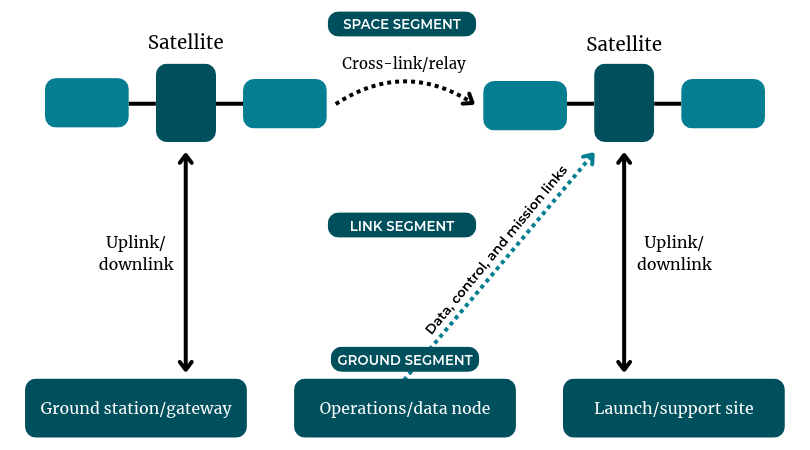
A satellite in orbit depends on extensive ground infrastructure and radio frequency links, as well as on computer networks and other parts of the Electromagnetic Spectrum (EMS). These components – orbital or space, link, and ground – known as segments, comprise a space system, and space control applies to all of them. Diagram 1 depicts a typical space system that comprises the space segment with satellites and spacecraft in space; the ground segment – including telemetry, tracking, and command ground stations, antennas, launch facilities, submarine cables, data centres, and other infrastructure; and the link segment, comprising the radio frequency up-down links for two-way communication that connect satellites with the ground and end-users. Each segment also depends on cyberspace for the functioning of the overall space system. Artificial Intelligence (AI) is increasingly being used to process satellite data into a usable product on board the satellite itself before being transmitted to the end-user on Earth, but again, that data must pass through antennas and cables. A space system can thus be disrupted, degraded, and even destroyed in several segments, not just in the space segment.
Beyond the typical space, ground, and link segments, a space system also depends on an industrial base, supply chain, and legal and financial processes, all of which can be disrupted, degraded, destroyed, or manipulated and exploited to create space control effects.
DIAGRAM 1: AN INTEGRATED SYSTEM OF SPACE, LINK, AND GROUND SEGMENTS
4.3 Space control and suppression of enemy space systems
Space control does not – and is not meant to – confer absolute superiority in the space domain, or across individual space systems, at all times and in all Earth orbits. Instead, space control should be understood as contingent, temporary, and location-specific. In this light, the most suitable terrestrial military analogy is Suppression of Enemy Air Defences (SEAD), where individual air operations require their own SEAD strategy and capabilities, selected according to the objective of the air operation and the capabilities of the adversary.
The proposed concept of Suppression of Enemy Space Systems captures the operational essence of space control in practical terms, in that every military operation, whether it be an air strike, naval manoeuvre, maritime assault, land operation, or even a cyber operation, will have to include a space control element that will be necessary for its success. Specific objectives, the character and capabilities of adversaries, and other factors, will determine the tactical requirements for every particular space control operation. However, in general, space control will protect friendly space systems and offensively suppress enemy space systems for the duration of the wider military operation – as is already understood to have been the case across Operation MIDNIGHT HAMMER against Iran in June 2025. Space control operations will take place in cyberspace, the EMS, on the ground, at sea, in the air, and in space, or a combination of all of these domains, as deemed suitable for achieving those specific military objectives.
4.4 Non-military space control instruments
Beyond military operations, space control is supported by diplomatic, legal, and financial instruments that are often applied before military operations even begin. The diplomatic instrument is used to maintain alliances and partnerships required for multinational space control operations, signalling political intent to adversaries, managing neutral parties, and seeking to encourage norms of behaviour in space operations prior to any conflict even beginning.
Legal instruments are useful for enforcing commercial space contracts during conflicts and for conducting ‘lawfare’ against adversaries and their commercial space sectors. For example, both Russia and the PRC have used international spectrum filings, licensing refusals, and import bans on user terminals to constrain Starlink’s access and operations in a legal fashion.
Financial instruments, on the other hand, are useful for buying up neutral commercial space services in a conflict to prevent adversaries from using them, as well as for ensuring that friendly commercial space sectors are adequately funded and are not beholden to adversary interests.
4.5 The requirement for offensive space-based space control capabilities
It would be a mistake to assume that the cross-domain composition and non-military elements of space control can make offensive, space-based space control capabilities somehow dispensable. Certainly, it can be envisaged that in the near future, the majority of space control operations will not require the use of offensive space-based capabilities, instead relying on counterspace operations conducted by other means in other domains – for example, through jamming or cyber capabilities deployed from the ground. However, there will be circumstances, especially in high-intensity warfare, where offensive space-based capabilities will be necessary.
Without offensive space-based space control capabilities, the UK would be left open to on-orbit coercion directed by adversaries against its critical space systems. Possessing sovereign space-based space control capabilities, therefore, signals resolve and bolsters deterrence against an adversary that might think that Britain’s space systems provide a soft target, or that such interference or attacks against the UK’s assets carries no risk of retaliation in kind.
Space-based space control spacecraft can be equipped with non-kinetic effectors, such as jammers or lasers. Some others, however, could be armed with kinetic effectors for the most exceptional of circumstances, if the future threat environment demands it and policy allows. A responsible offensive space-based kinetic space control capability should consider the ability to remove any debris created after any engagement with an adversary.
4.6 Effective space control requires a protected and resilient space architecture
Another mistake to be avoided is to invest heavily in offensive non-kinetic and kinetic counterspace capabilities while neglecting to invest in the unglamorous measures needed for passive protection of British and allied space systems and their supporting infrastructure. In turn, these create and sustain resilient space architectures capable of absorbing adversary attacks, and are thus vital to sustaining the overall space control mission.
An adversary will, of course, be seeking to deny the UK and its allies access to space with the intention that disruption, degradation, and even destruction of British and allied space systems will have the knock-on effect of undermining, restricting, and disabling the friendly ability to carry out military operations on land, at sea, and in the air.
These efforts by an assumed adversary can be mitigated by ensuring that vital satellite capabilities and their supporting infrastructure are protected and defended. This requires more than just passively protecting individual satellites, encompassing the disaggregation of satellite functions and the use of proliferated constellations in such a way that the loss of one or even a handful of friendly satellites does not result in catastrophic failure. Resilient space architectures, such as proliferated satellite constellations, inter-satellite links, secure and redundant ground infrastructure, encrypted links, and so on can all combine to create an overall ‘deterrence-by-denial’ space posture, ensuring that critical space services are available even when coerced, and degrade gracefully under sustained adversary attack.
Offensive space control capability cannot compensate for, or offset, fragile architectures if deterrence fails and an adversary decides to attack them. Instead, offensive space control is made more strategically effective when deployed to support an already resilient and protected space architecture. This will have a mutually reinforcing deterrent effect, whereby the deterrence-by-denial measures produced by a resilient architecture are enhanced by the ‘deterrence-by-punishment’ effect created by offensive counterspace capabilities.
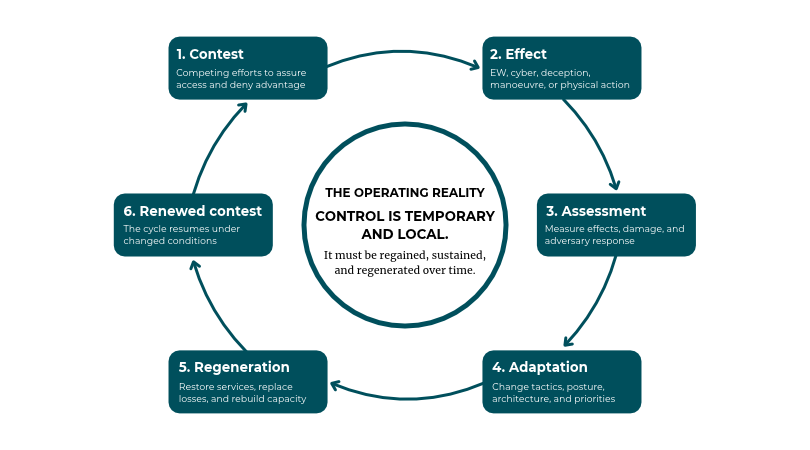
Similarly, the strategic value of space control – itself a continuing contest of action, response, recovery, and renewed action rather than a single, decisive event – is also undercut when the nation’s military is left without the ability to reconstitute, regenerate, and sustain friendly space forces in a prolonged conflict through either national or allied space industrial bases, or both, as depicted in Diagram 2.
DIAGRAM 2: THE ATTRITIONAL CHARACTER OF SPACE CONTROL
4.7 Space control, entanglement, and nuclear weapons
Space control is inextricably entangled with the UK’s nuclear weapons enterprise, as satellites used for nuclear C2, missile early warning, and ISR support are also used for conventional military purposes. Therefore, they are seen as legitimate targets by adversaries in the course of conventional warfare, even when an adversary might have no intention of initiating nuclear hostilities.
In the fog of war against a capable, determined, and nuclear-armed adversary, attacks against critical space systems, such as Skynet or American early warning satellites, might be viewed as precursors to imminent nuclear attack. Similarly, British and allied attacks on adversarial space systems used for their nuclear C2 might precipitate similar fears among their leaders.
In preparation for, and in order to deter, such attacks, the UK should possess space-based space control capabilities that can guard such critical but dual-purpose space systems from any adversarial co-orbital and other space-based threats.
5.0 BRITAIN’S PRESENT POSITION: PROGRESS WITHOUT A PROGRAMME
The need for space control, as acknowledged by the Ministry of Defence (MOD) and HM Government more widely, is largely confined to policy rhetoric and aspiration. While some concrete steps towards developing an actual capability have recently been taken, these are preliminary steps, and the UK is a long way off from fielding a comprehensive space control capability and programme commensurate with the threat and the country’s space defence interests. A number of gaps in Britain’s space control ambitions deserve attention.
5.1 The three gaps
The first gap may be discerned in the area of space control policy. Behind the public rhetoric, policy requires developing and establishing official positions that are politically and diplomatically defensible and sustainable over time on traditionally controversial topics. These include the potential deployment of weapons in space; the possibility that the UK or allied actions in space create debris, even if the effects used are not intended to create debris; establishing red lines and thresholds that would trigger British space control actions or escalation; and carefully crafted signalling and messaging to bolster deterrence. Clear policy direction on these – and other – issues related to space control is important, in the first instance, for force design and capability planning.
The second, and obvious, gap is investment. The funding formally announced in the UK Space Strategy for areas including SDA and In-orbit Servicing, Assembly, and Manufacturing (ISAM), along with the ‘at least’ £9 billion promised in the DIP for defence space spending during the 2030-2035 period,27 are to be broadly welcomed. However, they do not constitute a publicly intelligible force design, programme sequence, or sustained strategic demand signal for British space control.
The third and critical gap is capability. A credible space control programme requires advanced SDA, with the ability to maintain custody of space objects in peace, crisis, and war; robust and redundant C2 capabilities; assigned, equipped, and trained conventional and special operations forces from the British Armed Forces; specialised capabilities – not just ISAM, including RPO-capable spacecraft – for terrestrial and orbital defensive and offensive space control operations; battle damage assessment (including for orbital engagements); regeneration of lost capabilities; and, when required, capabilities to clear any debris created in a timely, responsible, and comprehensive manner.
5.2 The problem of strategic dependence
A UK space control programme will undoubtedly have significant allied and commercial components to it, with like-minded middle powers in particular potentially playing an important role in this respect. Ultimately, however, Britain should develop a core, nationally separable space control capability. This should be available to be used independently as required where the UK must act alone because the US has declined to support for national interest reasons, has dedicated all of its space forces to another strategic theatre, or American commercial space companies are either unable or unwilling to support British contractual obligations.
The solution here is not some kind of national space control autarky – that would be impractical and unsustainable. Rather, it is to develop core sovereign capabilities for the UK that fulfil vital strategic interests, are nationally separable from wider allied architectures or networks, and are not subject to external permissions or control. This should be viewed as strategic optionality for contingencies where Britain has to operate alone.28 In most future scenarios involving military action by the UK, it is expected that strategic optionality will not have to be exercised. Additionally, Britain should seek to forge new national security space alliances with select European partners across the space enterprise, to include space control.
A UK space control capability architecture, therefore, requires a clear-eyed assessment of where its access to space systems is dependent upon allies and commercial companies; which dependencies, if any, are acceptable to national interests; and what core sovereign capabilities must be built.
6.0 BRITISH SPACE CONTROL CAPABILITY ARCHITECTURE
Space control is more than a strategic definition and doctrine, and more than a handful of capabilities. Space control should be viewed within the MOD and HM Government more widely, in the context now set by the UK Space Strategy, as a national capability architecture that encompasses all of these and more, from nose to tail, and must be sustained for decades. The British Armed Forces cannot conduct space control in an improvised manner. Space control requires a rigorous intellectual framework, governance and command, sustained funding, supporting and supported forces, capabilities, and the ability to regenerate forces as necessary.
6.1 Definition and purpose
A British space control capability architecture should be understood as the enduring national security and industrial structure through which the UK designs, acquires, commands, employs, assesses, adapts, and regenerates the forces and capabilities required to assure British and allied freedom of action in, from, and through space, while denying adversaries the ability to impose unacceptable costs.
A UK space control capability architecture does not require a new service or layer of bureaucracy; nor is it merely the output of an industrial consortium. Rather, it requires a governed capability process that links the strategic requirement to operations and the industry to sustain them.
6.2 The operational architecture
A British space control capability architecture must be able to carry out space control operations throughout the entire mission cycle, starting with the ability to sense what is occurring, understand what it means, decide what must be done, target what should be affected, act appropriately, assess if it worked as intended, adapt as necessary, regenerate the required capabilities, and repeat. This architecture is conceptually depicted in Table 2.
Table 2: UK space control conceptual architecture
| Function | Core question | Illustrative requirements |
|---|---|---|
| Sense | What is occurring? | Multi-source SDA, terrestrial and orbital sensors, data access |
| Understand | What does it mean? | Attribution, intelligence fusion, behavioural analysis, threat assessment |
| Decide | What should Britain do? | Nationally separable C2, legal and policy advice, allied coordination |
| Target | What can be affected? | Characterisation, custody, target development, collateral and escalation assessments |
| Act | What effect is appropriate? | EW, cyber, deception, manoeuvre, protection, selected terrestrial and orbital kinetic and non-kinetic effects |
| Assess | Did it work? | Battle damage and service-effect assessments, feedback to C2 |
| Adapt | What must change? | Software, tactics, orbital posture, alternative services, and operating nodes |
| Regenerate | Can capability be sustained? | Spares, launch, logistics, replacement satellites, trained personnel, and industrial surge |
The decisive issue here is integration, as space control cannot be undertaken simply by tapping a handful of individual technologies in a crisis if they are not pre-assembled into an operational chain.
6.3 Design principles
A UK space control capability architecture should follow design principles that provide coherence, clear purpose, and governability – for example, along the following lines:
- Mission-led, not technology-led: A British space control capability architecture should start by focusing on the priority space services that space control is aiming to assure (e.g., space-based ISR, strategic military satellite communications [MILSATCOM], nuclear C2, etc.), which in turn enable freedom of manoeuvre and operational advantage for land, sea, and air forces in priority theatres of operations; against adversary capabilities and vulnerabilities; and the desired operational effects that will defend and further the UK’s national interests.
- Layered and graduated: A British space control capability architecture should emphasise reversible, discriminating, and proportionate options where objectives can be achieved while escalation options can be retained for initiative.
- Nationally separable strategic optionality: The core UK space control capability architecture should be built around sovereign command and control and assured strategic effects in case Britain has to act alone. The architecture’s shape should be based on rigorous assessments of what capabilities can and cannot be left to allies and commercial space companies.
- Federated: The UK’s space control capability architecture should be interoperable with and able to reinforce NATO, Five Eyes, and other partners, but with the ability to be used independently if required. Britain should seek to lead and expand on NATO’s current efforts29 in building a federated NATO space control architecture able to operate with or without the US.
- Regenerative: A UK space control capability architecture should treat replacement capabilities, in-orbit repair, responsive launch, in-space logistics, training, and strategic learning as day-to-day operational capabilities rather than as afterthoughts, disposable options, or unplanned externalities that will be somehow taken care of – unprompted – by others.
These design principles should also be used as benchmarks to prevent British space control from remaining an unfunded and unequipped rhetorical device that lacks operational and strategic credibility among allies and adversaries alike.
7.0 CAPABILITY REQUIREMENTS
With the operational architecture, design principles, and boundaries and safeguards established for a British space control capability architecture, the next step is to discuss what it must be able to achieve and where the UK must retain strategic optionality.
When developing and acquiring British space control capabilities, every investment should be subject to a few simple test questions: what function within the operational architecture it supports; what mission it enables; who authorises it; how it is assessed; and how it is replaced or adapted in an extended, attritional conflict against determined adversaries.
7.1 Awareness, understanding, custody, and attribution
This category of capability goes beyond generic SDA that utilises ground-based radars and telescopes. The more specific SDA requirements for space control involve acquiring and using awareness, understanding, and custody of space objects. Additionally, technical and political attribution of adversary actions require multi-domain SDA capabilities (covering Earth’s surface, upper atmosphere, and in orbit), multi-sensor (radar, optical, multi- and hyperspectral) fusion, behavioural-based warnings and indications utilising analogue and AI techniques, and in-orbit characterisation of RPO conducted by adversaries.
7.2 Command, control, targeting, and authority
Space control requires a secure, classified C2 architecture capable of fusing intelligence, satellite operations, cyber and electromagnetic characteristics, and wider joint and allied force needs and activities. This architecture must be robust enough and able to operate at the speed of space operations with AI decision support. Even the most comprehensive SDA capabilities will leave gaps in the operational picture available to commanders, requiring strategic and operational judgement and risk analysis – all within short and intense timelines given the relative velocities at which objects move in orbit.
Space control C2 requirements do not have to mean autonomous actions across the entire space operations chain. However, they do have to support the ability of commanders robustly and reliably and, when needed, political leadership to make timely, informed, and authoritative choices. AI will also have to play a role in certain space control decision-making functions given the speed at which space operations occur, especially when under attack or in the middle of a hostile engagement.
7.3 Defensive and offensive effects
Defensive and offensive space control effects should be understood by objective rather than platform or technology. These objectives include:
- Protect and defend: Using active and passive measures, space control should contribute to resilience, space manoeuvre, and satellite and constellation hardening and protection. This includes defensive cyber warfare and EW, deception operations to complicate and fool adversary intentions, distributed space architectures, and the protection of ground-based space infrastructure. When combined, these measures should contribute to a default deterrence-by-denial space posture.
- Disrupt and complicate: This involves the use of cyber and electronic warfare, such as jamming, spoofing, network intrusions and attack, active deception operations, countering adversary SDA operations, and other non-kinetic and reversible effects that degrade adversarial freedom of action and assured access to space.
- Deny and defeat: This is accomplished through the targeting of selected adversarial terrestrial and orbital capabilities using kinetic and select non-kinetic capabilities to prevent or defeat hostile actions in space, where other more reversible options are inadequate or have failed.
Importantly, public policy on space control should acknowledge that some threats – especially persistent, manoeuvrable, well-protected adversary co-orbital systems – may ultimately require kinetic responses to destroy the target physically in orbit.
7.4 Resilient services and terrestrial dependencies
A British space control capability architecture should consist of a portfolio of capabilities and force packages from existing conventional and special operations forces capable of deterring attacks against the UK’s space systems alongside those of allies, and, should deterrence fail, defeat adversarial threats to protect friendly satellites and other space infrastructures. As discussed in this Report, this deterrence objective can be further bolstered by ensuring that British and allied space capabilities across all segments are protected, disaggregated, and architectured in such a manner that they are resilient against potential adversary attack as a matter of course, thus creating a baseline deterrence-by-denial posture.
7.5 The sovereignty matrix
The UK cannot, and should not, attempt – or at least expect to be able to do so any time soon – to execute all of the tasks and capability developments outlined above, on its own. British defence space strategy and policy should ensure the necessary conditions for many of these tasks to be able to be sensibly left to allies and to trusted commercial partners, where dependencies on such actors can be tolerated and accepted.
Where external dependencies present the most strategic risk to the UK’s national security interests, and are therefore considered unacceptable, a policy test along the following lines should be used to determine what Britain should provide for its own strategic optionality (see: Table 3).
Table 3: UK space control sovereignty matrix
| Category | Test | Examples |
|---|---|---|
| Nationally separable | Britain must be able to authorise and deliver the effect without external permission | C2 and release authority; selected custody, EW/cyber/kinetic effects, mission data, and critical reconstitution |
| Specialist ally | The UK contributes a credible capability to a federated allied force | Shared SDA, specialised effects, common standards, and combined operations |
| Commercial/allied reliance is acceptable | Dependence does not remove essential national agency | Commodity capacity, augmentation, and non-critical services. |
Ideally, Britain will be able to build a space control programme capable of repeatedly achieving the eight discrete steps of space control as depicted in Diagram 3. Identifying the components and steps of space control, however, is not enough; a UK space control programme must also be delivered. Such space control requires a connected chain of functions, each with distinct but mutually dependent British capability requirements.
DIAGRAM 3: UK SPACE CONTROL FUNCTIONAL ARCHITECTURE
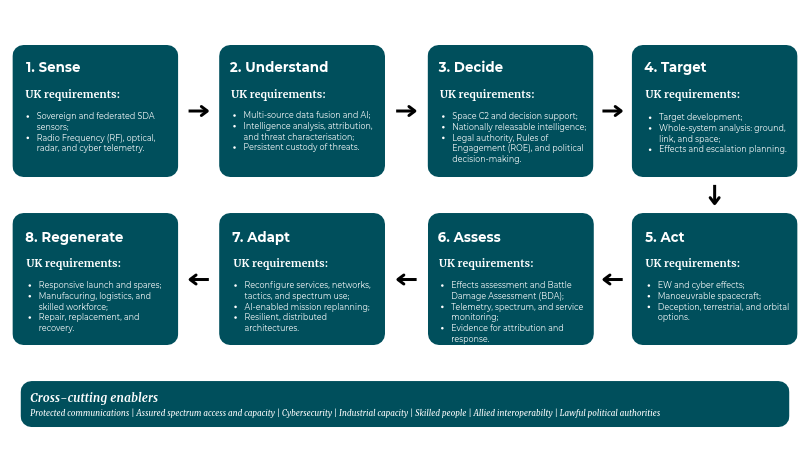
In this architecture, the chain is only as strong as its weakest function. British space control requires the capacity to complete the entire operational cycle.
8.0 DELIVERING THE PROGRAMME: GOVERNANCE, ACQUISITION, INDUSTRY, AND IMPLEMENTATION
With the requirements for a British space control capability architecture laid out, the next practical question is how to ensure that such a programme is actually established and delivered, rather than remaining a rhetorical aspiration.
8.1 Governance and operational ownership
Adding new layers of bureaucracy or establishing a new dedicated agency will likely be counterproductive in developing the UK’s space control capabilities. A better approach would be to organise HM Government’s space control programme under a senior responsible owner who would be accountable and responsible for developing, managing, and delivering the overall space control programme and for coordinating with stakeholders – such as the Department for Business, Innovation, Science, and Trade (DBIST); the Foreign, Commonwealth, and Development Office (FCDO); the Cabinet Office; intelligence services; allies; and the wider MOD and British Armed Forces.
UK Space Command, which already has the operational lead for space control, should establish a new branch responsible for space control operations. This would have command authority over forces such as No. III Space Effects Squadron, as well as other joint elements from the wider British Armed Forces assigned and specifically tasked as required for space control missions. The main purpose of these new arrangements would be to improve the coherence of space control both as a mission area and a specific new discipline within the military.
8.2 Acquisition and experimentation
Within the National Armaments Director Group’s (NAD) space portfolio, a similarly senior position should be created. This should be responsible for the development, acquisition, and provision of the extended space control capability set. The space control programme office within the NAD should publish, as required, an unclassified roadmap and maintain a classified capability plan for space control. To avoid the drawn-out and often unsuccessful acquisition experiences of the past, spiral acquisition, rapid operational experimentation, mission demonstrations, and open architectures should be adopted and utilised.
8.3 Industrial strategy
While commercial companies will deliver most of the capabilities for space control, there is no commercial market for space control operations. The only customer is HM Government, and it should therefore act as the anchor customer for the required capabilities. Although there is no need for state-owned enterprises or nationalisation of companies, the sensitive nature of space control requires trusted industrial partners with whom the MOD should share classified information and set rational requirements around desired strategic effects; resilience; test and assurance; sovereign control of critical data and Intellectual Property (IP); exportability where it is consistent with national security interests; and industrial surge capacity. The industrial strategy objective in relation to space control should not be the arbitrary creation of national champions or preselect suppliers, but to provide industry with a stable operational architecture that it can confidently and sustainably invest in.
8.4 Phased implementation and recommendations
This Report has established the worsening threat environment in space, the UK’s economic and military dependency on space, and the strategic and operational rationale for space control. It has also set out proposed requirements for a British space control capability architecture, and how it might be established from an institutional standpoint.
The case for a dedicated UK space control capability architecture can be made in six concise recommendations for British policymakers and senior commanders:
- Establish a UK space control programme office, with an accountable senior owner, in the MOD within the next 12 months, followed by a capability portfolio owner within NAD Space, as the focal point for space control acquisition, experimentation, and demonstration.
- Expand UK Space Command’s existing remit as the operational owner of the space control mission, ensuring it can command supporting joint forces for the space control mission across different domains as required.
- The MOD should publish, at the earliest opportunity, an unclassified force design framework for space control, approve a classified operational space control concept study, and conduct a mission area dependency assessment.
- Provide UK Space Command and No. III Space Effects Squadron with the personnel, authorities, doctrine, and exercise programme to operate the space control chain.
- Develop, build, and sustain nationally separable C2 and a graduated set of defensive and offensive space control effects and capabilities, to include orbital kinetic options.
- Treat space replenishment, repair, and regeneration as a core future strategic requirement through measures such as launch, rapid replenishment of lost space capabilities, industrial surge, and allied integration.
9.0 CONCLUSION
This Report attempts to guide Britain from rhetoric to a national space control capability architecture by clarifying the need for space control, setting out its requirements, identifying operational capabilities, and proposing general governance and acquisition arrangements. The standard that HM Government should meet is whether the UK can assure national and allied freedom of action in space, make decisions under pressure, impose proportionate costs, and restore combat power through a prolonged contest.
9.1 Key findings
Beyond space control, it should be apparent that space has strategically evolved from a remote vacuum where technical infrastructure is occasionally placed to a warfighting domain of great importance, akin to the sea and air domains in British defence and grand strategy. This opens the possibility that, as the UK’s space control reveals and creates strategic interests that Britain has never before considered, in the years to come HM Government will contemplate the creation of a Royal Space Force to defend and further the country’s interests.
9.2 Final reflections
Until such a time as a space force is established, the UK must prepare for an intensifying strategic competition in space that will likely be attritional and adaptive in character. That strategic competition will reward the side that combines operational judgement, technical capability, industrial endurance, alliance integration, and political resolve. Britain recognises this, and now it must deliver.
Acknowledgements
The authors would like to thank the reviewers, both internal and external, as well as the team at the Council on Geostrategy for their assistance with this study.
Notes
[1] To date, the best summation of space lessons to be learnt from Ukraine and the 2026 US-Israel-Iran conflict can be found in: Frank Rose, ‘The new space wars: lessons from Ukraine and the Middle East’, Space News, 31/07/2026, https://spacenews.com/ (checked: 11/11/2026).
[2] Colin S. Gray and John B. Sheldon, ‘Space Power and the Revolution in Military Affairs: A Glass Half Full?’, Airpower Journal, 13:3 (1999).
[3] Gabriel Elefteriu, ‘The role of space power in geopolitical competition’, Council on Geostrategy, 30/01/2024, https://www.geostrategy.org.uk/ (checked: 11/11/2026).
[4] On the ‘rimland’ concept, see: Nicholas Spykman, America’s Strategy in World Politics: The United States and the Balance of Power (New York: Archon Books, 1970); and Nicholas Spykman, The Geography of the Peace (New York: Harcourt, Brace, and Company, 1944).
[5] ‘Global Britain in a competitive age: The Integrated Review of Security, Defence, Development, and Foreign Policy’, Cabinet Office, 02/07/2021, https://www.gov.uk/ (checked: 11/11/2026).
[6] ‘UK Space Strategy’, UK Space Agency, 04/09/2026, https://www.gov.uk/government/ (checked: 11/11/2026).
[7] ‘The Defence Investment Plan: Equipping our forces, defending our future’, Ministry of Defence, 30/06/2026, https://www.gov.uk/ (checked: 11/11/2026).
[8] Ibid.
[9] In theory, there is a letter of last resort to provide a measure of contingency to ensure that there is not a total reliance on assured access to space.
[10] ‘Guidance: Skynet 6’, Ministry of Defence, 04/08/2025, https://www.gov.uk/ (checked: 11/11/2026).
[11] For example, see: Larisa Brown, ‘How UK space command is helping the US detect Iranian missiles’, The Times, 22/03/2026 https://www.thetimes.com/ (checked: 11/11/2026).
[12] ‘Trident Targeting and Fire Control’, Nuclear Information Service, No date, https://www.nuclearinfo.org/ (checked: 11/11/2026).
[13] On Oberon, see: Jeff Foust, ‘Airbus to build radar imaging satellites for UK military’, Space News, 11/02/2025, https://spacenews.com/ (checked: 11/11/2026).
[14] A scenario discussed in: Ian Bowers and Henrik Stålhane Hiim, ‘Knock-on Risks to NATO’s Space-Based Warfighting Capabilities’, Survival, 67:3 (2025).
[15] See: Anna Desmarais, ‘France wants to bolster its space defences. Here’s what it could buy first’, EuroNews, 14/11/2025, https://www.euronews.com/ (checked: 11/11/2026).
[16] Stephen Clark, ‘For the first time, the US military confirms it has deployed weapons in orbit’, Ars Technica, 15/09/2026, https://arstechnica.com/ (checked: 11/11/2026).
[17] On German military space developments, see Linus Höller, ‘Germany unveils $40bn military-space investment, citing new threats’, Defence News, 25/09/2025, https://www.defensenews.com/ (checked: 11/11/2026).
[18] For sources used for this table, see: Victoria Samson and Kathleen Brett (eds.), ‘2026 Global Counterspace Capabilities Report’, Secure World Foundation, 08/04/2026, https://www.swfound.org/ (checked: 11/11/2026); Clayton Swope et al., ‘Space Threat Assessment 2025’, Centre for Strategic and International Studies, https://www.csis.org/ (checked: 11/11/2026); and ‘Challenges to Security in Space: Congestion, Competition, and Cooperation’, United States Defence Intelligence Agency, 23/10/2026, https://www.dia.mil/ (checked: 11/11/2026).
[19] Tom Cotterill, ‘Chinese spy satellite spotted by UK’s military telescope’, The Telegraph, 22/05/2026, https://www.telegraph.co.uk/ (checked: 11/11/2026).
[20] Michael Weiss, Roman Dobrokhotov, and Christo Grozev, ‘Shooting Starlink: The “no-limits” partnership between Russia and China is taking aim at Elon Musk’, The Insider, 09/07/2026, https://theins.press/ (checked: 11/11/2026).
[21] Candace Huntington, ‘China’s Military Space Capabilities and Implications for the United States’, Centre for Global Security Research, 17/09/2025, https://cgsr.llnl.gov/ (checked: 11/11/2026).
[22] Nathaniel Rome, ‘China’s Space Export Strategy’, Space Policy, 66 (2023).
[23] Shoshana Baker, ‘Chinese-built satellite in Iranian hands tracked US bases’, The Jerusalem Post, 15/04/2026, https://www.jpost.com/ (checked: 11/11/2026).
[24] ‘US says Chinese satellite firm is supporting Houthi attacks on US interests’, Reuters, 17/04/2025, https://www.reuters.com/ (checked: 11/11/2026).
[25] Wes Streeting, Speech: ‘Defence Secretary Wes Streeting MP, keynote speech at UK Space Power Conference’, Ministry of Defence, 23/09/2026, https://www.gov.uk/ (checked: 11/11/2026).
[26] ‘Joint Doctrine Publication 0-40: UK Space Power’, Ministry of Defence, 01/09/2022, https://www.gov.uk/ (checked: 11/11/2026).
[27] ‘The Defence Investment Plan: Equipping our forces, defending our future’, Ministry of Defence, 30/06/2026, https://www.gov.uk/ (checked: 11/11/2026).
[28] John B. Sheldon, ‘Britain Needs Strategic Optionality in Space,’ AstroAnalytica, 20/07/2026, https://www.astroanalytica.com/ (checked: 11/11/2026).
[29] ‘NATO allies join forces to develop high-end space capabilities’, North Atlantic Treaty Organisation, 07/07/2026, https://www.nato.int/ (checked: 11/11/2026).
Editorial policy
Our publications are guided by our editorial policy and quality assurance processes. To view these, please visit:
http://www.geostrategy.org.uk/editorial-policy
DISCLOSURE ON ARTIFICIAL INTELLIGENCE (AI)
This research involved the use of AI as a tool to assist with copyediting, restructuring text, checking for errors and fallacies, and generating images. The author(s) and the editorial team at the Council on Geostrategy maintained full oversight throughout the drafting, copyediting, and formatting process, and assume complete responsibility for the final published content.
ISBN: 978-1-917893-36-7