
Executive summary
- The People’s Republic of China (PRC) employs the People’s Armed Forces Maritime Militia (PAFMM) to advance its aims within the First Island Chain. This blurs the distinction between civilian and military assets, creating difficulties for free and open nations in countering Chinese sub-threshold actions.
- A series of problems has arisen from Beijing’s use of the PAFMM, including operational asymmetry in vessel mass; strategic ambiguity stemming from the militia’s civilian façade; information warfare via the legal challenges presented; and potential legal paralysis within targeted nations.
- To counter these challenges, free and open Indo-Pacific nations should adopt a systematic lawfare response. This requires legal resilience, legal vigilance, and a robust legal arsenal to challenge the PRC’s plausible deniability in the First Island Chain.
Introduction
The ‘First Island Chain’ is a site of intense geopolitical contestation. Along it, the People’s Republic of China (PRC) claims Philippine maritime features in the South China Sea as part of its more extensive ‘Nine-Dash Line’, Japan’s Senkaku Islands, and, in between, the entirety of Taiwan. The Chinese Communist Party (CCP) has long sought to dismantle civilian-military barriers to modernise the People’s Liberation Army (PLA) – the Chinese armed forces – into a ‘world-class’ force, advancing national rejuvenation.
The maritime domain is no different. Here, the People’s Armed Forces Maritime Militia (PAFMM, hereafter also referred to as ‘the militia’) is a prominent example of this blurring between the civilian and military spheres. This Primer will explain what the militia is, what it does, and its connection to the Chinese state. Next, it will turn to the militia’s future role in the First Island Chain and the challenges, including the legal hurdles, this poses for frontline states and their allies and partners. Finally, the study will propose a legal response for the United Kingdom (UK) and its allies and partners to challenge Chinese maritime action.
The maritime militia and its activities
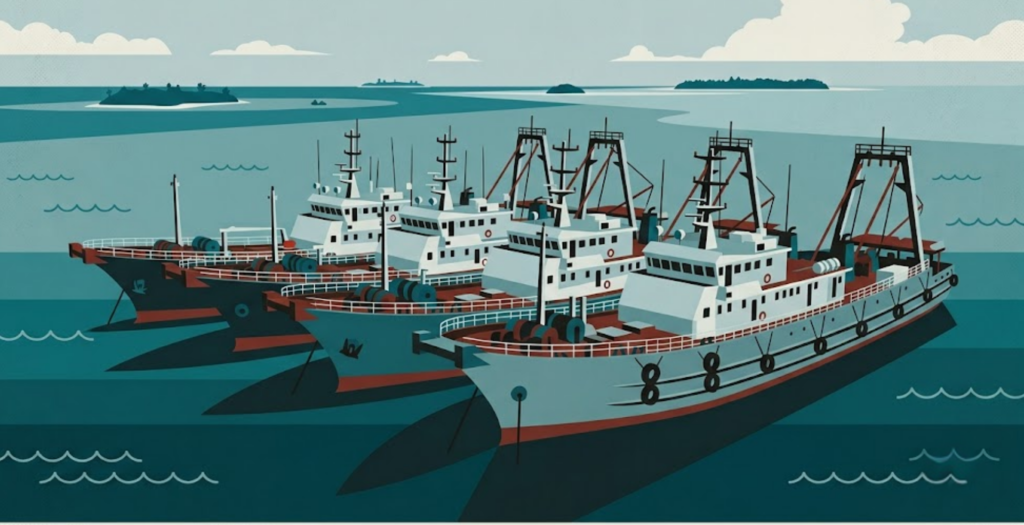
While the PAFMM includes elite, purpose-built vessels with professional crews, the majority of the fleet, used on a more ad hoc basis, consists of commercial fishing boats. Yet, despite appearing ostensibly civilian, these vessels have deep links with the Chinese state, and act on its behalf.
Article 22 of the PRC’s National Defence Law lists ‘the militia’ as part of the country’s armed forces with responsibility for ‘perform[ing] combat readiness service and carry[ing] out non-war military operations and defensive operations under the command of the military authorities.’[1] Accordingly, the PAFMM is subject to the PLA’s Command and Control (C2).[2] The militia is also in receipt of financial state support. Central government subsidies have been given for the construction of professional militia vessels and the installation of communication and safety equipment on fishing boats, as well as for fuel and training programmes.[3] Finally, the actions of the militia across the First Island Chain consistently demonstrate involvement in state-directed campaigns.
The militia’s activities in asserting the PRC’s territorial claims in the South China Sea have been extensively documented.[4] Activities here reveal a high degree of coordination between the PAFMM and other elements of the Chinese state. This is exemplified by the ‘cabbage strategy,’ where fishing vessels swarm a target while the Chinese Coast Guard (CCG) and People’s Liberation Army Navy (PLAN) provide outer layers of support to deter foreign vessels that might seek to intervene.[5] Meanwhile, there are numerous reports of the militia obstructing, harassing, and ramming foreign vessels.[6] Similar cooperation has been observed in the East China Sea. Notably, in August 2016, between 200 and 300 Chinese fishing boats and CCG vessels entered Japan’s Senkaku Islands contiguous zone.[7]
Historically, the militia’s role in Beijing’s pressure campaign against Taiwan has been relatively minor. In recent years, however, a variety of commercial vessels have been used for sub-threshold activities, with Taiwan’s Coast Guard Administration reporting that it had expelled 1,135 Chinese fishing boats from Taiwanese waters in 2024.[8] In May that year, the militia also patrolled the waters east of Taiwan with the CCG as part of the PLA’s large-scale ‘JOINT SWORD 2024A’ exercise.[9]
The above actions demonstrate that the PAFMM does not act as a standalone actor across the First Island Chain, but is instead a component in Beijing’s wider maritime coercion system.
Future role: Escalation, crisis, and conflict
The PRC will likely continue to use the militia for sub-threshold activities in the First Island Chain. The PAFMM’s presence in the South China Sea, for example, reached record highs in 2025, with the Centre for Strategic and International Studies’ Asia Maritime Transparency Initiative noting a daily average of 241 militia vessels – up from 232 in 2024.[10] Recent highly coordinated manoeuvres also suggest that the PAFMM would play a significant role should Beijing escalate its pressure on Taiwan.
On two occasions – 25th December 2025 and 11th January 2026 – more than 2,000 and 1,400 Chinese fishing boats respectively formed barriers in the East China Sea, stretching from 200 to 290 miles. Their formation was so dense that, according to The New York Times, ‘approaching cargo ships appeared to skirt around them or had to zigzag through’.[11] Some of the vessels are known to have taken part in previous militia activities, and those that took part in the January mobilisation stayed in place for 30 hours. Analysts argue that the scale of these mobilisations demonstrate both an increased capacity to control civilian shipping and a rehearsal for future contingencies.[12]
Therefore, the PAFMM looks set to expand its activities beyond asserting territorial claims in the South China Sea to aiding sub-threshold activities against Taiwan. These include possible efforts to impose a selective inspection regime, port-area control, a quarantine, or a blockade-like operation.
At the beginning of June 2026, in what might be a harbinger for further escalation, Beijing used civilian vessels to conduct a ‘special maritime traffic law enforcement’ operation in the waters east of Taiwan. During these patrols, at least three foreign-flagged merchant ships were radioed to ask for information on their port of departure, destination, and crew numbers.[13]
If the PRC decides to interfere further with maritime traffic around Taiwan, barriers of this kind could complicate supply operations and obstruct foreign warships. Militia vessels could aid CCG efforts by harassing, swarming, and ramming non-compliant merchant vessels.
Arising problems
The challenges Chinese sub-threshold activities pose to Indo-Pacific security include:
- Operational asymmetry: Using fishing vessels for military purposes provides the PRC with unrivalled mass. Tactics such as swarming or obstruction rely heavily on deploying a sheer volume of hulls. Moreover, the fact that these are relatively cheap vessels will add greater costs to resisting countries that may depend on a smaller number of higher-end vessels to safeguard their sovereignty and maritime interests.
- Strategic ambiguity: The civilian façade of the PAFMM complicates intelligence gathering and early warning capabilities. Should Beijing decide to escalate or advance its activities, its intentions might not be immediately apparent given militia vessels are designed to blend in with standard commercial or fishing activities. Consequently, targeted states are deprived of time to formulate and deploy an effective response.
- Information warfare: The legal challenge (see: Box 1) surrounding the PAFMM acts as a potent tool for narrative control. Should targeted states use force to counter aggressive militia tactics like ramming, Chinese propagandists could frame forceful responses as unprovoked, disproportionate attacks on innocent civilians. Consequently, aggressive tactics shift the escalatory burden onto the country defending against Chinese action.
- Legal paralysis: The deliberate blurring of lines directly assaults the ‘principle of distinction’; the fundamental requirement under international humanitarian law to differentiate between combatants and non-combatants. As sub-threshold activities escalate, military commanders and legal advisers in targeted states are drawn into difficult, prolonged debates over what constitutes a legitimate military target – and may ultimately counsel overly cautious restraint.
| Box 1: The legal challenge |
| 1. Principle of distinction: A central notion of the Law of Armed Conflict (LOAC) is that states have a duty to distinguish between combatants and non-combatants (who have protected status) and direct their military operations against military objectives only. Through the militia, the PRC muddles the boundaries between combatants and non-combatants, which makes it difficult for other states to differentiate whether a vessel is a civilian or military actor. 2. Self-defence: Under Article 51 of the United Nations (UN) Charter, states possess an inherent right to self-defence only when subjected to an ‘armed attack’. However, international jurisprudence dictates that low-level hostile actions do not cross this threshold unless they reach a specific level of gravity, scale, and effect. This creates a legal gap that licenses low-level asymmetric armed coercion, and is exploited by the PAFMM, which comfortably operates and dominates inside this gap while avoiding full-fledged conflict, thereby circumventing the Charter’s thresholds. These sub-threshold areas allow the PRC to engage in ‘battlefield-exploitation lawfare’, by exploiting international law-abiding countries’ military commitment to the LOAC. Militia vessels do not neatly fall into either definition of ‘civilian’ or ‘combatant’, as they are not clearly under the command of the Chinese state, they do not bear a fixed distinctive sign or clothing, they possess a civilian function, and they do not carry arms openly.[14] Whether they are under the command of the PRC depends on the day, and each legal analysis of whether a vessel is a legitimate military target is highly conditional. Combined with its engagement in low-level aggression, this provides the PRC with a veneer of deniability for insisting that the PAFMM is not a valid military actor or target engaging in an armed attack, as well as a pretext for false accusations of unlawful attacks on fishermen. |
Future role: Escalation, crisis, and conflict
A systematic and proactive lawfare response to this challenge should rest on three pillars: legal resilience, legal vigilance, and a legal arsenal.
Legal resilience
Legal resilience requires His Majesty (HM) Government to work with regional partners, particularly those situated in the First Island Chain, to ensure alignment on the legal recognition of the militia’s use of force and what constitutes an ‘armed attack’.
To combat the PRC’s plausible deniability, the PAFMM should be held to the same internationally recognised standards of law, seamanship, and communications, including the International Collision Regulations (COLREGS) and other international regulations governing allowable conduct by ships at sea.[15] Militia activity spans a spectrum of violations of increasing severity, from breaches of navigational safety rules – including of COLREGS and the United Nations Convention on the Law of the Sea (UNCLOS) – to unlawful coercion or use of force and, at the highest end, to blockade-like operations or conduct amounting to an armed attack where the scale and effects cross a particular threshold. As such, HM Government, alongside its allies and partners, should establish a common framework for categorising such conduct and for determining when that threshold is met.
Doing this should also account for the strategic implications of such classification, including the risks of escalation where conduct is characterised as an armed attack, and the potential erosion of credibility where it is thus characterised but not treated as such in practice. Accordingly, states should avoid prematurely characterising all sub-threshold conduct as ‘armed attack’, reserving that designation for clearly attributable and high-impact operations. Instead, they should employ appropriate response measures for each classification that maintain deterrence without generating escalation or credibility risks.
Legal vigilance
To bolster legal vigilance, Britain and allied nations should continue to identify early indicators of aggression and Chinese narratives associated with them, and engage in an appropriate response by leveraging all instruments of power in the ‘Diplomatic, Information, Military, Economic, Financial, Intelligence, and Law enforcement’ (DIMEFIL) spectrum. DIMEFIL responses could involve publicly highlighting each act of aggression through diplomatic statements, detailing how these actions legally constitute armed attacks and/or violate international law, or carrying out physical manoeuvres.
Indicators should encompass abnormal fishing vessel concentrations, long-duration loitering, barrier-like formations, Automatic Identification System (AIS) shutdown or spoofing, and coordination with CCG or PLAN units. It should also extend to the analysis of jurisdictional claims and associated legal narratives, including official Chinese legal pronouncements, Chinese academic commentary on the use of force, and information operations attributing blame of incidents to others. Such information should be systematically shared with partners to enhance their own vigilance capabilities and support a coordinated, real-time understanding of evolving patterns of Chinese conduct.
Legal arsenal
Building a robust legal arsenal requires defining the PAFMM’s status and pursuing accountability through international frameworks. This should include formally characterising the PAFMM, including ad hoc militia vessels operating under Chinese direction, as state-linked actors attributable to the PRC by way of ‘effective control’. It should be argued that where the PRC finances, organises, trains, equips, selects targets for, plans operations with, exercises operational command over, and issues instructions to ostensibly civilian or irregular maritime actors, a de facto agency relationship is established.
Additionally, the PAFMM’s involvement in the PRC’s breaches of international law and its direct attribution to the Chinese state should be publicised proactively to drive a broader narrative of Chinese aggression and illegality. This should be coordinated with allied nations to promote these narratives across various international organisations and bodies. As well as highlighting ‘armed attacks’, other relevant grounds can be explored to support the narrative and hold Beijing accountable, namely: violation of due diligence obligations under Article 94 of UNCLOS (effective exercise of jurisdiction and control over vessels flying its flag, including compliance with applicable international rules and standards); Article 58 of UNCLOS (respecting other states’ rights in its Exclusive Economic Zone [EEZ], including freedom of navigation, and exercising activities with due regard for those rights); and other obligations under Article 74(3) and Article 83(3) of UNCLOS (the obligation to make every effort to enter into provisional arrangements of a practical nature, and not to jeopardise or hamper the reaching of a final agreement in disputed maritime areas).
Britain and its allies should also support regional partners, including Association of South East Asian Nations (ASEAN) countries, with coordination, diplomatic, evidential, and legal support for fresh legal claims that focus explicitly on the PRC’s unlawful use of force, including the actions of the PAFMM. In recent years in particular, the Philippines has considered invoking the use of force as one of several legal grounds to initiate legal action against the PRC.[16] While this itself will not compel Beijing to drop its maritime claims, it would impose reputational costs and may influence Chinese behaviour, as did the Philippines’ successful arbitration in 2016.
Conclusion
The PAFMM operates as a critical vanguard of the PRC’s maritime coercion system across the First Island Chain. By blurring civilian and military lines, the militia affords Beijing operational asymmetry, strategic ambiguity, and an information advantage that can foster legal paralysis among frontline states. As the PAFMM expands its sub-threshold activities, particularly concerning Taiwan, free and open nations must prepare for future crises.
To counter this challenge, HM Government and its allies and partners should deploy a systematic lawfare strategy founded on legal resilience, legal vigilance, and a robust legal arsenal. This requires aligning with like-minded countries to establish a common framework for identifying an ‘armed attack’, leveraging DIMEFIL instruments to expose aggressive indicators, and formally attributing ostensibly civilian militia vessels to the Chinese state. By pursuing accountability through international frameworks like UNCLOS and supporting the fresh legal claims of regional partners, the UK can help to dismantle the PRC’s plausible deniability, impose reputational costs, and uphold international law in the Indo-Pacific.
Acknowledgements
ISBN: 978-1-917893-27-5
Disclaimer: This publication should not be considered in any way to constitute advice. It is for knowledge and educational purposes only. The views expressed in this publication are those of the author and do not necessarily reflect the views of the Council on Geostrategy or the views of its Advisory Board.
Notes
[1] ‘Law of the People’s Republic of China on National Defence’, Ministry of National Defence of the People’s Republic of China, 14/10/2025, http://eng.mod.gov.cn/ (checked: 26/06/2026).
[2] Conor Kennedy and Andrew Erickson, ‘China Maritime Report No. 1: China’s Third Sea Force, The People’s Armed Forces Maritime Militia: Tethered to the PLA’, US Naval War College, 03/2017, https://digital-commons.usnwc.edu/ (checked: 26/06/2026).
[3] Gregory Poling, Harrison Prétat, and Tabitha Mallory, ‘Pulling Back the Curtain on China’s Maritime Militia’, Centre for Strategic and International Studies, 18/11/2021, https://www.csis.org/ (checked: 26/06/2026).
[4] Gregory Poling, Harrison Prétat, and Tabitha Mallory, ‘Pulling Back the Curtain on China’s Maritime Militia’, Centre for Strategic and International Studies, 18/11/2021, https://www.csis.org/ (checked: 26/06/2026).
[5] Jeff Himmelman, ‘A Game of Shark and Minnow’, The New York Times Magazine, 24/10/2013, https://www.nytimes.com/ (checked: 26/06/2026).
[6] Joseph Potter, ‘Beyond Swarming: Documenting Harassment, Assault, and ICAD by Chinese Maritime Militia’, Small Wars Journal, 16/02/2026, https://smallwarsjournal.com/ (checked: 26/06/2026).
[7] Lyle Morris, ‘The New “Normal” in the East China Sea’, RAND, 27/02/2017, https://www.rand.org/ (checked: 26/06/2026).
[8] Alison O’Neil and Daniel Shats, ‘Silent Shadows: Tracking Disguised PRC Vessels in the Taiwan Strait and South China Sea’, Institute for the Study of War, 23/03/2026, https://understandingwar.org/ (checked: 26/06/2026).
[9] Ryan Martinson, ‘Missing in the Gray [sic] Zone? China’s Maritime Militia Forces Around Taiwan’, The Diplomat, 24/12/2024, https://thediplomat.com/ (checked: 26/06/2026).
[10] ‘All Together Now: China’s Militia in 2025’, Centre for Strategic and International Studies, 23/02/2026, https://amti.csis.org/ (checked: 26/06/2026).
[11] Chris Buckley, Agnes Chang, and Amy Chang Chien, ‘Thousands of Chinese Fishing Boats Quietly Form Vast Sea Barriers’, The New York Times, 16/01/2026, https://www.nytimes.com/ (checked: 26/06/2026).
[12] Ibid.
[13] The four vessels were Haixun 09, a maritime safety ship; Haixun 06, a rescue vessel; Haixun 08, a deep-sea hydrographic survey vessel; and Donghaijiu 113, a professional maritime rescue ship. See: Zack Liao, ‘Chinese presence east of Taiwan’, Observing China, 16/06/2026, https://www.observingchina.org.uk/ (checked; 26/06/2026).
[14] Jill Goldenziel, ‘Law as a Battlefield: The US, China, and the Global Escalation of Lawfare’, Cornell Law Review, 106 (2020).
[15] ‘Convention on the International Regulations for Preventing Collisions at Sea, 1972 (COLREGS)’, International Maritime Organisation, 20/10/1972, https://www.imo.org/ (checked: 26/06/2026).
[16] Kathrin Hille, ‘Philippines considers new UN case against Beijing over South China Sea activity’, Financial Times, 12/12/2024, https://www.ft.com/ (checked: 26/06/2026).