

Executive summary
- The United Kingdom (UK) needs a clearer and more rigorous doctrinal definition and implementation framework for space resilience.
- The purpose of space resilience is to ensure space architecture mission continuity at the operational level. This also requires enterprise-level support, which should be considered part of resilience.
- Effective resilience increasingly depends on more than classic resilience methods such as proliferation; it now includes defensive space control plus allied and commercial partnering.
- British space resilience should be driven by specific standards and requirements, and should lean more on space control capabilities. It should integrate more allied and private sector support through sovereign interoperability enabled by new technologies.
Introduction
The word ‘resilience’ has become a fixture in the United Kingdom’s (UK) space policy conversations, just as it has across British defence, and indeed recent national strategy debates and documents more broadly.[1] His Majesty’s (HM) Government’s Defence Space Strategy (DSS) itself repeatedly highlights the need to enhance resilience and to build resilient space capabilities in the face of evolving risks and threats in the space domain.[2]
Space resilience is therefore widely affirmed as essential, but the term remains undefined and unfocused, and continues to be used in an often generic manner. The UK’s space doctrine does contain important references to the topic, but these are often contextual rather than systematic. Official publications say nothing specific about space resilience requirements, implementation or responsibilities. In short, a coherent understanding of space resilience is lacking.
This Primer attempts to bring some clarity to this concept, seeking to narrow and specify its scope from a terminological perspective, and to consider aspects pertaining to its practical application, particularly in a British context.
Firstly, this study considers the doctrinal meaning of resilience in the space domain, proposing a combined mission-focused and enterprise-level understanding specifically tailored to the UK’s circumstances. Secondly, the classic methods of achieving resilience are presented, together with a set of new conceptual challenges and opportunities opened up by changing space technologies. Finally, this Primer outlines a future British model of space resilience, together with a consideration of three major areas of focus which can support it.
What is space resilience?
For all its constant invocation in today’s debates and official documents, space resilience has received remarkably little formal conceptual attention. As recently as 16 years ago, the Ministry of Defence’s (MOD) official Space Primer[3] – the reference publication in this area – did not mention the term at all.[4] Certainly, the logic of resilience was present in references to the need to protect, defend, and recover from attacks. However, the Space Primer belongs to a period in which space power was understood primarily as a question of access and utilisation, not survivability in a contested environment. This too is a reminder that the understanding of concepts like resilience evolve over time as the strategic and technological context changes.
Even today there are no clear definitions. The MOD’s primary (and current) space doctrine document is ‘UK Space Power’ from September 2022; the keystone space domain doctrine.[5] It mentions space resilience in the context of ‘societal reliance on assured access to space’, in the general sense of ‘resilience of space capabilities to disruption’, and as a broad, diffuse goal – a ‘resilient space domain’. What it does not do is define it.
Mission focus
Britain should look to external models for guiding its conceptual approach to space resilience, and adapt them to its own circumstances. The United States (US) – as the country with the most evolved space capabilities, space power scholarship, and space doctrine – remains the benchmark in this regard. In particular, Britain can and should adopt the Pentagon’s standing definition of space resilience:
…the ability of a [space] architecture to support the functions necessary for mission success with higher probability, shorter periods of reduced capability, and across a wider range of scenarios, conditions, and threats, in spite of hostile action or adverse conditions.[6]
This formulation has the advantage of incorporating in a single definition four essential aspects of space resilience:
- The architecture framing, which positions the concept at a higher, operational/strategic level, rather than extending it to individual satellite systems and tactical considerations;
- The mission focus, which provides a clear object for any resilience discussion in a military/security context, and prevents conceptual dilution into generic statements (as is often the case at present);
- The dynamic aspect, which captures the idea that resilience is not a fixed value or measure on a linear scale, but a relational concept that changes with evolving operational circumstances (‘scenarios’); and
- The hostile context, which sets the expectation that resilience has to withstand attack/disruption from an active adversary over a potentially prolonged period of time, not as a single event.
With space resilience centring on the architecture – as a system of space systems, including the crucial ground and link segments – its purpose is to ensure mission continuity for the architecture as a whole despite potential losses and disruption. This includes the ability to reconstitute lost capabilities.[7] The ultimate goal is not complete system survival, but continued delivery of the required effects.[8]
Mission continuity is therefore to be understood here in an effects-focused operational sense rather than from a narrow, engineering perspective of maintaining certain levels of technical performance for the space system itself. In other words, the mission is not simply a set of technical parameters to be met by keeping the system working as it should, but an operational objective that may be attained through a combination of means and effects.
Enterprise perspective
While the primary utility of space resilience as a mission-focused concept is clearly located at the system architecture/operational level, there is also a secondary, higher-level, understanding of it centred on the domain itself – or, more precisely, on the National Space Enterprise.[9]
Whereas mission resilience centres on continuity of effects, domain or enterprise resilience is what delivers continuity of capability generation, and is also therefore the key enabler of reconstitution. Again, enterprise resilience is not a doctrinally defined term, but from practical use – including inferred use in statements about ‘space resilience’ in general – it refers to how a country’s space ecosystem as a whole is able to endure, adapt, and remain functional under systemic stress; i.e. in wartime conditions and/or in strategic peacetime competition. Seen from this angle, space enterprise resilience includes the industrial base (e.g., launch and manufacturing), supply chains, workforce and skills, programme leadership and policy, alliances and access to allied support/capabilities, and so on.
A detailed discussion of space enterprise resilience is beyond the scope of this Primer, but it should be noted that from a strategic point of view, successful mission-level resilience can be undone or undermined by enterprise-level failure in a major conflict, or even in peacetime in the face of aggressive competition.[10] It is possible to achieve high mission resilience via a proliferated Low Earth Orbit (LEO) constellation, for example, but to have low enterprise resilience because of dependence on foreign launch or fragile supply chains, and through a weakening national capacity to develop and maintain adequate space capabilities.
Application: The classic resilience ‘stack’
There is a well-established set of high-level concepts for achieving space mission resilience. They should all be employed where possible, for cumulative effect. The principal methods, laid out in both American and North Atlantic Treaty Organisation (NATO) doctrine, include:[11]
- Disaggregation, where a multi-role satellite is replaced by multiple satellites each performing one of those roles;
- Distribution, where the system’s mission or function is spread across multiple satellites, as with Global Positioning System (GPS);
- Diversification, where the mission is broken up into tasks performed or supported by a variety of different satellites – including commercial – in different orbits, and often part of other systems;
- Protection, with active and passive measures, from electromagnetic interference and nuclear hardening to manoeuvrability, on-board detection, and other countermeasures;
- Proliferation, as with megaconstellations – large numbers of the same satellites performing the same mission, providing redundancy; and
- Deception (only openly mentioned in US doctrine), which aims to confuse or mislead a threat with respect to the location, capability, operational status, mission type, etc.
These concepts – aside from ‘Deception’ – have also been de facto adopted in a British context, with one significant difference in the ‘Protection’ area. Unlike the American doctrine, which clearly separates defence space tasks (i.e., space control) from resilience and only includes some active and passive protection measures in the resilience taxonomy, the UK’s doctrine explicitly frames ‘Defensive Space Control’ (DSC) as a resilience function. It notes DSC’s purpose to ‘protect space capabilities from attack’, detailing, under this headline, ‘various methods [that] can be used to maximise the resilience of space capabilities from disruption’.[12] The DSS similarly tasks space control with ensuring that ‘space capabilities have adequate resilience to disruption from adversarial activity’.[13]
To complete the ‘resilience stack’, these mission-focused approaches – which apply to space system architectures at the operational level – must be accompanied by enterprise-level measures. This is particularly required in order to enable reconstitution and recovery, which should be considered an integral part of space resilience.[14] Reconstitution and recovery for all space segments depend on capacity and functionality on Earth across ground station and launch infrastructure, the health of the space industrial base, and programme execution and space support operations by civil-military agencies.
Conceptual gaps
A number of conceptual areas around key challenges to practical applicability remain underdeveloped. Addressing and incorporating them into a more coherent space resilience doctrine would also open new possibilities for policy and strategy.
Specificity
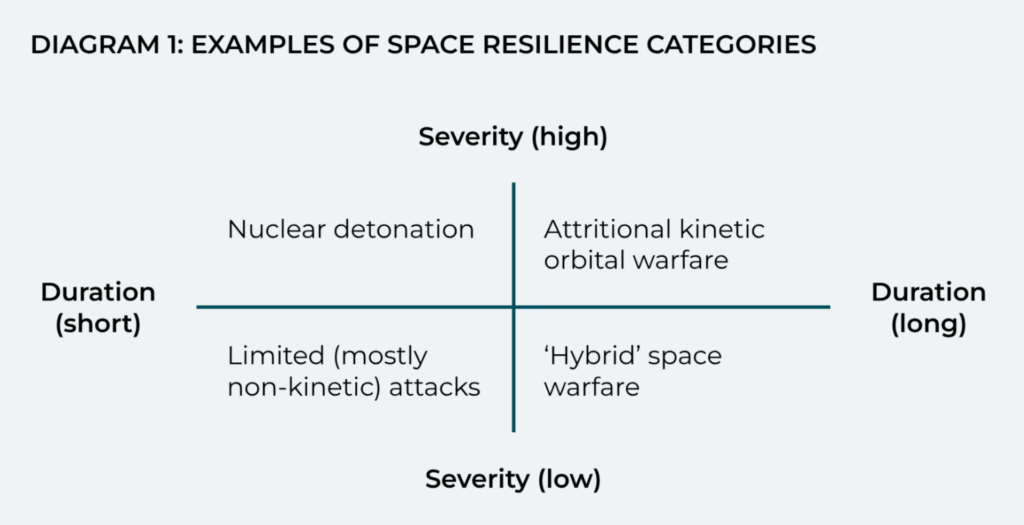
Resilience solutions cannot be designed in the abstract or against generic threats; they must account for specific conditions. Scenarios involving the loss of service or capability in wartime sit on a spectrum. At one end, there are non-kinetic individual attacks on a limited number of satellites and ground stations. A much graver situation would involve a mix of different types of attack, including kinetic, against significant numbers of space systems.[15] At worst, multiple nuclear weapons would be detonated in different orbits, with indiscriminate and catastrophic effects across the entire space domain.
It is not enough to set ‘increased resilience’ as a policy goal without specifying a verifiable standard for it.[16] This alone can drive clearer resilience requirements. Here lies an important conceptual gap which British space doctrine should address, perhaps by developing level-categories for space systems disruption (see: Diagram 1).
Change
The resilience profile of space architectures is subject to continuous and rapid change through the unremitting evolution of technology, partner-owned systems, and threat vectors. New vulnerabilities arise, as do new possibilities to address them and to interconnect with other supporting systems. For example, Global Navigation Satellite System (GNSS) signal loss may be compensated through Position, Navigation, and Timing (PNT) techniques using signals of opportunity, or new solutions such as Xona.[17] Satellite communications (satcom) networks are gaining the ability to ‘self-heal’ by re-routing data dynamically through optical inter-satellite links.18 Autonomy – i.e., on-board decision-making – is also proliferating, making spacecraft more self-reliant and allowing for more complex missions.
The net result is that next-generation space resilience cannot be designed as a ‘fixed’ solution; it will need to be dynamic and continuously updated.[19] In this area, too, current doctrine is reaching its limits: more conceptual development around the dynamic/adaptive resilience problem-set is required.
Interoperability
Resilience planning and implementation must now increasingly balance the opposing imperatives of sovereignty and partnering. Both are required: the need for greater sovereign control is driven by geopolitical tensions, while partnering – with allied countries as well as commercial providers – is required because of growing space threats and security exposures at a time of financial constraint. The real question is how to partner safely; i.e., achieving space systems interoperability while retaining control and the integrity of sovereign data.
Emerging high-capacity optical link technology is beginning to provide an answer. It is now becoming technically possible to relay data optically in real time at sensor collection rate without the need to buffer any data and identify the source – thus eventually enabling secure point-to-point connections between different governments’ systems. This will eventually allow easy reconfiguration of connectivity between allied systems – and commercial providers – as well as Command and Control (C2) coordination, intelligence sharing, and joint operations. This would be the bedrock of a modern adaptive or dynamic approach to space resilience (which also currently lacks doctrinal coverage), opening a multitude of new options for solving resilience challenges.
Planning level
As noted, space architecture resilience is a space domain operational requirement focused on mission continuity; i.e., delivering certain space effects in support of warfighters. However, from a higher, multi-domain strategic perspective, campaign planning – as well as peacetime force design – must and does include reversionary modes (partial alternatives to space) in case of space denial.[20] In other words, a higher planning level can essentially provide resilience to the loss of space resilience.
This is highly consequential for space resilience planning in practice, given that capability requirements – and therefore programmatic decisions – flow downwards from the strategic level. Ultimately, resilience – in space as in other domains – is a relative outcome from a process that weighs cost, planned use, consequences of lost or degraded capability, and the availability of other means to perform missions.
Towards a British model of space resilience
Given the UK’s reduced – even minimal – inventory of sovereign orbital assets, much of the domestic discussion about mission-focused space resilience is necessarily future-oriented, looking ahead to a time when the country will develop significant in-space operational capability.
In this sense, from a specifically British point of view – based on existing doctrine with some of the additions and clarifications suggested in this study – a resilient space architecture would be one that accomplishes the following:
- Has active and passive resilience measures and protections deployed across the entire structure, from orbital assets to ground segment infrastructure including cyber-secure data networks;
- Incorporates on-orbit defensive space control capabilities – as on-board payloads and/or co-orbital ‘bodyguard’ satellites – with the ability to ‘target adversary threats’;[21]
- Operates a diversified (and ideally proliferated) multi-orbit constellation interoperable with third-party allied and/or commercial systems that are either contributing to the mission or are ‘pre-integrated’ and available for back-up support at short notice (the ground segment is similarly diversified with alternative communication paths and expanded C2 infrastructure); and
- Is backed by a capable, efficient National Space Enterprise which can support space operations and reconstitution through protracted periods of conflict, and which, in peacetime, can sustain space capability advantage through intense, fast-moving strategic competition.
Moving towards actualising this kind of model in the future will require the UK to lean more on space control, on allies, and on private operators in order to attain its space resilience objectives.
The doctrinal and strategic choice made by the MOD to make defensive space control part of resilience creates the premise for leaning more on counterspace – including with a deterrent effect – than on other methods in building the resilience stack, across both civil and defence space capabilities (both current and future). As previous Council on Geostrategy research has explained,[22] a stronger British counterspace posture requires not just maintaining, but deepening, defence space cooperation with the US Space Force.
Secondly, with new technologies enabling more secure sovereign interoperability, the feasibility of leaning even more on allies for adaptive resilience is now growing. There is excellent scope here for developing new ‘space alliance’ models; not just for resilience, but for joint space capability development as well, with forward-leaning countries including Canada, Australia, and Japan, and/or through a space component for the Joint Expeditionary Force (JEF).
Finally, private sector support will be foundational for British space resilience as security exposures grow. There is already commercial input into the UK’s space operations, especially on Space Domain Awareness (SDA). However, the aim should be the creation of a private space reserve: a pool of ‘pre-integrated’ commercial capabilities, with all the technical connectivity details and protocols in place that can be activated to boost British space resilience in a crisis.
The UK Cyber Force already operates a similar model. In the space domain, the reference framework is the US’ Commercially Augmented Space Reserve (CASR),[23] which Britain should also look to adopt.
Conclusion
With resilience now at the top of the space agenda, it is time to bring more rigour and coherence to the concept and its application. The current generalisations and imprecisions in the use and understanding of space resilience are detrimental to effective policy and capability development. Unlike American doctrine, which separates defence, resilience, and reconstitution, the UK is best served by a unified approach combining them into a single mission-focused space resilience concept linked to enterprise-level support functions.
Resilience is not an add-on to system architectures, and it is certainly not a fixed value on a linear scale. On the contrary, it is increasingly dynamic, requiring adaptive solutions as the operational and technological environment keeps evolving. Additionally, it certainly must lean more – not less – into space control, allies, and commercial partners.
A number of unresolved conceptual questions around resilience standards, sovereign interoperability, and reversionary planning remain to be addressed. As this work progresses, a holistic but structured and mission-focused approach to space resilience can become even the organising principle of British space power.
Acknowledgements
ISBN: 978-1-917893-26-8
Disclaimer: This publication should not be considered in any way to constitute advice. It is for knowledge and educational purposes only. The views expressed in this publication are those of the author and do not necessarily reflect the views of the Council on Geostrategy or the views of its Advisory Board.
Notes
[1] It was listed as a core pillar and foundational goal from the 2021 Integrated Review and 2023 Integrated Review Refresh to the 2025 Strategic Defence Review and National Security Strategy.
[2] See: ‘Defence Space Strategy: Operationalising the Space Domain’, Ministry of Defence, 01/02/2022, https://www.gov.uk/ (checked: 23/06/2026); and Victoria Samson and Kathleen Brett (eds.), ‘2026 Global Counterspace Capabilities Report’, Secure World Foundation, 08/04/2026, https://www.swfound.org/ (checked: 23/06/2026).
[3] ‘The UK Military Space Primer’, Ministry of Defence, 01/06/2010, https://www.gov.uk/ (checked: 23/06/2026).
[4] The very recognition of space as part of Critical National Infrastructure – laying the foundation for what has become the national space resilience debate – is even more recent, dating from 2015.
[5] ‘UK Space Power’, Ministry of Defence, 01/09/2022, https://www.gov.uk/ (checked: 23/06/2026).
[6] Articulated in its current form as early as 2012; see: ‘Space Policy,’ US Department of War, 18/10/2012, https://www.acqnotes.com/ (checked: 23/06/2026).
[7] ‘Reconstitution’ refers to launching additional satellites to replace lost assets or bringing additional ground stations, new signals, and spectrums into play to bolster the ability to provide the capabilities and capacity required for mission success.
[8] The higher-level US concept of space mission assurance further separates resilience from reconstitution and defensive operations. See: ‘Space Domain Mission Assurance: A Resilience Taxonomy’, US Department of War, 09/2015, https://www.govinfo.gov/ (checked: 23/06/2026). On this particular point, British thinking differs sharply. The UK’s space doctrine – in line with generic British resilience doctrine – tends to regard defensive/counterspace means as part of space resilience, and to overlook ‘reconstitution’ altogether.
[9] See: Gabriel Elefteriu, ‘Better space: Consolidating the UK National Space Enterprise’, Council on Geostrategy, 12/11/2024, https://www.geostrategy.org.uk/ (checked: 23/06/2026).
[10] The current British space industrial base does not yet have the ability to develop the technologies necessary to achieve mission resilience across the full resilience stack.
[11] See: Andrea Console, ‘Space Resilience – Why and How?’, The Journal of the JAPCC, 27 (2018); ‘Space Operations’, US Department of War, 10/04/2018, https://iwar.org.uk/ (checked: 23/06/2026); and ‘Space Domain Mission Assurance: A Resilience Taxonomy’, US Department of War, 09/2015, https://www.govinfo.gov/ (checked: 23/06/2026).
[12] ‘UK Space Power’, Ministry of Defence, 01/09/2022, https://www.gov.uk/ (checked: 23/06/2026).
[13] See: ‘Defence Space Strategy: Operationalising the Space Domain’, Ministry of Defence, 01/02/2022, https://www.gov.uk/ (checked: 23/06/2026).
[14] The US Space Force lists reconstitution as a part of resilience, as on Space Systems Command’s website. See: ‘Race to Resilience’, US Space Systems Command, No date, https://www.ssc.spaceforce.mil/ (checked: 23/06/2026). At the same time, US space mission assurance doctrine treats reconstitution as distinct from resilience, as previously discussed.
[15] The People’s Republic of China is already modelling orbital manoeuvre solutions, allowing it to target thousands of adversary satellites with a handful of interceptor spacecraft within a short period of time.
[16] The idea of a ‘Theatre Entry Standard’ as a resilience and survivability benchmark for new British satellites has been proposed publicly since 2021, with the concept allegedly gaining some traction with UK Space Command. See: ‘Written evidence submitted by Athena’, Defence Select Committee inquiry on Space Defence, 28/06/2021, https://committees.parliament.uk/ (checked: 23/06/2026).
[17] See: ‘Purpose-built for navigation’, Xona, No date, https://www.xonaspace.com/ (checked: 23/06/2026).
[18] Sweety Pate, ‘Space operations in 2025: Intelligence, resilience, and sustainability’, Aerospace America, 02/01/2026, https://aerospaceamerica.aiaa.org/ (checked: 23/06/2026); and ‘Space Development Agency Completes Successful Launch of First Tranche 1 Satellites’, Space Development Agency, 10/09/2025, https://www.sda.mil/ (checked: 23/06/2026).
[19] As a baseline design requirement, key military satellites (at the very least) should have the ability to be upgraded throughout their life, both in terms of hardware and software.
[20] For example, inertial navigation systems (including quantum-based) as a backup to space-derived PNT; airborne Intelligence, Surveillance, and Reconnaissance (ISR); relays when ISR and satcom satellites fail, etc.
[21] ‘UK Space Power’, Ministry of Defence, 01/09/2022, https://www.gov.uk/ (checked: 23/06/2026).
[22] Gabriel Elefteriu, ‘Rethinking Britain’s defence space posture’, Council on Geostrategy, 21/05/2025, https://www.geostrategy.org.uk/ (checked: 23/06/2026).
[23] See: ‘Space Force Accelerates Commercial Reserve Fleet Integration for 2026 Operations’, Satnews, 27/01/2026, https://satnews.com/ (checked: 23/06/2026); and Gary Davenport, ‘US Commercial Augmentation Space Reserve: Integrating Commercial Capabilities for a Resilient and Flexible Space Architecture’, Æther: A Journal of Strategic Airpower and Spacepower, 3:1 (2024).