
Executive summary
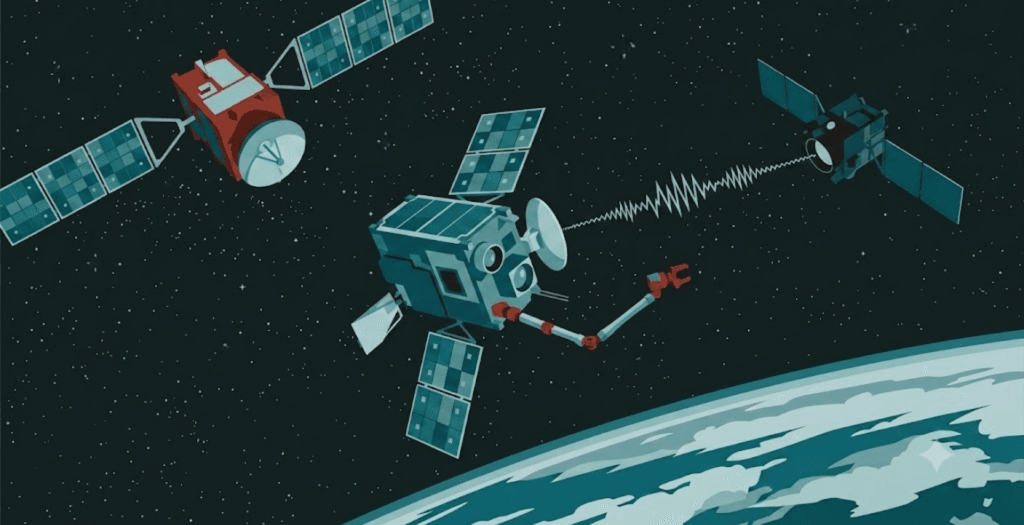
- Under an updated definition, ‘orbital warfare’ should be understood as the employment of space-based assets to control the space domain through in-orbit kinetic or non-kinetic military effects, movement and manoeuvre.
- Terms like ‘space control’ or ‘counterspace operations’ lack the precision required, particularly for doctrine and policy development in response to evolving operational conditions in orbit in an era when space has become a warfighting domain.
- Orbital warfare is already here, in the form of sub-threshold (or ‘grey zone’) space activities intended to coerce, spy, threaten, or gain positional advantage in potential combat scenarios, to constrain and shape allied operations and political responses in a crisis.
- Orbital warfare should be adopted into the British military lexicon and embraced explicitly as a core mission for national spacepower, in the same way that the Royal Navy uses ‘surface warfare’.
Introduction
The rapid development of the global space domain has opened new possibilities and imperatives for using space power for strategic advantage and to advance national interests. Even if they do not always use the same term, leading space powers are, in practice, expanding and accelerating their preparations for orbital warfare at every level through new concepts and doctrine, capability build-up, and operational testing and exercising.
This Primer builds upon a workshop hosted by the Council on Geostrategy on 2nd July 2026 to flesh out the concept of orbital warfare.[1] It makes the case for recognising in-space activities and effects delivered by space-based platforms as a distinct and specific discipline within counterspace operations. It is not about the conduct of ‘space warfare’ in general, but about orbital warfare in particular.
Why orbital warfare?
The specific term ‘orbital warfare’ is a relatively recent United States Space Force (USSF) doctrinal construct, unique to America. It does not exist in the official lexicon of other allied countries.[2] Concepts like ‘space warfare’, ‘space control’, or ‘counterspace’, for example, are much more established and have greater currency in government and military circles, among experts, and even with the wider public. However, they also arguably lack the precision that is now increasingly required for serious strategic thinking, policy decision-making, and doctrinal development in an era when space has become, in practical terms, a warfighting domain. The latter point still lacks full recognition by the North Atlantic Treaty Organisation (NATO) and among other partners, most of whom – apart from the United States (US) and, tentatively, the United Kingdom (UK) and Japan – continue to define space formally in merely operational terms.[3]
Hostile and even coercive military activities in orbit – intended to condition and constrain allied operations, and shape political perception and responses of such events in a potential future crisis – continue to expand and increase in sophistication.[4] This was demonstrated recently in the case of a formation of Russian spacecraft closing in on a Finnish ICEYE radar satellite which provides intelligence to the Armed Forces of Ukraine.[5] Other incidents involving harassment of and spying on allied spacecraft, sometimes prompting evasive manoeuvres, have become routine in a way that is similar to what is seen in the air or sea domains in the Euro-Atlantic or Indo-Pacific theatres. There is now a consensus among experts and senior space leaders that such activities amount to a form of sub-threshold space warfare.
Aggressive behaviours and worsening operational conditions are only part of the challenge. Another is the growing threat from adversaries’ orbital coercive power, as the People’s Republic of China (PRC) and, to a lesser extent, Russia continue to deploy new military space capabilities. The expectation that the next major war will involve combat across the different segments of the space domain is hardly questioned any more.
In this context, the time has come to bring more specificity to British and allied thinking about space warfighting, to enable a better view of the requirements and planning decisions involved at subsidiary levels of these types of operations. Understanding and adopting orbital warfare as a specific and inevitable aspect of ‘space war’ can also help inject more urgency in British and allied debates on military space development.
Orbital warfare in a nutshell
While USSF doctrine has the merit of having established orbital warfare as a formal concept for the first time, the actual definition that it offers carries some ambiguities. As such, it is helpful only in part, as a starting point:
Orbital warfare: Combat operations conducted through fires, movement, and manoeuvre to control the space domain.[6]
The USSF positions orbital warfare as a mission area – alongside space domain Electromagnetic Warfare (EW) and Cyberspace Warfare (CW) – within counterspace operations.[7] There are also explicit references to a number of counterspace activities, including orbital strike (specifically targeting in-space platforms), space link interdiction (via EW or CW), or terrestrial strike (targeting ground segment elements of adversary space systems).[8]
In turn, these tasks can also – or even exclusively – involve other parts of the Joint Force. For example, orbital strike could be conducted through ground-based fires, or terrestrial strike through space-based fires, whether EW or perhaps even kinetic in future. However, as a result of this potential Joint Force tasking, none of these activities are doctrinally assigned to any particular counterspace mission area, thus leaving the exact scope and nature of orbital warfare rather unclear.
For instance, the definition given above does not specify whether orbital warfare operations are conducted exclusively within the orbital segment by space-based assets, or also from orbit to ground and vice-versa. It is also less than clear, for example, whether in-space EW fires from a bodyguard or escort satellite against an approaching hostile spacecraft qualify as orbital warfare or EW.
A clearer and more useful definition of orbital warfare – particularly in a non-US, allied context – would build on that provided in USSF’s doctrine, but tighten and specify its remit to maintain coherence. The following alternative formulation is thus proposed:
Orbital warfare: The employment of space-based assets to control the space domain through in-orbit kinetic or non-kinetic military effects, movement, and manoeuvre.
This proposed definition offers a number of advantages from a terminological and conceptual standpoint:
- It confines orbital warfare to the space segment – only spacecraft-on-spacecraft engagements (including space dogfighting)[9] – to the explicit exclusion of terrestrial strike from orbit and orbital strike from Earth;[10]
- It clarifies the full-spectrum (‘kinetic or non-kinetic’) nature of effects available for employment to avoid potential overlaps with the standalone EW mission area,[11] and thus enhances conceptual warfighting coherence;
- It retains military purpose while removing the ‘combat’ conditionality;
- It retains the emphasis on movement and manoeuvre, such as Rendezvous and Proximity Operations (RPO); and
- It is agnostic as to the type of actors involved (government/military or private) and the level of conflict (whether open warfare or sub-threshold activities).
Seen from this perspective, orbital warfare appears more clearly – and more usefully – as a distinct subcategory of counterspace, which itself is a subset of joint functions and not exclusively a ‘space’ task. In this sense, the most important delineation that this alternative definition achieves is that between the purely orbital (i.e., in-orbit) operations and terrestrial-linked operations (i.e., either space-to-ground or ground-to-space effects). Space warfare in general can be conducted through a variety of means,[12] but the main virtue of beginning to recognise orbital warfare as a specific, distinct discipline is that it accelerates specialisation – particularly in orbital manoeuvre, which is set to become a major aspect of dynamic space operations.[13]
The rise of orbital warfare
Orbital warfare is already here – currently conducted below the threshold of open space warfare – but it will inevitably escalate in prominence, reach, and importance in the coming years.[14] This evolution is being driven by several accelerating strategic factors.
Firstly, orbital systems are becoming vital targets because of their deepening role in enabling contemporary and future military operations. As the Defence Investment Plan shows, for example, space is at the heart of the Ministry of Defence’s thesis for autonomous and uncrewed systems on land, at sea, and in the air, and is recognised as ‘the central nervous system of modern, high-intensity warfare’.[15] In the US, Department of War officials recognised publicly that in the case of the military operations in Venezuela and Iran, space forces delivered ‘decisive’[16] effects that permitted the rest of the operations to progress.[17]
Russia’s well-known attack on ViaSat at the start of its full-scale invasion of Ukraine was conducted through cyber means against the ground segment to disrupt Geostationary Orbit (GEO)-based satellite communications.[18] At the time, this represented a relatively rare, high-impact target. However, the orbital build-up by all key players, with a plethora of resilient, multiuse, multiorbit large and mega-constellations in planning or deployment, is moving the weight – the targeting focus – of adversary counterspace operations to the more vulnerable space segment.[19] Both the Kremlin and Beijing view Starlink, for example, as a key military threat, and are developing in-space capabilities to counter it.[20] The PRC, in particular, is working on operational solutions for conducting mass interceptions of Starlink satellites in orbit (see: Box 1).
| Box 1: Hunting Starlink |
| In an illustration of the future of orbital warfare, the PRC simulated in 2025 how it could effectively approach – ‘hunt’ – nearly 1,400 Starlink satellites within 12 hours using just 99 Chinese satellites. This kind of exercise involves extremely complex orbital calculations due to the disparity in numbers between targets and interceptors, as well as the need to account for sun-facing charging time for each interceptor, manoeuvre time, and a minimum ten-second engagement time within the effective detection range. The simulation, undertaken by an elite team of Chinese scientists, reportedly used a new Artificial Intelligence (AI) algorithm, and can be replicated for a different scenario in less than two minutes.[21] |
The second key factor supporting the rise of orbital warfare is the growing importance and economic value of non-military space infrastructure. The fact that modern societies and economies are already deeply dependent on space-based data and services, such as Positioning, Navigation, and Timing (PNT), is well documented. This dependency will only increase with the expansion of space activities and the global space sector. The next development stage of the orbital economy – including space data centres and space-based solar power – may even give space infrastructure a core role in sustaining national economic-technological competitiveness in the long term.[22] In any scenario, a more valuable orbital network will inevitably become a more attractive target for adversaries seeking to disrupt it through orbital warfare means in order to gain strategic advantage.
Thirdly, and connected to the first two strategic drivers, the operational conditions in the space domain increasingly favour sub-threshold orbital warfare with the purpose of coercing, spying, threatening, or gaining positional advantage in potential combat scenarios. Additionally – and crucially – these types of activities also pursue political effects, seeking to shape allied behaviours and gain psychological and political advantage in a crisis situation. This approach follows the same strategic intent that applies in better-known sub-threshold warfare activities in terrestrial operational environments, for example in the Baltic area. In space, these conditions are emerging for a number of reasons:
- Rapidly increasing congestion, with over 16,000 active satellites in orbit[23] – compared to just over 3,000 five years ago,[24] and around 100,000 expected by 2030[25] – which drastically complicates tracking and Space Domain Awareness (SDA) tasks, while offering nefarious actors more opportunities to conceal their activities.
- The proliferation of non-state actors – principally private space companies – operating advanced dual-use orbital capabilities, particularly on the side of Britain and its allies, which incentivises adversary sub-threshold activities against them.
- The increasing manoeuvrability of spacecraft with the development of new propulsion, autonomy, power, and in-space refuelling technologies, which is opening up new operational possibilities in orbit and making it harder to spot and track adversary activities.
- The legal and political ambiguity characterising many space activity scenarios and behaviours, including possible response patterns from different states with different cultures, which again incentivises sub-threshold operations.[26]
No nation with significant space interests to protect can afford not to develop robust capabilities to compete successfully – particularly through assets capable of agile, sustained manoeuvre – in sub-threshold space operations against present and future adversaries. The failure to recognise and debate this threat more clearly – despite parallel discussions on ‘hybrid’, ‘grey zone’, and ‘sub-threshold’ warfare in other domains – stems from a lack of the forward-leaning terminology and conceptual framework that orbital warfare offers.
Adopting orbital warfare
The need to be prepared to fight in the space domain has begun to be recognised more deeply and widely among allied powers beyond the US. However, military space policy development and programmatic decisions necessary to meet the threat continue to be held back by a general reluctance to move beyond the rather cautious defensive-geared vocabulary that has traditionally characterised space power debates – insofar as these have existed at all.
For allied defence establishments, where terminology and doctrine for space warfighting do not reach beyond overarching concepts like space control and counterspace, policy will continue to make only incremental progress and prioritise the easier or cheaper capability options that fit under those headlines. Often, these are either ground-based – such as EW, cyber, or SDA systems – or provided by other parts of the Joint Force, such as fires conducted from other domains against ground segment space targets, which doctrinally qualify as counterspace operations. In short, better terminology not only unlocks new debates and doctrinal concepts, but ultimately leads to stronger policy.
Adopting orbital warfare into the UK’s military lexicon – as well as into that of Britain’s allies – would enable a clearer appreciation of the dangerous reality unfolding in orbit. A clear response is needed, with increasing urgency. As indicated, the global build-up of capabilities specifically designed and deployed for in-orbit combat is irreversible, and raises distinct strategic and operational problems. The most pressing ones revolve particularly around having the capability and ability to conduct orbital combat manoeuvres.
Solving this problem set and dealing with challenges like sub-threshold space warfare requires a dedicated effort and clear doctrinal guidance that goes beyond merely testing RPO capabilities as generically placed under space control. This can only be coherently achieved by embracing orbital warfare explicitly as a core mission for national spacepower, in the same way that the Royal Navy uses surface warfare, and acting upon that decision to field the operational assets needed to fight and win in orbit.
One important consequence of switching to an orbital warfare mindset would likely be to make room for a more offensive space posture. As previous Council on Geostrategy research has shown, such a posture is necessary in order to remain competitive in this strategic arena, and retain the ability to deter and respond to space domain aggression in the future.[27] Again, however, the policy argument must be paired with a corresponding move in the same direction at the level of doctrine.
Conclusion
Orbital warfare is not theoretical. It is a present condition of the operating environment already taking shape in orbit, conducted for now below the threshold of open conflict, but escalating in reach and consequence with every passing year. The convergence of vital military dependence on space systems, a rapidly expanding space economy, and operational conditions that reward concealment and manoeuvre makes this trajectory irreversible.
The UK and its allies cannot meet a threat they have not named. Continuing to fold in-orbit combat into overarching concepts like space control and counterspace will keep policy tethered to the easier, ground-based and Joint Force options that are closer to policymakers’ comfort zones. Meanwhile, the decisive arena for securing spacepower advantage is orbit itself, and the key means to achieve this is hard orbital capability.
Orbital warfare should be adopted into the British and allied military lexicon, under the tightened definition proposed here. Far from a semantic indulgence, this is a strategic and policy enabler. It can sharpen doctrine, discipline capability choices, and make room for the more offensive, manoeuvre-centric posture that credible deterrence in orbit now demands.
As the long naval experience with surface warfare terminology shows, clarity in language is the first act of preparation. The nations that name the fight will be the ones equipped to win it.
Acknowledgements
ISBN: 978-1-917893-28-2
Disclaimer: This publication should not be considered in any way to constitute advice. It is for knowledge and educational purposes only. The views expressed in this publication are those of the author and do not necessarily reflect the views of the Council on Geostrategy or the views of its Advisory Board.
Notes
[1] The author would like to thank those present at the workshop for participating and sharing their perspectives. The analysis and conclusions presented here are the author’s own.
[2] Nor, according to open source information, in that of adversaries such as Russia or the People’s Republic of China (PRC).
[3] The Strategic Defence Review, published by the Ministry of Defence in June 2025, calls space ‘a domain that is central to warfighting’. See: ‘The Strategic Defence Review 2025 – Making Britain Safer: secure at home, strong abroad’, Ministry of Defence, 02/06/2025, https://www.gov.uk/ (checked: 14/07/2026). Japan’s ‘Space Domain Defence Guidelines’ state that space is developing into a warfighting domain. See: ‘Outline of Space Domain Defence Guidelines’, Ministry of Defence (Japan), 28/07/2025, https://www.mod.go.jp/ (checked: 14/07/2026). It is important to note that, even if it has not yet formally adopted a warfighting framework, France is de facto very forward-leaning, with robust doctrine and space power thinking including in official statements, alongside the development of offensive orbital capabilities.
[4] With a military purpose, i.e., seeking a military effect.
[5] See: John Sheldon, ‘Russia, ICEYE, and Orbital Competition: Emerging Realities for Europe’, AstroAnalytica, 28/05/2026, https://www.astroanalytica.com/ (checked: 14/07/2026).
[6] ‘Space Force Doctrine Document 1’, US Space Force, 03/04/2025, https://www.starcom.spaceforce.mil/ (checked: 14/07/2026).
[7] ‘Counterspace operations’ is a wider term that covers all offensive and defensive activities which contribute to achieving space control, defined in British space power doctrine as ‘the use of defensive and offensive capabilities to assure access and freedom of action in space’. See: ‘UK Space Power’, Ministry of Defence, 01/09/2022, https://www.gov.uk/ (checked: 14/07/2026). In turn, in military-operational terms, ‘space control’ carries a meaning similar to ‘sea control’ in the maritime domain.
[8] Other named types of activities, such as escort, counterattack, or suppression of adversary counterspace targeting, involve functionally similar types of operations. See: ‘Space Warfighting – A Framework for Planners’, United States Space Force, 02/03/2025, https://www.spaceforce.mil/ (checked: 14/07/2026).
[9] In 2025, Gen. Michael Guetlein, US Vice Chief of Space Operations, referred to a complex set of Chinese spacecraft manoeuvres observed in orbit as ‘dogfighting’ practice. See: ‘China Practising “Dogfighting in Space”, US Space Force Says’, Air and Space Forces Magazine, 18/03/2025, https://www.airandspaceforces.com/ (checked: 14/07/2026).
[10] This is also consistent with the mission set of Mission Delta 9, the USSF’s specialist orbital warfare unit, which includes in-space Intelligence, Surveillance, and Reconnaissance (ISR); in-space ‘full spectrum orbital warfare operations’; and X-37B spaceplane operations. See: ‘Mission Delta 9 – Orbital Warfare’, United States Space Force, No date, https://www.ussf-cfc.spaceforce.mil/ (checked: 14/07/2026).
[11] This mission area involves largely ground-based EW fires, as evidenced by the responsibilities and systems operated by Mission Delta 3, the USSF’s specialist Space EW unit. See: ‘Mission Delta 3 – Space Electromagnetic Warfare’, United States Space Force, No date, https://www.ussf-cfc.spaceforce.mil/ (checked: 14/07/2026).
[12] British space power doctrine even stretches the remit of space control to the area of ‘diplomatic, regulatory, and legal channels’ to shape the strategic environment. See: ‘UK Space Power’, Ministry of Defence, 01/09/2022, https://www.gov.uk/ (checked: 14/07/2026).
[13] See: ‘Dynamic Space Operations’, Air and Space Forces Magazine, 06/02/2026, https://www.airandspaceforces.com/ (checked: 14/07/2026).
[14] See: ‘Charles Galbreath, Jennifer Reeves, and Kyle Pumroy, ‘Space Superiority Through the Spectrum of Conflict: Findings and Recommendations from the Conflict in Space Workshop’, Mitchell Institute for Aerospace Studies, 23/06/2026, https://www.mitchellaerospacepower.org/ (checked: 14/07/2026).
[15] ‘The Defence Investment Plan’, Ministry of Defence, 30/06/2026, https://www.gov.uk/ (checked: 14/07/2026).
[16] Theresa Hitchens, ‘Epic Fury highlighted Space Force needs for distributed ops, EW sites’, Breaking Defence, 28/05/2026, https://breakingdefense.com/ (checked: 14/07/2026).
[17] Aaron Mehta, ‘150 aircraft, cyber effects and “overwhelming force”: How the Venezuela operation unfolded’, Breaking Defence, 03/01/2026, https://breakingdefense.com/ (checked: 14/07/2026). Details remain classified, but official statements indicate the use of space effects including cyber, electromagnetic spectrum operations, and targeting/geolocation while preventing interference, aside from missile warning and critical ISR; Positioning, Navigation, and Timing (PNT); and Satellite Communications (Satcom) support. Also see: Mikayla Easley, ‘Exclusive: Space Force’s role in Iran, Venezuela raids fuelling push for more resources’, DefenceScoop, 22/02/2026, https://defensescoop.com/ (checked: 14/07/2026).
[18] A Russian cyberattack (using AcidRain wiper malware) on Viasat’s KA-SAT satellite network occurred on 24th February 2022, disabling thousands of modems in Ukraine and parts of Europe at the outset of the full-scale invasion. See: ‘KA-SAT Network cyber attack overview’, ViaSat, Inc., 30/03/2022, https://www.viasat.com/ (checked: 14/07/2026).
[19] Through the proliferation of on-board computing and dynamic signal routing, for example.
[20] See: John Leicester, ‘Starlink in the crosshairs: How Russia could attack Elon Musk’s conquering of space’, AP News, 22/12/2025, https://apnews.com/ (checked: 14/07/2026); and Erika Kinetz and Elise Chen, ‘Chinese researchers suggest lasers and sabotage to counter Musk’s Starlink satellites’, AP News, 31/07/2025, https://www.ap.org/ (checked: 14/07/2026).
[21] See: Stephen Chen, ‘Chinese scientists simulate “hunting” Starlink satellites in orbit’, South China Morning Post, 12/01/2025, https://www.scmp.com/ (checked: 14/07/2026).
[22] A recent example is Starlink’s filing for 100,000 new third-generation satellites to deliver the ‘multi-gigabit’ connectivity required to support high-capacity uplinks to future orbital data centres. See: Rachel Jewett, ‘SpaceX Files for 100,000-Satellite Gen-3 Constellation’, Via Satellite, 09/07/2026, https://www.satellitetoday.com/ (checked: 14/07/2026).
[23] As of 8th July 2026. See: ‘Satellite statistics: Satellite and Debris Population’, Jonathan’s Space Pages, 08/07/2026, https://planet4589.org/ (checked: 14/07/2026).
[24] Nibedita Mohanta, ‘How many satellites are orbiting the Earth in 2021?’, Geospatial World, 28/05/2021, https://geospatialworld.net/ (checked: 14/07/2026).
[25] See: ‘The King visits site of new UK Space Agency project to safeguard satellites in an increasingly crowded space’, UK Space Agency, 05/05/2026, https://space.blog.gov.uk/ (checked: 14/07/2026).
[26] See: ‘Charles Galbreath, Jennifer Reeves, and Kyle Pumroy, ‘Space Superiority Through the Spectrum of Conflict: Findings and Recommendations from the Conflict in Space Workshop’, Mitchell Institute for Aerospace Studies, 23/06/2026, https://www.mitchellaerospacepower.org/ (checked: 14/07/2026).
[27] Gabriel Elefteriu, ‘Why should Britain invest in military spacepower?’, Council on Geostrategy, 17/10/2024, https://www.geostrategy.org.uk/ (checked: 14/07/2026).