
Executive summary
- Evolving threats have outpaced naval escort capacity: Proliferating missile and drone capabilities and decades of fleet reductions have left North Atlantic Treaty Organisation (NATO) navies without enough high-end warships to protect vital commercial shipping reliably.
- Pragmatic solutions to bolster the survivability of commercial ships are needed: The United Kingdom (UK) and NATO should explore lower-cost survivability measures – including trialling bolt-on decoy and point defence systems, and hardening vulnerable points – while proactively resolving legal and insurance hurdles.
- Civil-military integration should be deepened: NATO governments should support training for civilian crews to operate under Electronic Warfare (EW) and kinetic attack. NATO navies should also replace ad hoc peacetime coordination with regular, realistic, large-scale reinforcement exercises involving trusted shipping partners.
Introduction
At 19:42 on 25th May 1982, two Exocet anti-ship missiles slammed into the side of SS Atlantic Conveyor.1 The vessel was a commercial Ship Taken Up From Trade (STUFT) by Her Majesty’s (HM) Government to help support the mammoth logistics effort that allowed the United Kingdom (UK) to retake the Falkland Islands. Atlantic Conveyor’s sinking did not terminate the campaign, but the loss of the stores she was carrying – particularly the helicopters on board – was sorely felt, and tragically, the incident led to the loss of life of 12 sailors on board.
Cold War planning for a ‘third battle of the Atlantic’ and the experiences of both the Falklands conflict and the so-called ‘Tanker War’ in the 1980s were a reminder of how vital maritime supply lines are. After three decades of post-Cold War peace, these factors were largely taken for granted. The recent surge in shipping attacks is a harsh reminder that maritime security requires active protection. New military technologies, alongside the intensification of geopolitical competition, mean that the level of protection afforded to commercial ships needs to be reconsidered. The experience of Atlantic Conveyor led directly to the Royal Navy introducing Close-in-Weapons Systems (CIWS) for many of its ships, including Royal Fleet Auxiliary (RFA) vessels.
This Primer will explore the evolving threat picture and how better protection can come through deeper civil-military integration, exploration of refits to provide defences and decoys, and enhanced training for civilian crews to operate in such environments.
Evolving threats
Peer adversaries such as Russia have been investing heavily in their ability to interdict logistics, as seen in the Kremlin’s concerted effort to target Ukraine’s critical infrastructure, supply lines, and shipping in the Black Sea. The threat to shipping has increased at both the higher and lower ends with a new generation of sophisticated missiles entering service, as well as the increasing use of simpler drones. The proliferation of these weapons systems has also meant that both state and non-state actors that traditionally possessed limited means to track and strike shipping far out at sea – such as the Houthis in Yemen – are now able to do so more effectively. The balance between sea control and sea denial has shifted towards the latter.
At the same time, North Atlantic Treaty Organisation (NATO) naval forces have reduced in size over the past decades. In some cases, European NATO navies maintain peer-relevant naval warships capable of operating in the most challenging threat environments, but a concerningly high proportion of the alliance’s navies have not been built for these duties: they possess either old warships waiting to be replaced or newer ones primarily designed for low-intensity operations such as anti-piracy patrols. Not a single European NATO navy possesses high-end Ballistic Missile Defence (BMD)-capable warships. Dutch and Spanish frigates can provide tracking and cueing, and a small number of British, French, and Italian escorts equipped with Aster 30 missiles possess only nascent terminal interception capabilities.
Although investment is coming, and NATO navies are growing and modernising at a scale not seen for nearly half a century, the ramifications of not having sufficient numbers of capable escorts available have already been felt. When the Houthis – a rebel group in one of the world’s poorest nations – began attacking Red Sea shipping in 2023, European navies could barely muster a handful of ships with the capabilities required to safeguard maritime traffic.
In an ideal world, there would be ample investment made by free and open countries in the high-end naval escort capabilities needed to protect the shipping upon which their economies and military planners rely. Increased investment, however, will take time to translate into warships at sea and, given the growth in shipping volumes, it will always be a challenge to provide adequate escorts in a crisis.
How to increase survivability
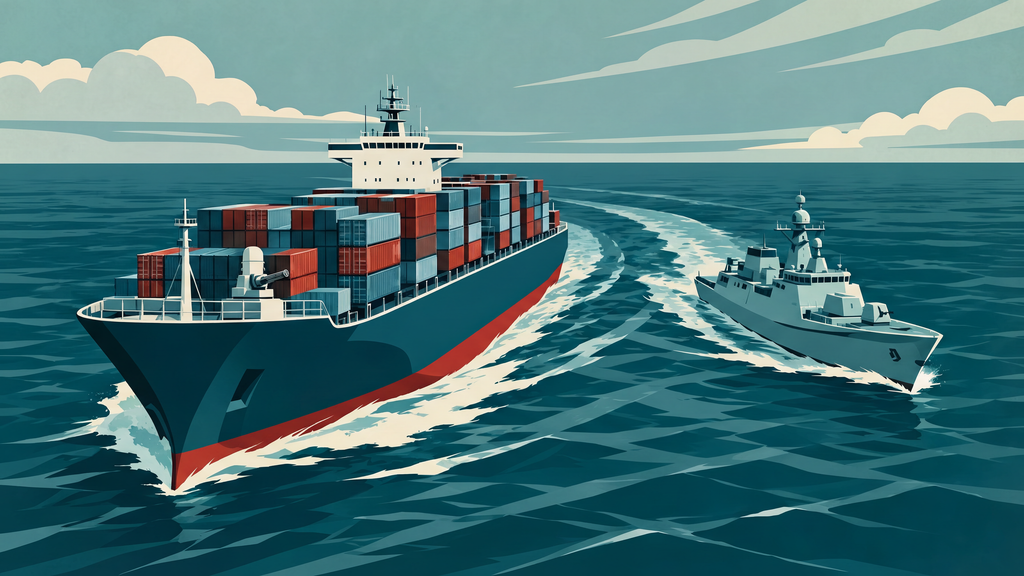
The most obvious answer to bolstering survivability is to equip civilian vessels with their own suite of weapons, sensors, and combat management systems, all made easier with the rise of ‘containerised’ versions of these capabilities. The People’s Republic of China (PRC) has already invested in these modern ‘Q-ships’ – the name given to heavily armed merchant ships with concealed weaponry. In late December 2025 and early January 2026, images were released of Zhong Da 79, a Chinese container ship with several containerised radars, CIWS, mounted countermeasures dispensers, and 60 containerised Vertical Launch Systems (VLS) for missiles in Shanghai.2 However, replicating such a Q-ship approach would be overkill for NATO navies.
For a start, the cost of turning commercial vessels into de facto major surface combatants would have opportunity costs. Procuring 60 missiles alone to fill the VLS would cost tens – if not hundreds – of millions of pounds, and, if kitted out in this manner, would reduce the amount of cargo that each ship could carry. Alongside this are legal and insurance barriers that warrant caution when considering arming commercial shipping. This begs the question: are there any relatively low-cost and legally viable defensive options?
While a few bolted-on countermeasures and point defences will not guarantee a ship’s survival, they will significantly raise its chances, and should thus be explored. One of the reasons Atlantic Conveyor was hit in 1982 was the lack of onboard defences, partly due to concerns over the legality of placing weapons on the ship.3 These legal concerns remain today. Placing weapons or military-grade decoys on board a commercial vessel has serious repercussions, including making it a legitimate military target – although for ships carrying military cargo, they already could be considered as such according to the ‘San Remo Manual’ (on International Law Applicable to Armed Conflicts at Sea).4
This creates a grey area, but in a peer conflict, an adversary is likely to target commercial shipping – most likely including those not involved in military logistics, regardless of the legal ramifications. Legal workarounds would need to be found, including arrangements related to rules of engagement and close collaboration with HM Treasury and shipping insurers over insurance implications. This was the case in the Second World War: in the first six months, some 1,900 commercial ships had been equipped with defensive weapons, and by the end of 1940, the number had risen to 3,400.5 However, given the shipping industry has since evolved to become far more multinational, strategic arrangements with trusted partners will be necessary.
Britain currently maintains up to 41 Phalanx CIWS – a radar-guided 20 millimetre six-barrelled gun with a range of up to 1.5 kilometres.6 These weapons are rotated between active ships and ships in refit meaning there are enough to cover the Royal Navy’s existing needs. However, there is no surplus to provide bolt-on options for STUFT vessels deployed into contested waters. Similarly, the Royal Navy has also ordered a new trainable decoy launcher – Project ANCILIA – for its surface fleet to replace the current Sea Gnat system: a total of 38 launchers to equip 19 ships were ordered for £135 million.7 Soft-kill measures, such as Electronic Warfare (EW) suites or even simple anti-drone netting, as well as novel drone interceptor systems, such as the Ukrainian ‘Sting’ drone, are also options.
Although it will require some additional investment for storage and maintenance, the UK should establish and maintain old point defences and decoys as they are replaced. Old decoy launchers should be held in a ready reserve along with Phalanx CIWS as they are replaced. Additional orders for bolt-on point defences and decoy systems to ensure adequate numbers in a crisis should also be considered.
Such an approach would ensure that at least some sealift assets could be provided with point defences in an emergency to enhance a ship’s chances of survival against any threats that make it through area defences. One of the ironies is that by deploying their own decoys, modern warships may inadvertently lure threats onto the very ships they are trying to protect – as happened in the case of Atlantic Conveyor.
The addition of bolt-on defences and decoys should be put into practice with defence teams invited to assess and conduct trials to establish feasibility and test integration challenges. These will include factors such as power requirements, interface adaptations, deck strength tests, and line-of-sight tests for optimal placement. Beyond point defences, other means of bolstering survivability through refits would include reinforcing the wheelhouse – commercial vessels tend to have large windows – and engine room to reduce the chance that a hit cripples the ship or kills crew.8 Navies should work closely with the shipping industry to factor these elements into future designs to make it easier to adapt them for hardened defences. Such a programme of trials could even be called ‘Project Conveyor’, to reference the vessel it draws inspiration from.
These steps will need to be taken in close collaboration with trusted shipping partners to ensure that legal concerns and the appetite of ship owners are duly taken into consideration. Even if there is limited appetite for onboard defences during ‘normal’ operating conditions, trials can and should be conducted. The lessons from these trials will ensure that adaptations can be deployed swiftly and effectively during a peer conflict.
Personnel requirements
The addition of weapons systems would bring further trained personnel requirements to operate these systems and for rules of engagement to be considered. However, the need for personnel to be ready to operate in a contested environment extends beyond just those required to operate potential weapons systems. In the second half of the 2020s and beyond, crews must be able to operate in an environment where they will be subject to heavy EW as well as the prospect of sustained and complex kinetic attack.
Crews need to be able to operate without reliance on many of the satellite and electronic systems they depend on to navigate safely. They also need to be trained to minimise electronic signature, potentially for prolonged periods of time. In the modern operating environment, simply using a personal mobile phone could give away a ship’s position. The need is not just technical; crews must be psychologically prepared to deal with coming under attack, taking damage, and making the correct calls during times of high stress.
Civilian seafarers are too used to relying on systems, practices, and amenities that are at risk in contested areas. Outlined below is just one example from each of these categories, but in reality the list is far more extensive:
- Global Navigation Satellite System (GNSS): GNSS is an umbrella term for any of the world’s satellite systems that provide positioning, navigation, and timing services. Despite increasing cases of GNSS spoofing, a recent report by the Royal Institute of Navigation found that ‘the maritime industry has a widespread and deeply integrated reliance on GNSS that needs to be carefully addressed and managed’.9 Of the shipping sector surveyed for that report, 18% of respondents stated that they have not received training to avoid, detect, or manage GNSS interference, and 46% reported that their training was only informal or based on experience.10 Royal Navy personnel are trained for EW environments, including navigation without access to GNSS. Shipping operators whom the Ministry of Defence expects to support sealift missions should be provided with training to prepare them along similar lines.
- Ship routing practices: Civilian shipping, in particular large commercial vessels, is used to following pre-determined routes at slow speed.11 This is understandable for normal conditions; such regulation of maritime traffic helps avoid accidents. However, established practices in contested environments can get ships sunk. Civil crews should be trained and drilled to navigate in a more unpredictable manner if conditions require it.
- Personal mobile phones: Use of mobile phones can be tracked to provide targeting information. A strict emissions discipline needs to include personal devices. Even military personnel, who have this discipline instilled in them, sometimes prioritise use of the amenities they are used to – as demonstrated when a French sailor revealed the location of the aircraft carrier Charles de Gaulle in March 2026 by posting on the sports app Strava.12
Throughout the 20th century, Britain could call upon a significant reserve of experienced seafarers, many of whom spent portions of their careers serving in the Royal Navy. This is no longer the case. The naval component of the strategic reserve today – those who previously served and could be called back into service – numbers only around 12,000. Beyond this, it is unclear how many would have the right qualifications, experience, and availability to serve onboard STUFT.
HM Government should take a far more proactive approach to ensuring the necessary pool of trusted and trained personnel is available. Strategic partnerships with trusted shipping companies could include agreements to provide a level of joint training to ensure that the crews of ships expected to sail into dangerous waters are better prepared.
Civil-military integration
Evolving personnel requirements speak to a wider challenge: the need for much deeper civil-military integration. Shipping needs to become far more familiar operating alongside navies and, for their part, navies need to integrate shipping into their exercises far more often, and into their operating picture more deeply. There is already a foundation of civil-military coordination to build on, with the core of these existing structures including:13
- The Shipping Defence Advisory Council (SDAC): The primary body through which HM Government departments engage with the shipping sector on defence issues.
- The Joint Maritime Security Centre (JMSC): An internal government body that provides a cross-government forum for sharing maritime security information.
- Maritime Trade Operations (MTO): A Royal Navy organisation that provides the operational liaison and interaction between military commanders and the merchant shipping community.
- The NATO Shipping Centre (NSC): Permanently manned by NATO, this entity is the primary point of contact for the exchange of merchant shipping information between the alliance’s military authorities and the international shipping community.
While these frameworks provide a solid baseline, they were designed for a much more benign operating environment, where the most serious threat was the risk of piracy. Recent years have seen a flurry of activity to build a deeper relationship as a result of attacks on shipping in the Red Sea and the Persian Gulf – such as Operations PROSPERITY GUARDIAN and ASPIDES – but many of these arrangements have been ad hoc and have had a mixed record on keeping shipping safe and flowing.
The most important step is to involve shipping in defence planning at the earliest possible stage, and to provide a greater level of transparency. Obviously, this will involve sharing of sensitive information and plans with an industry that has become increasingly globalised and multinational. To get around this problem, the establishment of strategic partnerships with a suite of trusted and capable providers from NATO members should be sought. From here, these partners should participate in regular and realistic military exercises to build the experience and personal relationships that could mean the difference between life and death in a contested environment.
Current coordination is ad hoc, and written guidance is a poor substitute for regular exercising. NATO publishes an 80-page document – which is updated on an ad hoc basis – to provide guidance for shipping owners, operators, masters, and officers, for naval cooperation and operating in contested environments.14 The advice, although sensible, is limited. For example, advice on the submarine threat begins with ‘Avoid, whenever possible, areas where submarines are likely to operate.’ The document mostly provides basic instructions such as simple emissions reduction measures and crew safety instructions.
During the Cold War, NATO involved the shipping industry closely in its exercise programme. By the 1980s, this had been honed into a well-oiled machine. The United States (US) conducted near-annual REFORGER exercises (the return of forces to Germany) both to practise and demonstrate the goal of reinforcing Europe with ten divisions in ten days.15 In the words of Ron Watts, a Lt. Gen. in the US Army who participated in these exercises, one of the biggest benefits was forcing military leaders to ‘pay as much attention to logistics as they did tactical operations’.16 For its part, the UK conducted similar exercises, the culmination of which was Exercise LIONHEART. This exercise involved over 130,000 personnel, the chartering of numerous civil logistics providers (including ten foreign-flagged vessels), and required 290 commercial flights and 150 English Channel/North Sea crossings from these civilian assets.17
It was not until 2018 that large-scale reinforcement exercises returned, and even then they have been less ambitious than those in the Cold War. Exercise TRIDENT JUNCTURE in 2018 involved over 50,000 personnel; it was the largest exercise since the Cold War and required 2,100 containers to be offloaded from 250 cargo ships.18 However, its preparations started months in advance, which does not reflect the time available to deploy in an actual escalation scenario. Furthermore, in the eyes of some, it ‘did not go as smoothly as would be needed to respond successfully to a capable and modern belligerent’.19
Subsequent exercises, namely STEADFAST DEFENDER in 2021 and 2024, were an improvement. STEADFAST DEFENDER 2024 involved over 90,000 personnel practising reinforcing across NATO’s eastern front. Subsequent national-level exercises have also seen greater involvement of civil actors. For example, the French included their merchant fleet in their POLARIS 25 exercise, and the British Army recently chartered ferries for the first time in 20 years.20
However, a major difference between Cold War NATO and the contemporary alliance is the lack of large-scale forward-deployed forces. In the 1980s, there were seven NATO corps forward-deployed in West Germany (alongside three Bundeswehr corps), whereas the forward-deployed forces from the Barents Sea to the Black Sea today barely amount to one division’s worth. Large-scale reinforcement and resupply will be the make-or-break factor for success in an Article 5 contingency.
Despite the positive steps in recent years, even greater realism is needed, with closer collaboration with the shipping industry being a key element of this. NATO should institute a new phase of more regular large-scale exercises; ideally a minimum of a corps-level reinforcement exercise annually. Wherever possible, future exercises should include a contested element where ships that are ‘sunk’ by red team forces return home – with their cargo – so that commanders have to adjust their plans accordingly.
These kinds of regular exercises will build the hand-in-glove working relationships between trusted shipping partners and NATO militaries that will be required to defend logistics in the years ahead. These relationships will extend beyond Article 5 contingencies; the experience and doctrine developed on these exercises can be deployed in contested seas in conditions of ‘grey zone’ warfare.
Conclusion
With both state and non-state actors increasingly capable of striking commercial targets at sea – and increasingly willing to do so – the era of relying solely on a shrinking pool of high-end naval escorts to protect vulnerable commercial shipping has closed. NATO navies and their commercial partners should look to reinforce their escort capabilities through a more agile and pragmatic approach to vessel survivability, ranging from training for civilian seafarers to non-kinetic defensive options (such as hardened wheelhouses or drone netting) through to military point defences. Efforts to provide the legal and logistical groundwork for this should be established now, as well as what thresholds of attack warrant each level of protective measure to be applied.
Hardware adaptations, however, will only be as effective as the seafarers operating them. Improved resilience requires a reserve of civilian seafarers who have been provided training to navigate contested environments. By moving beyond ad hoc peacetime coordination and resurrecting rigorous, realistic, and larger-scale civil-military exercises, NATO and trusted shipping partners can forge the readiness necessary to secure shipping in contested waters more effectively. Many details and hurdles will undoubtedly emerge and require resolution, from costs to rules of engagement, but the sooner these efforts are begun, the sooner these challenges can be overcome.
Notes
[1] ‘Board of Inquiry Report: Loss of SS Atlantic Conveyor’, Ministry of Defence, 21/07/1982, https://webarchive.nationalarchives.gov.uk/ (checked: 25/11/2026).
[2] It is unclear what military role the PRC envisions for these platforms, if any at all. For a more detailed analysis, see: H. I. Sutton, ‘China’s Q-Ship Containerised Weapon System’, Covert Shores, 05/01/2026, https://www.hisutton.com/ (checked: 25/11/2026).
[3] ‘The Atlantic Conveyor’, Think Defence, No date, https://www.thinkdefence.co.uk/ (checked: 25/11/2026).
[4] ‘San Remo Manual on International Law Applicable to Armed Conflicts at Sea’, International Humanitarian Law Databases, 12/06/1994, https://ihl-databases.icrc.org/ (checked: 25/11/2026).
[5] ‘Defensively Equipped Merchant Ships (DEMS)’, National Museums Liverpool, No date, https://www.liverpoolmuseums.org.uk/ (checked: 25/11/2026).
[6] ‘Babcock awarded three-year Phalanx support contract extension’, Babcock, 30/10/2023, https://www.babcockinternational.com/ (checked: 25/11/2026).
[7] ‘Royal Navy to equip 19 ships with trainable decoy launchers’, Navy Lookout, 29/04/2024, https://www.navylookout.com/ (checked: 25/11/2026).
[8] From an author interview with a commercial ship designer.
[9] Ramsey Faragher and Ivana-Maria Carrioni-Burnett, ‘The Impact of GNSS Interference on Maritime Safety’, Royal Institute of Navigation, 23/01/2026, https://rin.org.uk/ (checked: 25/11/2026).
[10] Ibid.
[11] ‘Ships’ routing’, International Maritime Organisation, No date, https://www.imo.org/ (checked: 25/11/2026).
[12] Sofia Ferreira Santos, ‘Officer reportedly leaks location of French aircraft carrier with Strava run’, BBC News, 20/03/2026, https://www.bbc.co.uk/ (checked: 25/11/2026).
[13] See: ‘Safety of British merchant ships in periods of peace, tension, or conflict’, Ministry of Defence, 01/2026, https://msi.admiralty.co.uk/ (checked: 25/11/2026). This is the 2026 edition of Annual Statutory Notice 3 in the UK Hydrographical Office’s (UKHO) ‘Annual Summary of Notices to Mariners’.
[14] ‘Naval Cooperation and Guidance for Shipping (NCAGS)’, NATO Standardisation Organisation, 19/12/2024, https://shipping.nato.int/ (checked: 25/11/2026).
[15] Matthew Morton, ‘We Were There: REFORGER Exercises Designed to Counter Soviet Threat’, Association of the United States Army, 24/03/2022, https://www.ausa.org/ (checked: 25/11/2026).
[16] Gregory Fontenot, ‘Demonstrating Rapid Reinforcement of NATO: Return of Forces to Germany (REFORGER)’, in Gregory Fontenot and James O’Neal (eds.), Lariat Advance: Insights from the Cold War for the Twenty-First Century (Fort Leavenworth, Kansas: United States Army University Press, 2026).
[17] ‘The Biggest British Army Exercise…And Why It Probably Always Will Be’, Forces News, 02/05/2019, https://www.forcesnews.com/ (checked: 25/11/2026).
[18] ‘NATO Exercise TRIDENT JUNCTURE 18 Concludes’, Joint Forces Command Naples Public Affairs Office, 07/11/2018, https://jfcnaples.nato.int/ (checked: 25/11/2026).
[19] Aric Ramsey, ‘TRIDENT JUNCTURE 2018: Lessons for the North Atlantic’, Proceedings, 145:3:1,393 (2019).
[20] William Freer and Charlotte Kleberg, ‘Strategic sealift: Resilience in an era of contested logistics’, Council on Geostrategy, 02/09/2026, https://www.geostrategy.org.uk/ (checked: 25/11/2026).
Editorial policy
Our publications are guided by our editorial policy and quality assurance processes. To view these, please click here.
DISCLOSURE ON ARTIFICIAL INTELLIGENCE (AI)
This research involved the use of Artificial Intelligence (AI) as a tool to assist with copyediting, restructuring text, checking for errors and fallacies, and generating images. The author(s) and the editorial team at the Council on Geostrategy maintained full oversight throughout the drafting, copyediting, and formatting process, and assume complete responsibility for the final published content.
Disclaimer: This publication should not be considered in any way to constitute advice. It is for knowledge and educational purposes only. The views expressed in this publication are those of the author and do not necessarily reflect the views of the Council on Geostrategy or the views of its Advisory Board.
ISBN: 978-1-917893-37-4