
Executive summary
CONTEXT
- For over 30 years, the United Kingdom (UK) assumed it could shelter under the protection of the post-Cold War ‘rules-based international system’. Today, with the return of great power confrontation, war on the European continent, and the alignment of the ‘CRINK’ powers (the People’s Republic of China [PRC], Russia, Iran, and North Korea), that system is fracturing. British citizens experience this instability through rising living costs, attacks on Critical National Infrastructure (CNI), and severe supply-chain disruptions, while the UK’s primary ally – the United States (US) – increasingly focuses its strategic bandwidth on the Western Hemisphere and the Indo-Pacific.
- Despite these geopolitical shifts, British strategic thinking has remained mired in post-Cold War habits of legalism, risk aversion, and process compliance. While recent strategic reviews – culminating in the 2025 National Security Strategy (NSS) and the Strategic Defence Review (SDR) – have driven real intellectual progress, the reality of managed decline remains stark. For decades, successive governments have permitted industrial decay, underfunded national defence, and deployed international legal arguments to rationalise strategic inaction.
- The UK cannot match peer revisionists pound-for-pound across every domain of statecraft, nor can it afford to rely on slow, gridlocked multilateral institutions. However, Britain possesses a rich inheritance – from global financial dominance and intelligence networks to nuclear capability and diplomatic reach – that can generate outsized influence. Reclaiming national agency requires a pragmatic ‘Plan B’: operationalising an asymmetric doctrine across Whitehall to weaponise adversary constraints, dislocate rival decision-making, and project persistent power in a volatile world.
KEY FINDINGS
- The conceptual gap in British strategy: Although the UK’s strategic reviews since 2015 incrementally challenged post-Cold War habits – culminating in the NSS’ embrace of ‘asymmetric advantage’ – Whitehall left a conceptual vacuum by failing to provide an operational blueprint for asymmetric statecraft. This study delivers that architecture by mapping ten operational vectors across a comparative framework, juxtaposing asymmetric advantage against its symmetric counterpart to guide practitioners.
- The temporal decay of asymmetric levers: Asymmetric initiatives – such as pre-emptive intelligence declassification over Ukraine, founding AUKUS, or establishing Artificial Intelligence (AI) safety governance – are dramatic and inherently temporary. As adversaries adapt and develop countermeasures, initial disorientation can swiftly decay into strategic attrition, proving that isolated wins cannot substitute for an institutionalised, continuous drumbeat of strategic disruption.
- Institutional risk-aversion as the primary bottleneck: The most formidable barrier to British asymmetric statecraft is not adversary capability, but Whitehall’s post-Cold War Civil Service architecture. Although the Cabinet Office, Foreign, Commonwealth, and Development Office (FCDO), and Ministry of Defence (MOD) are dedicated and durable, they have become optimised for administrative predictability, risk-aversion, and process compliance – exacerbated by excessive churn at the political level. Without dedicated mechanisms for bureaucratic insurgency, the institutions of state can behave as a self-imposed brake on the UK’s power.
- Vulnerability to inverse asymmetry: Adversaries aggressively weaponise economic openness, regulatory ‘grey zones’, and supply chain dependencies – as demonstrated by the PRC’s rare earth element export chokehold – to induce decision paralysis in rival capitals. Unhedged globalisation leaves Britain uniquely exposed to economic coercion unless matched by strategic realism and collective economic defence.
- The ‘balanced force’ as a strategic trap: Reaching the target of investing 3.5% of Gross Domestic Product (GDP) in defence while pursuing a legacy full-spectrum ‘balanced force’ is a symmetric mistake. Given substantial land rearmament by continental North Atlantic Treaty Organisation (NATO) allies (principally Germany and Poland), reinvesting in heavy British armoured divisions merely duplicates allied capacity; the UK’s asymmetric edge lies in a focused force dominating the sea, air, space, and nuclear domains.
RECOMMENDATIONS
To establish an asymmetric approach to statecraft, His Majesty’s (HM) Government should:
- Centralise asymmetric governance: Establish a National Asymmetric Strategy Cell (NASC) within the Cabinet Office under the Prime Minister’s Office and National Security Council, chaired by the First Secretary of State, replacing single-department silos with agile, cross-government command structures capable of auditing, developing, and deploying exploitative levers against CRINK adversaries.
- Build a ‘venture state’: Create a specialised legal advisory body to advise civil servants on exploiting regulatory ambiguity and normative grey zones, while adopting a venture capital risk model to streamline research and development in defence and other sectors, take golden shares in critical technologies, and bypass cumbersome procurement rules.
- Reopen the Defence Investment Plan (DIP): Revisit the DIP to establish a binding, multi-year pathway to reach 3.5% of GDP on defence by 2035, providing long-term demand certainty for the British defence industrial base while delivering a constructive shock to allies and adversaries alike.
- Implement a focused force posture: Follow the SDR to its logical conclusion by directing defence capital towards the Royal Navy (including 12 SSN-AUKUS submarines and the New Hybrid Navy), Royal Air Force (RAF), a specialised Space Force, and rapid improvements in the lethality of capabilities in these domains, while expediting the transformation of the British Army to avoid duplicating German and Polish continental land rearmament.
- Regenerate sub-strategic nuclear statecraft: Procure more F-35A Lighting II Joint Combat Aircraft for NATO’s Dual-Capable Aircraft mission and pioneer UK-owned and -led nuclear-sharing arrangements with key European allies (such as Germany, Poland, Romania, and the Nordic states) to close a critical escalation gap against Russian coercion.
- Spearhead a European deep-strike coalition for Ukraine: Transform the minilateral ‘coalition of the willing’ alongside Poland, France, Germany, and Baltic and Nordic partners to finance, arm, and enable Ukraine to execute an extended deep-strike campaign against strategic targets (excluding nuclear capabilities) deep inside Russian territory to force the Kremlin to the negotiating table.
- Institutionalise lawfare and psychological statecraft: Place the PRC on the Enhanced Tier of the Foreign Influence Registration Scheme (FIRS), bar foreign enablers from government consulting, adopt a strict enforcement rule prohibiting new treaties with non-compliant states, and normalise, when appropriate, real-time intelligence declassification to dislocate adversary decision- making cycles.
- Collectivise economic defence via a modern Coordinating Committee for Multilateral Export Controls (CoCom): Lead Group of Seven (G7) and European Union (EU) partners in establishing a coordinated economic defence architecture to harmonise export controls, counter critical mineral monopolies, and shield open economies from unilateral CRINK coercion.
STRATEGIC OUTLOOK
- History demonstrates that Britain generates outsized leverage not when it seeks to preserve an orderly equilibrium, but when it exhibits calculated, disruptive audacity. For the UK, accepting a strategic retreat is an institutional choice, not an inevitability of global affairs – especially when economic projections show that the British economy will leap over Japan and close on Germany over the coming decade.
- When HM Government has embraced paradigm-breaking statecraft in the past – whether in 1945-1949 by establishing a permanent geopolitical commitment to Western Europe, in 2021 by co-engineering AUKUS, or in 2022 by weaponising intelligence declassification and financial statecraft to assist Ukraine – it has generated strategic leverage for the UK far outstripping the nation’s size. Britain no longer possesses the scale of a superpower, nor does it require such scale. What the UK needs is the political resolve to abandon outmoded post-Cold War habits, execute a binding 3.5% of GDP defence buildup, and deploy an asymmetric approach to shape the international order in pursuit of its national interests.
Foreword
From a British and Euro-Atlantic perspective, there is no doubt the strategic landscape is deteriorating. Free and open nations face compounding pressures across military, economic, technological, and informational dimensions from the ‘CRINK’ – an increasingly aligned group comprising the People’s Republic of China (PRC), Russia, Iran, and North Korea. With war having returned to Europe and great power competition intensifying, the assumption that the United Kingdom (UK) can coast on the protection of a fraying post-Cold War order is no longer viable.
As recent geopolitical events have shown, relying on legalistic assumptions from the 1990s ‘peace dividend’ threatens British security. Muddling through via incrementalism, administrative risk aversion, and process compliance is an institutional choice – and one that guarantees managed decline. The international environment demands a level-headed recalibration of policy in Whitehall to protect British national security and economic prosperity in an era of coercion and hard power.
This timely Report sets out a blueprint for operationalising an alternative doctrine of asymmetric statecraft. It argues that while the UK cannot match peer rivals pound-for-pound across every domain of statecraft, it possesses a rich inheritance – from global financial dominance and intelligence networks to sovereign nuclear deterrence and diplomatic reach. By pivoting from passive multilateralism towards agile minilateralism, intelligence transparency, and strategic audacity, His Majesty’s (HM) Government can bypass institutional gridlock, dislocate adversary decision-making, and reclaim its strategic agency.
This study is essential reading for ministers and senior officials across Whitehall – particularly within the Cabinet Office, the Foreign, Commonwealth, and Development Office, the Ministry of Defence, and HM Treasury – who are navigating peer competition and machinery-of-government reform. It also serves as a critical resource for strategic planners across the armed forces and allied capitals who are adapting to multitheatre threats. This Report is therefore a vital resource that points to realistic, audacious, and urgently needed solutions for British statecraft.
THE RT.HON. LORD ROBERTSON OF PORT ELLEN KT GCMG
Secretary General of the North Atlantic Treaty Organisation (1999-2003)
Secretary of State for Defence (1997-1999)
1.0 INTRODUCTION: THE PARADOX OF ORDER AND DECLINE
For well over 30 years, the United Kingdom (UK) has assumed it can coast on the protection of the ‘rules-based international system’ it helped create. Today, with the return of great power politics between the United States (US) and the People’s Republic of China (PRC) and war on the European continent, the functioning, maintenance, and protection that this system offers can no longer be taken for granted. At the time of writing, the number of global conflicts has reached its highest point since the Second World War, the World Trade Organisation (WTO) has received the largest number of trade complaints in over six years as countries favour protectionism and tariffs, deadlock has become the norm at the United Nations (UN) Security Council, and the World Health Organisation (WHO) remains unable to establish either the full casualties of the Covid-19 pandemic or its origins.[1]
Instead of cooperation at the multilateral level, there is frequent talk of a ‘G2’ world dependent on agreements brokered between the US and the PRC, the return of ‘global spheres of influence’, and the increasing reassertion of a world described by Thucydides, ‘where the strong do what they can and the weak suffer what they must.’[2] For the British public, such a world is experienced through rising costs of living, increased sub-threshold ‘grey zone’ attacks on Critical National Infrastructure (CNI) by hostile states, regular supply chain disruption, and where their closest ally – the US – may be less aligned than before in terms of geopolitical focus.[3]
To draw from the film The Wizard of Oz: we are not in Kansas anymore. However, the old thinking dies hard. The analysis offered by some British policymakers has failed to move with the times. Rather than accepting that international relations are entering what the 2025 National Security Strategy (NSS) describes as ‘radical uncertainty’, their worldview remains mired in legalism, risk aversion, and process compliance. Take the examples set out by Lord Hermer, former Attorney General, for instance: in a speech to the Royal United Services Institute (RUSI) in May 2025, he dismissed the idea of ‘a pick and mix approach’ to international law, warned that ‘if’ the multinational institutions fail, then British adversaries would succeed, and advocated the UK treating its international obligations as akin to a legal contract.[4]
Of course, states have always selectively enforced international law: consider the ‘Bush Doctrine’ of pre-emptive military strikes, the Doctrine of International Community articulated by Tony Blair, a former Prime Minister, which justified humanitarian intervention over state sovereignty, or the ‘European realism’ advocated by Emmanuel Macron, President of France, which encourages Europeans to abandon their naivety when dealing with foreign powers that disregard the rules which the European Union (EU) applies to itself, particularly in trade and environmental standards.[5] Similarly, the UK’s rivals, namely the PRC, have successfully increased spending and developed global initiatives – such as the Global Development Initiative, Global Civilisation Initiative, Global Security Initiative, and Global Governance Initiative – to recast multinational institutions and norms in their autocratic image.
Consecutive British governments have embraced the ethos of globalisation and economic openness, which, despite reducing prices for consumer goods, has seen the UK deindustrialise at a faster rate than other major developed economies, create unhealthy economic dependencies on authoritarian adversaries, reduce spending on defence to historically low levels, and use judgements, whether from foreign courts like the European Court of Human Rights or directives from multilateral organisations like the EU, to justify policy inaction.[6]
In turn, British influence in these multilateral organisations and internationally has dwindled. For instance, the UK no longer has a judge on the International Court of Justice (ICJ); with several notable exceptions, British nationals have never led the major multinational institutions; and increasingly, the relevance of multilateral institutions such as the UN, World Trade Organisation (WTO), and WHO have been supplanted by new emerging groups designed to challenge the prevailing international order.[7] This was reflected when Narendra Modi, Prime Minister of India, and Cyril Ramaphosa, President of South Africa, elected to skip the 2024 Commonwealth Heads of Government Summit in Samoa in favour of attending the BRICS Summit in Russia.
The UK’s adversaries see international law differently, and have demonstrated that they are more than willing to use coercive and gravitational power, including wars of conquest, imperialism, sub-threshold attacks, and economic coercion in the pursuit of their national interests. These countries, namely the PRC, Russia, North Korea, and Iran – the so-called ‘CRINK’ – no longer bemoan their misfortune at having to play by someone else’s rules, but are now creating alternative mechanisms and alliances to supplant them. For British policymakers, continuing to gamble national security and economic prosperity on a creaking international order is a risk that the country can no longer afford. National decline is not inevitable. Instead, the challenge now is to combine support for existing international rules and norms with building up Britain’s own capacity to shape a fragmenting international order in accordance with its national interest: in effect, a ‘Plan B’.
1.1 Aim and structure
This Report seeks to challenge the narrative that the UK should cling to the prevailing international order and that it is inevitable that British power and prosperity will decline. It offers a pragmatic blueprint to explain how the British state can be reorganised and empowered to practice asymmetric statecraft, as introduced by the NSS in June 2025.[8] In doing so, policymakers can ensure that the UK is armed with asymmetric advantages, a mindset that is willing to utilise them, and through them a level of agency in an unpredictable world.
As such, this study begins by explaining the conceptual shift in British strategic discourse since 2015 as His Majesty’s (HM) Government has grappled with the onset of geopolitical competition. It pays particular attention to how the UK has embraced two forms of advantage: strategic and asymmetric, before progressing to identify how the concept of asymmetric strategy requires further development before it can become operational doctrine. Next, the Report pinpoints how Britain has embraced asymmetry by way of three specific contemporary case studies – forming AUKUS, assisting Ukraine, and filling the global vacuum in Artificial Intelligence (AI) safety leadership. The study then moves on to show what reforms HM Government needs to make for the UK to become an asymmetric state, with particular focus on the military and diplomatic dimensions of national strategy. Ultimately, in the conclusion, the key findings are presented, before the Report moves to identify final reflections.
2.0 THE CONCEPTUAL SHIFT: FROM ‘STRATEGIC’ TO ‘ASYMMETRIC’ ADVANTAGE
For much of the post-Cold War era, British strategic thinking was shaped by the assumption that the international order was becoming progressively more benign. Geopolitical challenges were understood to be giving way to transnational threats, such as international terrorism, failed states, and organised crime. Despite localised pockets of instability in the Western Balkans, Europe was viewed as an increasingly orderly region – characterised by one senior British official as a ‘postmodern zone’.[9] The UK’s primary national interest was conceptualised as upholding this prevailing order, formalised by the mid-2010s as the maintenance of the ‘rules-based international system’.
However, the rapid resurgence of state-on-state competition has rendered this mindset increasingly obsolete. HM Government has realised that British strategic policy must change if the UK is to remain secure and prosperous. Yet, achieving this paradigm shift has required a painful amount of intellectual renewal. Even now, despite accepting the logic of geopolitical competition, Britain struggles to view itself as an insurgent on the world stage. The traditional school of thought, with its deep-seated preference for international law, multilateralism, and preserving established norms, continues to hamper the emergence of more realist and forceful strategic doctrine. As a new generation of theorists and practitioners has sought to move the dial, the UK’s security strategy has evolved through a series of distinct stages – refining the broader concept of ‘strategic advantage’ to incorporate a more dynamic and complementary layer of ‘asymmetric advantage’.
2.1 The policy trajectory
Through four strategic reviews since 2015 – in 2015, 2021, 2023, and 2025 – HM Government has progressively, although not entirely, moderated its post-Cold War strategic assumptions. Another review, the National Security Capability Review (NSCR), was undertaken in 2018, but despite its movement towards a ‘fusion doctrine’, it amounted to an implementation review – a follow-on from the 2015 review rather than a full strategic reappraisal. Prompted by Russia’s initial invasion of Ukraine in 2014 and the growing power of the PRC, the Strategic Defence and Security Review (SDSR) of 2015 and the NSCR reintroduced geopolitical thinking into Britain’s strategic lexicon, although their response was still ‘preservationist’ rather than ‘disruptive’.[10] The true conceptual pivot began in late 2019 with the announcement in the Queen’s Speech that HM Government would undertake a root and branch reassessment of the UK’s place in the world – a genuinely integrated review.[11]
2.1.1 INTEGRATED REVIEW 2021
The ‘Integrated Review of Security, Defence, Development, and Foreign Policy’, entitled ‘Global Britain in a Competitive Age’, challenged post-Cold War British strategic orthodoxy. Rather than seeking passively to preserve the so-called rules-based international system, the Integrated Review recognised that ‘intensifying geopolitical competition’ had returned as the defining feature of world affairs.[12] Its foundational innovation was the explicit reinsertion of geopolitical, even geostrategic, logic into British statecraft, framing national security not merely as risk mitigation, but as an active, ongoing contest for systemic influence. It asserted that peace and prosperity could no longer be taken for granted; the UK had to ‘shape’ the international environment proactively to stay ahead.
Accordingly, the Integrated Review introduced a ‘strategic framework’ to ‘provide handrails for future policy-making to deliver…[Britain’s] long-term approach.’[13] It was within this framework that the concept of ‘strategic advantage’ was first introduced. Although the review failed to articulate a complete operational architecture for strategic advantage, its premise was that the UK could lean on specific capabilities – especially science and technology – to achieve its national objectives. This represented a sharper posture than its predecessors: instead of treating the prevailing order as something to be maintained, HM Government accepted that it needed to generate decisive leverage in emerging fields such as AI, engineering biology, and quantum computing.
By fusing domestic scientific and technological innovation with foreign and defence policy, the Integrated Review went further than the NSCR in establishing a unified model of national power. It recognised that in an era defined by systemic rivalry, Britain could no longer guarantee peace and prosperity through the multilateral channels of the post-Cold War era. However, strategic advantage would still be exercised through legitimate, established channels – scientific leadership, regulatory alignment, and new minilateral structures – rather than through the exploitation of normative, structural, or legal seams. So, while the Integrated Review put national power back at the heart of British strategy, it continued to see the primary objective as building positional strength within a system that the UK still had a strong interest in upholding.
2.1.2 INTEGRATED REVIEW REFRESH 2023
Published two years later, the Integrated Review Refresh (IRR) accelerated the shift towards a more sombre, geopolitically infused perspective. Triggered by Russia’s full-scale invasion of Ukraine in February 2022 and the growing assertiveness of the PRC, the IRR sharpened the assumptions of its 2021 predecessor. If the Integrated Review re-injected geopolitics into the British strategic lexicon, the IRR confronted the Kremlin’s imperialism in Ukraine and the weaponisation of economic dependencies by Russia and the PRC – countries which HM Government had welcomed into the global economic system during the heady years of the post-Cold War era.
The IRR’s primary innovation lay in its operationalisation of geopolitical competition across four overarching pillars: shaping the international environment, deterring threats, building national resilience, and securing strategic advantage. It formally designated the PRC as an ‘epoch-defining challenge’ and reconfirmed Russia as an ‘acute’ and ‘direct’ threat to British interests in the Euro-Atlantic area. Consequently, the refresh shifted the UK’s focus even further towards relative power analysis and positional maximisation.
Most importantly, the IRR refined the concept of strategic advantage by providing an explicit, albeit concise, definition: ‘the UK’s relative ability to achieve…[its] objectives compared to…[its] competitors.’[14] It noted that ‘in a more contested environment, this is indispensable to maintaining Britain’s freedom of action, freedom from coercion and…[its] ability to cooperate with others, and is the underpinning for the other pillars of the strategic framework.’[15] While the IRR continued to treat science and technology as the primary catalyst for cultivating strategic advantage, it also expanded the concept to encompass supply-chain sovereignty and economic statecraft. By transitioning from a theoretical model of international competition to a pragmatic strategy for positional strength, the IRR reinforced HM Government’s desire to generate usable, resilient, and persistent power.
2.1.3 NATIONAL SECURITY STRATEGY 2025
The NSS, published in June 2025 alongside the Strategic Defence Review (SDR), represents the culmination of an evolution in British strategic thinking over the past decade. The new strategy establishes a broader and more sophisticated strategic framework than either the Integrated Review or the IRR. It rests on three pillars:
- Pursuing security at home: Building resilience on the British Isles against future threats, defending the national territory, and hardening CNI, including the fibre optic cables, electrical interconnectors, and energy pipelines that link the UK to the rest of the world.
- Projecting strength abroad: Bolstering collective security, particularly in the Euro-Atlantic, renewing and developing key alliances (principally through a ‘North Atlantic Treaty Organisation [NATO]-first’ posture), and building innovative relationships across new domains.
- Enhancing sovereign capabilities: Rebuilding the defence industrial base towards rapid iteration, continuous software adaptation, and scalable production; nurturing sovereign capabilities in the civilian sector intrinsic to economic statecraft; and pursuing asymmetric advantage.[16]
While the Integrated Review introduced the term ‘strategic advantage’ and the IRR directed its conceptual application in relation to the most immediate threats, the NSS marks a further refinement in strategic philosophy. Informed by a harsher political and economic climate, this shift is not semantic. By introducing the concept of ‘asymmetric advantage’, the NSS abandons the idea implicit in earlier reviews that Britain can always match adversaries pound-for-pound across multiple vectors of statecraft. Instead, it asserts that effort should be concentrated in areas where the UK’s strengths – geographic, technological, institutional, and historical – may yield disproportionate returns.
The NSS’ conceptual dimension of asymmetric advantage, however, is only faintly drawn. It describes asymmetry as ‘utilising unique or cutting-edge capabilities to bolster…alliances’ to provide ‘an advantage over adversaries and competitors’; elsewhere, it describes the goal as to ‘develop a baseline level of sovereign capability’, to ‘strengthen the UK’s asymmetric position within a broader international ecosystem.’[17] Little additional definition is given, although the strategy does specify that, in practical terms, asymmetry involves a sharper ‘focus on arenas of current and future competition, from the Arctic and space to AI, in concert with…[key] allies’, which suggests that it is about more than merely technology, extending where Britain chooses to compete, and with whom.[18] Similar to previous reviews with strategic advantage, the NSS places particular emphasis on science and technology, especially ‘frontier industries’, such as AI, telecommunications, advanced materials, biomanufacturing, quantum computing, semiconductors, and nuclear energy. The strategy backs this ambition with £86 billion earmarked for research and development, alongside a pledge to expand sovereign compute capacity twentyfold, both by 2030.[19]
3.0 ASYMMETRIC STRATEGY: DEVELOPING DOCTRINE
The NSS rightly introduces asymmetric advantage, although it fails to explain how it relates to the strategic advantage – mentioned only twice – of earlier reviews. Reading between the lines, it appears that the NSS positions asymmetric advantage as a component of strategic advantage rather than its replacement – asking practitioners to identify a narrower set of arenas where specialised capabilities can generate outsized effects. Yet, by failing to define the link between strategic and asymmetric advantage, the NSS creates a conceptual and operational vacuum that must be filled if British statecraft is to be readied for an era of persistent, systemic conflict – if not outright confrontation.
To overcome this vacuum, this study conceptualises strategic advantage as an umbrella framework comprising two distinct forms: firstly, symmetric advantage, oriented towards generating catalysts to enhance a state’s relative power within existing paradigms over longer timeframes (the focus of the Integrated Review and the IRR); and secondly, asymmetric advantage, a complementary lens designed to help practitioners identify unique national capabilities, especially those that provide unconventional leverage against adversaries, often at the borders of, or outside of, existing rules, and over shorter timeframes.[20]
Building on this distinction, this study also establishes a comparative framework that translates asymmetry into an operational doctrine. To build this architecture, ten operational vectors have been identified by blending classical strategic theory with the bureaucratic and operational realities of modern British statecraft. These vectors have been specifically chosen to operationalise asymmetry across three interdependent levels of classification:
- Strategic perspective, including core philosophy, systemic posture, and normative framework;
- Operational application, comprising centre of gravity, success metric, adversary impact, and timespan;
- Institutional execution, incorporating resource dynamics, command and control, and risk profile.
Together, these vectors help to distinguish symmetric from asymmetric advantage, as well as to outline in more detail how asymmetric approaches can be constructed and pursued (see: Table 1).
TABLE 1: SYMMETRIC AND ASYMMETRIC ADVANTAGE COMPARED
| Vector | Symmetric advantage | Asymmetric advantage |
|---|---|---|
| STRATEGIC PERSPECTIVE | ||
| Core philosophy | Outplaying or overawing the adversary within an existing paradigm. | Bending, bypassing, or even redefining an existing paradigm to change the rules of the game. |
| Systemic posture | Assertive and positional; seeks to fortify or take advantage of status quo structures. | Offensive and highly focused; exploits systemic friction and structural ambiguity. |
| Normative framework | Compliance and norm-reinforcement; operates within established legal and institutional frameworks. | Calculated exploitation; utilises or harnesses normative, geopolitical, and legal gaps and boundaries. |
| OPERATIONAL APPLICATION | ||
| Centre of gravity | Generative catalysts – the foundational engines that induce structural superiority. | Exploitative levers and strategic audacity – the targeted mechanisms that weaponise an adversary’s constraints or dislocate their levers. |
| Success metric | Relative power; measurable advantage in established areas of national power. | Decision paralysis; deactivating the adversary’s ability to respond. |
| Adversary impact | Outpaces or dissuades the adversary through rapid advancement or predictable strength. | Catches the adversary off guard; induces cognitive disorientation (ideally a ‘doom spiral’) to deactivate response. |
| Timespan | Enduring and continuous; focused on long-term systemic dominance. | Acute and disruptive; shorter-term operations with potentially long-term cascading effects. |
| INSTITUTIONAL EXECUTION | ||
| Resource dynamics | Balanced and resource-intensive; relies on scaling existing power and influence. | Relational and resource-agnostic; multiplies effect via unconventional vectors. |
| Command and control | Integrated and orchestrated; relies on high-bandwidth multi-domain networks. | Agile and permissive; empowers disruptors and prioritises rapid experimentation. |
| Risk profile | Overextension and high sunk costs; vulnerability to rapid, inexpensive, or highly innovative disruptions. | Reputational fallout or unintended escalation; misjudging an adversary’s breaking point. |
If viewed in this way – i.e., as doctrine – the introduction of asymmetry does not mean that symmetric approaches or advantages should be disregarded. As the NSS hints, these forms of advantage remain essential for the cumulative generation of national power in its broadest sense over the longer term – building the scientific base, industrial capacity, and alliance structures necessary to maintain a permanent edge. A doctrine of asymmetric advantage, by contrast, allows a protagonist to focus on strengthening its position and undermining an opponent’s ability to respond in the shorter term.
3.1 The anatomy of an asymmetric approach
For a free and open country with global reach like the UK, generating an asymmetric doctrine presents an ethical and political dilemma: generating outsized strategic impact while preserving domestic democratic legitimacy and international credibility. Unlike revisionist adversaries, democratic asymmetry relies not on systemic subversion, but on the targeted exploitation of an opponent’s operational gaps, cognitive vulnerabilities, and institutional differences to reset the terms of competition without incurring undue political, financial, or human costs. To operationalise this approach, four key dimensions – paradigm disruption, cognitive disorientation, bureaucratic insurgency and resource utilisation, and temporal management – become essential.
3.1.1 BYPASSING PARADIGMS: THE MECHANICS OF STRATEGIC DISRUPTION
Constructing an asymmetric strategy requires a fundamental willingness to bypass or redefine existing paradigms rather than competing within them.[21] Where national interests demand it, Britain should not hesitate to embrace an offensive, fluid posture that exploits systemic friction and structural ambiguity. To be clear, this should not be seen as an embrace of outright anarchy or nihilism; rather, it acknowledges the true nature of an international environment where sub-threshold competition renders purely defensive postures and traditional diplomatic overtures increasingly ineffective.
This operational shift demands a more confrontational approach within the UK’s normative framework. A democratic power need not shatter international law to act in such a way, although it should not be afraid of leveraging legal ambiguity – a practice sometimes termed ‘lawfare’.[22] It should also pull regulatory levers, and utilise normative grey zones both defensively and offensively. By enforcing strict regulatory standards and export controls on critical technologies, leveraging high environmental and labour standards – through initiatives like carbon border adjustment mechanisms and stringent green supply chains – or challenging illegitimate territorial claims, Whitehall can disrupt an opponent’s commercial, diplomatic, or military superiority. Further, paradigm disruption requires diplomatic agility: compensating for cumbersome or outmoded multilateral bodies with bespoke, flexible minilateral coalitions designed to overcome points of institutional gridlock or confront specific geopolitical problems.
This mechanism of paradigm change and strategic disruption has a clear precedent in British statecraft. Following the Second World War, Clement Attlee, then Prime Minister, and Ernest Bevin, then Foreign Secretary, faced a pressing geopolitical and economic situation. They executed a decisive shift in the UK’s core geostrategic philosophy, upending centuries of commitment to offshore balancing by establishing the British Army of the Rhine, initiating a nuclear weapons programme, and offering security guarantees to France and the Low Countries.[23] By fundamentally shaking up the UK’s commitment to European security, they demonstrated how an established democracy can overcome a superior rival through asymmetric levers.
3.1.2 THE PSYCHOLOGY OF OFFENSIVE DISORIENTATION
In terms of adversary impact, asymmetry is as much cognitive as purely physical. Its primary success metric depends not on physical attrition or technological overmatch – as with symmetric advantage – but on decision paralysis: deactivating an adversary’s capacity to respond effectively over a specific period of time. While conventional strategy seeks to destroy an opponent’s physical capabilities and forces, asymmetric strategy aims to disrupt its capacity to think, decide, and act. It should be seen as a form of psychological statecraft designed to exploit the cognitive processing cycle – the Observe-Orient-Decide-Act (OODA) loop – of a rival’s leadership.
The centre of gravity in this approach rests on exploitative levers and strategic audacity: targeted mechanisms that weaponise an adversary’s constraints, while attempting to dislocate its advantages. In this sense, by prioritising surprise and psychological dislocation over symmetric competition, asymmetry shares similarities with the manoeuvrist approach to military operations.[24] By launching focused actions that do not conform to conventional doctrines or adversary expectations, HM Government can introduce operational noise and stymie an opponent’s decision-making system. Crucially, effective asymmetry should target a rival’s deep-seated paranoia and systemic fears – such as its domestic stability, technological capability, economic competitiveness, or problems within its command structure. By threatening these specific vulnerabilities, an asymmetric disruptor can up-end an opponent, inducing serious cognitive disorientation – even a ‘doom spiral’ – that forces it into a confused or reactive posture where every response arrives too late.
This cognitive mechanism was demonstrated during Operation MILLENNIUM in May 1942. By concentrating 1,000 aircraft into a single night using the novelty of the bomber stream, the Royal Air Force (RAF) saturated the air defences of the Kammhuber Line, shattering the Nazi myth of German invulnerability, and inducing temporary operational decision paralysis. Executed over a compressed timespan, this single raid delivered acute cognitive shock – with longer-term cascading effects (manifested further with Operation GOMORRAH against Hamburg in July 1943) – forcing Berlin to invest significant resources into the defence of Germany, and the industrial heartlands of the Ruhr Valley in particular.[25]
3.1.3 BUREAUCRATIC INSURGENCY AND RESOURCE UTILISATION
The most formidable barrier to an asymmetric strategy lies not in the cleverness of adversaries, but within the internal bureaucracy of a democracy. Since the end of the Cold War, the strategic cultures of governing bureaucracies of free and open states – the Civil Service in Britain’s case – have converged around administrative predictability, process compliance, and risk aversion.[26] This situation has been compounded by relentless political churn and frequent ministerial turnover, which have eroded long-term planning and strategic focus. Under duress, HM Government has proven capable of undertaking departmental restructures to respond to crises and foreign policy challenges. It established the Department for Exiting the European Union to head up Brexit negotiations, the Vaccine Task Force during the Covid-19 pandemic, and the Office of Trade Sanctions Implementation to deal with sanctions circumvention following Russia’s full-scale invasion of Ukraine. However, the tragedy is that these interventions are reactive administrative fixes rather than true drivers of strategic initiative.
Even when the UK has established genuine asymmetric engines, it has typically done so under external pressure. In 1940, during the early phase of the Second World War, the Special Operations Executive was set up to undertake espionage across Nazi Germany and organise national resistance movements. Later, during the onset of the Cold War, the Labour government founded the Information Research Department (IRD) in 1948 to counter Soviet influence around the world.[27] While also set up during times of tension, these organisations were not administrative fixes: they were designed for offensive disruption, cognitive impact, and unconventional statecraft.
More recently, the establishment of the National Security Secretariat Strategy Team in the Cabinet Office and the Secretary of State’s Office for Net Assessment and Challenge (SONAC) in the Ministry of Defence (MOD) show how agile and insurgent actors can be installed outside of crises. These bodies provide the structural machinery for policymakers to anticipate change, leverage vacuums, and challenge outdated assumptions, rather than waiting for the next crisis to provoke administrative reform. However, to systematise the pursuit of asymmetry, HM Government should adopt a more agile and permissive command and control system that empowers disruptors, accepts a higher risk profile, and prioritises rapid experimentation over prolonged interdepartmental coordination.
Finally, the resource dynamics of asymmetry are also critical. Rather than relying on the symmetric scaling of existing power and influence, asymmetry multiplies strategic effect via unconventional means – fusing, for example, economic and discursive statecraft with the latest advances in technology, or forming new alliances with specific nations to amplify the power of one’s own. This was precisely the relational logic of Attlee’s and Bevin’s post-war continental commitment: by harnessing American industrial and military power, London multiplied its strategic weight while preserving the fiscal headroom needed to construct the welfare state.[28]
3.1.4 PREPARING FOR THE TEMPORAL DECAY OF ASYMMETRY
By its very nature, asymmetric advantage does not last long. Unlike symmetric capabilities – such as raw industrial capacity, a global diplomatic service, or a powerful navy or air force, which provide durable influence – asymmetric strategies should be pursued with a specific window of time in mind. This approach relies on novelty, surprise, and the temporary inability of an adversary to comprehend or respond to a specific operational method. Although the initial move should produce the greatest degree of cognitive shock and grant the most strategic leverage, the target is likely to adapt over time. As the opponent studies the disruptor’s techniques, develops technical or doctrinal countermeasures, and recalibrates its decision-making cycles, the initial disorientation fades – forcing the asymmetric advantage into either a symmetric capability or obsolescence.
This temporal transition was visible following Operation MILLENNIUM: while the British raid on Cologne in 1942 was initially executed asymmetrically to induce shock, Bomber Command’s wider operations steadily evolved into a long-term war of symmetric attrition (even if they utilised asymmetry on subsequent occasions, such as the deployment of ‘Window’ radar chaff during Operation GOMORRAH).
The lesson for modern British statecraft is clear: HM Government cannot assume that an asymmetric act will last forever. To maintain a persistent asymmetric posture over time, the UK must institutionalise a continuous drumbeat of paradigm disruption, systematically developing the next generation of asymmetric levers before existing capabilities lose their operational edge.
3.2 Towards asymmetric practice
In sum, an asymmetric approach is neither a rhetorical substitute for conventional mass, nor does it render the foundational pursuit of symmetric advantage obsolete. Instead, it represents a demanding and highly calculated doctrine of statecraft, functioning alongside symmetric advantage as part of a dual-track approach. Cultivating such a posture means that HM Government will need to work harder to align normative audacity with cognitive precision, overcoming Whitehall’s deep-seated administrative risk aversion while remaining acutely aware of the temporal decay inherent in every asymmetric lever.
When operationalised effectively, however, asymmetry allows an established democracy, such as the UK, to convert its strategic constraints into instruments of decisive leverage – enabling British strategists to bypass rigid paradigms, paralyse adversary decision-making, and project persistent, disproportionate influence in an increasingly volatile world.
4.0 HISTORICAL MANIFESTATIONS: CASE STUDIES IN ASYMMETRY
Historically, asymmetry has been seen as the preserve of the weak, the insurgent, or the revisionist power seeking to undermine a prevailing order or resist a superior enemy through unconventional means – with non-state actors often being seen as the quintessential asymmetric strategists.[29] Such approaches are often associated with religious extremists and political insurgents, such as Daesh and the Taliban, as well as revisionist authoritarian states, such as Iran, and particularly Russia with its ‘non-linear warfare’.[30] These actors, often emerging ad hoc and unencumbered by constitutional structures, frequently exploit barbaric, extreme, high-shock methods to disorient their rivals and bypass their economic or military superiority.
For HM Government, however, asymmetry is no longer merely an abstract doctrine deployed by insurgents or rogue states; it is increasingly experienced as an inverse threat – a strategy leveraged against British interests by rivals with the willingness to weaponise structural dependencies in international trade, technology, and supply chains. A prime example is the PRC’s weaponisation of rare earth export licences (see: Box 1).[31]
| BOX 1: THE PRC’S WEAPONISATION OF CRITICAL MINERALS (2025-) |
|---|
| Despite its size, the PRC has grown adept at asymmetric strategy. In April and October 2025, it turned its monopoly in the refinement of Rare Earth Elements (REEs) into an explicit asymmetric advantage by introducing export controls as an exploitative lever. Through the weaponisation of REEs, the PRC executed a sharp paradigm disruption, forcing the US into a ceasefire whereby it removed tariffs on Chinese goods in exchange for a one-year delay in introducing further export controls (running out in November 2026). Despite these measures being aimed at the US, the UK suffered immediate collateral damage within its own resource dynamics, which in the case of the global automotive sector saw some companies just weeks away from closing down plant production. Within its normative framework, the PRC’s choice of an arbitrary export licensing system provided Beijing the flexibility to manipulate the flow of REEs to countries or companies based on bilateral alignment. In the case of India, which has had tense relations with the PRC, no Indian company received an export licence in 2025. South Korea, which has an interlinked semiconductor supply chain with the PRC, anecdotally reported that none of its companies were impacted. As part of the licensing system, the PRC has been able to entrench its advantage by requiring companies to submit sensitive supply chain information in the name of preventing stockpiling. This creates an information asymmetry as the PRC has a better understanding of British companies’ supply chains than HM Government does. In terms of adversary impact, despite efforts by Group of Seven (G7) partners to diversify the critical mineral supply chain away from the PRC, Beijing is fighting to maintain its asymmetric position through the expansion of export controls and export control staff. The PRC has also introduced two new supply chain directives which seek to frustrate managed de-risking. This chokehold has provided a useful counter-response to EU sanctions, with the PRC imposing export controls on European companies that turn critical minerals into chemicals and alloys for manufacturing. At the same time, the looming deadline of additional REE export controls is driving up REE prices, adding further costs for businesses, while allowing Chinese companies a competitive edge in industries which require an uninterrupted REE supply. |
As the PRC’s chokehold over critical minerals demonstrates, failing to anticipate the levers of rivals leaves free and open countries weakened and exposed. Countering these inverse threats requires more than just passive defence or national resilience; it demands a more proactive approach – which is why reclaiming asymmetry is so essential.
4.1 Reclaiming a tradition: British asymmetric statecraft in action
As the glimpses of British asymmetric examples have shown in the previous section, asymmetry should not be viewed as the preserve of revisionists or insurgents. It has also been employed by democratic nations, particularly for those seeking to project power beyond their raw physical mass.
From a historical perspective, the UK may even be the leading practitioner of asymmetric statecraft. Lacking the heft of a vast continental state, Britain has often lacked comparable advantage in terms of population, land area, and even, at times, economic strength. What it lacked in mass it made up for in asymmetry: leveraging naval power by combining superior technology with doctrine to destroy larger enemy fleets; pioneering financial mechanisms, inherited from the Dutch after the Glorious Revolution, to fund military campaigns others could not afford; and pursuing a wily approach to diplomacy – ‘Perfidious Albion’ – to contain and then overwhelm rivals before they could bring their superior mass to bear.
Since 2020, HM Government has revived this tradition to outmanoeuvre rivals, often with significant success. Facing increasing geopolitical instability and the need to focus constrained resources, recent British initiatives demonstrate how targeted levers – on the diplomatic, intelligence, military, technological, and legal planes – can be used to generate disproportionate impact in service of the national interest. Three contemporary case studies demonstrate this doctrine in action: forming AUKUS, assisting Ukraine, and filling the global vacuum in AI safety leadership.
4.1.1 CASE STUDY I: FORMING AUKUS (2021-)
- Vectors prioritised: Systemic posture (proactive/offensive); resource dynamics (relational and resource-agnostic leverage); centre of gravity (strategic audacity and exploitative levers).
- Paradigm broken: The longstanding taboo against sharing nuclear propulsion technology with a non-nuclear weapon state; reliance on legacy alliance frameworks over agile minilateralism, bypassing traditional diplomatic protocols with key European allies to reshape regional architecture.
- Asymmetric move: Forming a trilateral technology-sharing arrangement that joins Australia to a British-led nuclear submarine programme (SSN-AUKUS) and integrates both with the US to pursue joint frontier technology, allowing the UK (alongside the Australians and Americans) to deter adversaries in the Indo-Pacific (as well as the Euro-Atlantic) more effectively.
- Adversary impact: Caught the PRC completely by surprise, invalidating its long-term geostrategic planning assumptions in the Indo-Pacific, introducing a highly survivable undersea threat along Chinese maritime communication lines; forced Beijing into a reactive and ultimately unsuccessful diplomatic campaign to undermine the initiative.
The formation of AUKUS in 2021 represents a textbook case of an asymmetric strategy in contemporary British (and Australian and American) statecraft. The UK seized on Australia’s desire to procure nuclear-powered attack submarines (SSNs) after the PRC’s aggression in the South China Sea, the Chinese adoption of a confrontational ‘wolf warrior’ diplomatic posture, and Beijing’s opaque handling of the Covid-19 crisis. This set the stage for one of the most secretive negotiations in the history of diplomacy: with the Australian and American governments, HM Government co-engineered a trilateral agreement that, when announced on 15th September 2021, astonished the world.
AUKUS’ core philosophy bypasses and redefines existing geopolitical paradigms by strengthening the three allies’ position in the Indo-Pacific, while connecting it to the Euro-Atlantic. Consequently, the arrangement’s systemic posture is proactive, if not offensive, while its normative framework exploits structural ambiguity by bypassing existing multilateral and normative paradigms: Britain and America engaged in calculated exploitation by agreeing to share submarine nuclear propulsion technology with Australia – a level of sensitive transfer unseen since the 1958 UK-US Mutual Defence Agreement.
In terms of centre of gravity and resource dynamics, AUKUS functions as an audacious force multiplier for the three partners, enabling the Royal Australian Navy to procure a specialist capability that will greatly strengthen the three nations’ ability to deny adversaries’ attempts to assert control over key regional maritime communication lines. More than that, however, AUKUS is also a technological accelerator, particularly for AI, quantum computing, hypersonics, and autonomous undersea systems. In the words of Sir Stephen Lovegrove, then National Security Adviser, AUKUS represents ‘perhaps the most significant capability collaboration anywhere in the world in the past six decades.’[32] This relational manoeuvre locks two of the UK’s closest allies into a shared defence industrial ecosystem, establishing a persistent British presence in the Indo-Pacific without incurring the expenditure of maintaining a large forward-deployed fleet.
Regarding adversary impact, the announcement of AUKUS shocked the PRC and irked Russia. In particular, Beijing’s regional calculus had operated under the assumption that the UK was a declining power and that all three AUKUS partners were unlikely to act as radical geopolitical disruptors. AUKUS dismantled these assumptions by promising to introduce an additional, highly survivable, nuclear submarine capability directly into the PRC’s maritime periphery. Beijing’s immediate response – ranging from hostile diplomatic rhetoric to failed legal challenges at the International Atomic Energy Agency (IAEA) – highlighted its temporary decision paralysis in countering this unexpected shift in the Indo-Pacific power balance.
AUKUS’ risk profile was not without danger. A severe French diplomatic reaction was anticipated – and accepted as a diplomatic trade-off on Britain’s part given the political difficulties between the two governments at the time. Likewise, Australia was concerned that the PRC would fan regional discontent, particularly in South East Asia. Fears of friction over export arrangements and domestic political changes were also accepted as possible, even likely. However, to date, this friction has been carefully managed, largely because of the adroit British and Australian diplomacy that followed. Indeed, the asymmetric timespan of the initial AUKUS move may now be passing as the arrangement transitions from an acute disruption to an enduring symmetric advantage to deter aggression and maintain international order.
4.1.2 CASE STUDY II: ASSISTING UKRAINE (2022-)
- Vectors prioritised: Normative framework (calculated exploitation of military, regulatory, and intelligence norms); centre of gravity (exploitative levers via weapons provision and economic statecraft); resource dynamics (relational diplomatic networks and minilateral coalitions).
- Paradigm broken: The intelligence community’s sacred rule of absolute secrecy and protecting sources/methods at all costs; delivering lethal aid to a non-NATO European nation; refraining from weaponising peacetime global commercial services (maritime insurance); relying strictly on slow, consensus-bound multilateral institutions rather than flexible minilateral structures.
- Asymmetric move: Pre-emptively declassifying Russian invasion plans and false-flag pretexts in real time; leveraging the City of London’s dominance over maritime protection and indemnity insurance to enforce the G7 oil price cap; convening an agile 36-nation ‘coalition of the willing’ and establishing a British-French leadership axis.
- Adversary impact: Neutralised the Kremlin’s own asymmetric approach to Ukraine, stripping the Russians of plausible deniability; exploited Russia’s strategic miscalculation regarding British and European strategic resolve, resulting in €210 billion (£180 billion) in frozen sovereign reserves; forced the Kremlin into expensive, high-risk operational workarounds – the so-called ‘shadow fleet’ – to bypass energy export restrictions.
Britain’s response to Russia’s plans in 2021 to mount a renewed offensive against Ukraine is a clear case of shifting its systemic posture to utilise asymmetric advantages in intelligence gathering, weapons provision, global insurance and finance, and diplomacy to isolate an opponent and erode its respective capabilities to act.
As part of the Five Eyes intelligence partnership, the UK, alongside the US, executed a decisive shift in its normative framework by declassifying intelligence in November 2021 of Russia’s plans for invasion. While initially sceptical of these intelligence reports, the decision to declassify and break with conventions regarding absolute secrecy, while protecting sources and methods, allowed Britain and America to deliver lethal aid to Ukraine and attempt to find a diplomatic solution to avert conflict. In terms of adversary impact, this pre-emptive move stripped the Kremlin of any ‘false flag’ pretext for war, left the Russian command politically exposed on the international stage, and blunted Russia’s initial military advance.
Consequently, this paradigm disruption made it far easier for free and open countries to forge a consensus regarding the need to impose financial sanctions on Russia and isolate its economy from the global financial system with its removal from the Society for Worldwide Interbank Financial Telecommunications (SWIFT) banking system and the revocation of Most Favoured Nation trading status. Russia’s miscalculation that European partners would not join the US’ sanctions cost the Russian state €210 billion (£180 billion), which sits frozen in Brussels and has allowed European partners to use the interest from the frozen assets to supply a credit for Ukraine to purchase arms for its defence.[33]
The UK pursued a second line of asymmetry by weaponising a core financial centre of gravity: the City of London’s dominance in the global insurance industry, which provided 60% of global cover in 2022.[34] Deploying this exploitative lever, Britain has been able to impose a price cap on Russian oil tankers (which is calculated on the average market price for Russian oil minus 15%). The result has been to weaponise a strategic vulnerability of Russia, as energy exports account for over 30% of its total federal reserves, which in turn funds the Kremlin’s war machine in Ukraine.[35]
As with the temporal decay of asymmetry over an extended timespan, Russia has sought ways to get around the cap, including through the deployment of a so-called ‘shadow fleet’ that has no insurance and flies false country flags, as well as sanctions circumvention by exporting oil to third countries such as India and Turkey. According to the Foreign, Commonwealth, and Development Office (FCDO), Russia’s shadow fleet has ballooned to 600 vessels carrying around 1.7 million barrels of Russian oil per day.[36] The UK has responded by sanctioning 595 vessels in the shadow fleet.
Exploiting its relational resource dynamics, the third asymmetric advantage that Britain has deployed has been its diplomatic network and the strength of its alliances to convene a ‘coalition of the willing’ of 36 countries to coordinate further measures to erode the Kremlin’s war machine. As part of these efforts, the UK and France have formed a European-led coalition to guarantee support for Ukraine and to discuss measures to end the conflict, including a deterrent force after any ceasefire and post-war construction. Since its inception in March 2025, the coalition has met 17 times and played an important role in applying diplomatic pressure on the administration of Donald Trump, President of the US, to continue its support for Ukraine – particularly after Trump’s meeting with Vladimir Putin, President of Russia, in Anchorage on 15th August 2025.
This minilateral framework’s risk profile has not been without obstacles – notably the practical challenge of commitments of troop deployments in Ukraine after a ceasefire, with questions raised about whether Britain and France alone would have enough troops to deploy as part of a peacekeeping mission without America. However, it has also led to the UK’s participation in an EU support loan for Ukraine buying arms, which benefits British-based defence companies, and the launching of an initiative between the UK and nine European countries to pool resources to build a shared European anti-ballistic missile programme.
4.1.3 CASE STUDY III: FILLING THE GAP IN AI SAFETY LEADERSHIP (2023-)
- Vectors prioritised: Systemic posture (exploiting unowned policy seams and structural ambiguity); centre of gravity (first-mover advantage in setting international standards); resource dynamics (fusing domestic scientific leadership with relational diplomatic networks).
- Paradigm broken: Passively awaiting consensus-driven multilateral technology regulation; allowing the AI superpowers (the US and the PRC) to set the global AI governance paradigms by default.
- Asymmetric move: Seizing an unowned policy space following the ‘ChatGPT moment’ by establishing the world’s first state-backed AI Safety Institute (AISI) and hosting the 2023 Bletchley Park Summit, coaxing both Washington and Beijing into a British-led governance framework.
- Adversary impact: Pre-empted rival attempts to shape emerging technology norms, compelling foreign technology giants and competitors to engage with British-designed safety protocols; disrupted Chinese ambitions to frame global technology governance, forcing Beijing into reactive counter-initiatives (such as the Shanghai-based World AI Cooperation Organisation) as initial British leadership faced temporal decay.
In terms of systemic posture, sometimes asymmetric advantage can be gained simply by identifying a policy gap that is not gaining the level of international attention or policy coordination it deserves. In the case of AI, HM Government was quick to identify after the ‘ChatGPT moment’ that there was an opportunity for the UK to lead on AI safety.
Leveraging asymmetric resource dynamics, HM Government sought to build upon Britain’s diplomatic network and strength as a convenor and combine it with the UK’s leadership in science and research. This includes Britain being home to two of the top ten universities in the world, a technology sector worth over US$1 trillion (£733 billion), and where AI company DeepMind was founded.[37]
Executing a clear paradigm disruption, the UK hosted the first AI Safety Summit at Bletchley Park in early November 2023 with 29 countries in attendance, including the two AI superpowers – the US and the PRC – as well as leading AI companies. The attendees signed the first joint statement on AI safety – the Bletchley Declaration – which secured first-of-their-kind commitments from frontier AI companies to develop safety frameworks.[38] Subsequent AI summits have been held each year in South Korea, France, and India, respectively.
To establish a permanent centre of gravity, HM Government launched the first AI Safety Institute (AISI) with a mandate to test and rate AI models. AISI has been able to attract a significant amount of talent from OpenAI and other technology companies, which has only furthered its reputation, and opened up offices in San Francisco to test further AI models. The success of AISI has seen other countries establish similar institutes and sign formal agreements with it, strengthening the British normative framework in this area as the UK has become an influential leader in setting AI safety standards.
However, illustrating the temporal decay inherent to asymmetric moves over a compressed timespan, AI safety appears to have gradually fallen off the agenda of subsequent AI summits, with the UK joining the US in refusing to sign the declaration at the Paris AI summit in February 2025, citing concerns that it did not go far enough in addressing global governance of AI or its impact on national security. The declaration at the AI summit held a year later in India emphasised the democratising of AI resources ahead of AI safety.
Regarding adversary impact, the PRC has sought to counter initial British first-mover advantage and establish itself as a leader in setting standards with the creation of the World AI Cooperation Organisation in Shanghai. The new intergovernmental body has 29 countries signed up as founding members. The PRC has also announced 5,000 AI training opportunities to developing countries over the next five years and the development of international AI cooperation centres, as well as offering 30 countries access to its AI-generated early-warning weather system.
While managing the risk profile of shifting international agendas – and as science has returned to the Department for Business and Trade (i.e., as the Department for Business, Innovation, Science, and Trade [DBIST]) alongside the appointment of an AI cabinet minister – it remains to be seen how Britain’s role in AI safety will adapt. Nevertheless, it is clear that many countries remain concerned about a bifurcated world torn between competing American and Chinese AI regulations: a structural seam that can still be weaponised as an exploitative lever by HM Government (potentially in partnership with other countries).
5.0 THE BLUEPRINT FOR AN ASYMMETRIC STATE
To practise effective asymmetric statecraft, HM Government should consider initiating a series of reforms to institutions in Whitehall. If the UK is to move beyond reactive adaptation, the Cabinet Office, FCDO, MOD, and other departments need to be aligned so that Britain’s technological, economic, military, and diplomatic strengths can be used proactively – even offensively – to generate persistent asymmetric leverage.
To begin with, as per the NSS, institutional transformation would allow HM Government to overcome administrative risk aversion, building agile command structures capable of rapid experimentation and bureaucratic insurgency. Second, drawing from the cues within the SDR, defence policy should pivot towards a more focused force design that prioritises high-yield, heavy forces in the domains where the UK excels and where key European allies are weaker. Finally, foreign policy and economic statecraft should harness Britain’s relational networks, regulatory authority, and financial dominance to disorient the decision-making processes of adversaries on the international stage. Together, these reforms would establish the institutional system needed for HM Government to uphold asymmetric advantage, even if the world becomes more volatile.
5.1 Institutional reform: Preparing Whitehall for asymmetry
5.1.1 CENTRALISE ASYMMETRIC GOVERNANCE
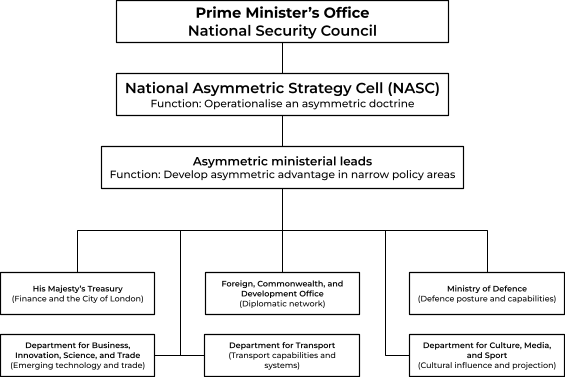
An empowered and newly formed Prime Minister’s Office (PMO) within the Cabinet Office would centralise policy planning and coordinate statecraft across Whitehall to challenge the stubborn culture of risk aversion that squanders rather than utilises the UK’s inherent strengths (see: Figure 1). To operationalise this shift, HM Government should start with the creation of a National Asymmetric Strategy Cell (NASC), sitting directly under the PMO and the National Security Council (NSC) and chaired by the First Secretary of State. A kind of ‘super SONAC’, the NASC would be charged with reforming Whitehall’s command and control model – shifting the national security apparatus from administrative predictability, process compliance, and risk aversion to an agile, permissive entity capable of rapid experimentation – to pursue asymmetric advantage in the national interest. At its core, the NASC would be responsible for determining the priority of addressing dependencies, the British asymmetric advantages that need sharpening, implementation, and arbitration between competing dependencies and advantages.
As part of this doctrine, it should be clearly recognised that the PRC, Russia, Iran, and North Korea – the CRINK – are at the very least states that seek to undermine the UK’s national interests and security. British policymaking should be geared to auditing, developing, and utilising asymmetric advantages against these actors. Every civil servant from Grade 6 onwards working on foreign, defence, or national security-related policy should be required to understand this doctrine and incorporate it as a starting point when considering their respective policy work and advice to ministers (for an operational checklist, see: Annex 1). This doctrine should be internalised across Whitehall, then complemented with a published strategy document which articulates the posture shift and partnered work programme to the public.
Further machinery-of-government reforms to entrench a proactive systemic posture – requiring deeper political buy-in, time, and resources – should be pursued in tandem. To begin with, transferring trade policy from the DBIST to the FCDO would explicitly fuse economic statecraft with diplomatic priorities. At the same time, the re-establishment of a Department for Information Services – modelled off the Ministry for Information during the Second World War and sitting in the Home Office – would provide a permanent engine for counter-disinformation and discursive statecraft.
FIGURE 1: PROPOSED STRUCTURE FOR ASYMMETRIC STATECRAFT (SOURCE: AUTHORS)
5.1.2 ENGAGE DEPARTMENTAL AUDITS AND EXTERNAL EXPERTISE
HM Government should rationalise and reform the current payroll system to align institutional architecture better with statecraft. Beyond enforcing political discipline, there is little merit in each department having at least three parliamentary private secretaries.[39] Instead, departments should be limited to one parliamentary private secretary and the additional headcount should be replaced with a dedicated ministerial asymmetric lead. Ideally these ministerial leads would sit in the House of Lords, allowing them to focus full-time on their briefs without the distraction of electoral politics. These leads, supported by dedicated departmental policy units such as SONAC, would then be tasked with auditing and cultivating Britain’s exploitative levers across targeted policy domains – whether aerospace, small modular nuclear reactors and fusion, or quantum computing and semiconductor chips – and reporting back to the NASC.
To ensure operational success, the NASC and the departmental asymmetric units should be able to bring private sector, technical, and industrial expertise into government. Ideally, the ministerial asymmetric leads would be appointed individuals with proven experience in areas of asymmetric advantage.[40] The Vaccine Taskforce and the AI Safety Institute provide clear precedent for how external talent can bypass departmental deadlock, create a culture shift in the Civil Service, accelerate capability development, and ensure a continuous drumbeat of new asymmetric initiatives before existing ones begin to decay.
5.1.3 CONSTRUCT THE ‘VENTURE STATE’
Within these units and the NASC, HM Government should establish a specialised legal advisory body to redefine Britain’s normative framework in terms of international law. Empowered by the PMO to sit above the Government Legal Department and the FCDO’s Legal Directorate, this body would advise civil servants on how legally to exploit regulatory ambiguity and normative grey zones – transforming lawfare into an offensive instrument of statecraft rather than allowing legal risk aversion to act as a self-imposed brake. To reinforce structural agility, HM Government should also restore the traditional convention of the Attorney General attending the NSC or relevant Cabinet committees when legal advice is sought. Returning to precedent and removing the Attorney General’s automatic participation reinforces an agile normative framework, ensuring that legal counsel acts as an enabler of strategy rather than an impediment to taking risk.
Adopting a ‘venture state’ model would similarly allow these units and the NASC to adjust Whitehall’s risk profile, accepting higher portfolio risk in exchange for flexibility and speed to bypass traditional levers. By streamlining cumbersome procurement rules, the state can provide agile capital funding and take golden shares in unproven technologies while reinforcing sectors offering asymmetric advantage. This should include expanding upon HM Government’s planned overhaul of procurement contracts and ensuring that UK Research and Innovation, the National Wealth Fund, and UK Export Finance are mandated not only to support the creation of British-based jobs, but also to cultivate asymmetric advantages for the UK.
In parallel, Britain’s regulatory agencies should be directed to move away from simply promoting growth towards creating a regulatory environment which favours UK-based companies and jobs while supporting existing sectors where Britain holds an advantage. Above all, these units and the NASC should sit outside the humdrum of daily politics and focus ruthlessly on the development and utilisation of asymmetric advantage, feeding into broader national security aims and reporting directly to the NSC and PMO. The stated aim should be that ministers have a menu of policy options, an understanding of key advantages, and a recommendation on how these advantages can be deployed and calibrated for maximum effect.
5.2 Defence policy and the focused force design
5.2.1 REVIEW THE DEFENCE INVESTMENT PLAN
HM Government could generate immediate asymmetric momentum by reviewing the Defence Investment Plan (DIP) and establishing a binding, multi-year path to invest 3.5% of Gross Domestic Product (GDP) in defence by 2035 – which is what it agreed to do at NATO’s annual summit in The Hague in 2025.[41] The asymmetry in this move lies in its unexpectedness: after years of incrementalism, fiscal hedging, and muddling through, a bold British financial commitment would shatter the expectations of adversaries and allies alike. Crucially, a decade-long DIP would also change domestic resource dynamics, providing the UK’s defence industrial base – from shipbuilders and aircraft manufacturers to Small and Medium-sized Enterprises (SMEs) – with the demand signals that they need to make long-term investment decisions.
In terms of impact on adversaries, a fully funded, decade-long DIP would have a potentially profound impact on the Kremlin, as well as its CRINK associates. Russia’s strategic calculations rely on the premise that European rearmament will be slow, fragmented, and dominated by Germany, Poland, and the smaller Baltic and Nordic states. Forcing the Kremlin to confront the two largest economies in Europe at the same time – with Germany providing continental military mass, and a rearmed UK commanding the sea, air, space, and nuclear domains – would fundamentally destabilise Russia’s calculus and long-term war potential.
Simultaneously, this fiscal audacity would deliver a constructive shock to NATO capitals and, above all others, to Washington – Britain’s closest and most powerful ally. It would also restore the UK’s standing in Europe, reversing the narrative that the British are dragging their feet in terms of investing more in defence. Developing a clear path to the 3.5% of GDP on defence baseline would provide immediate geopolitical leverage: it proves to the US that the UK has the strategic gravity needed to uphold European defence, while ensuring that European allies, especially those in Northern and Eastern Europe, continue to treat Britain as their principal partner of choice.
5.2.2 FOCUS ON ASYMMETRIC MASS
It is tempting to think that if HM Government now unleashes the fiscal firepower needed to reach its commitment to invest 3.5% of GDP in defence by 2035, a balanced force will still be within reach. From an asymmetric vantage point, this would be a symmetric mistake. Two watershed developments since 2022 – the Finnish and Swedish accession to NATO and the unprecedented rearmament of European allies, particularly Germany and Poland – mean that attempting to build a balanced force would lead to strategic duplication.
While the UK must draw on the lessons surrounding Russia’s war against Ukraine, HM Government must extrapolate from, rather than copy, Kyiv’s experience: Britain’s unique maritime geography demands a distinct posture focused on sea and air control, technological overmatch, and strategic depth. With European allies now fielding heavy land forces in greater numbers along NATO’s central front, the UK no longer needs to duplicate their efforts.[42]
Consequently, Britain should follow the SDR to its logical conclusion: shifting its centre of gravity towards a focused force – drawing on the strategic logic behind the Australian model – where the Royal Navy, the RAF, and a dedicated Space Force receive the lion’s share of resources. In addition to the Type 26 and Type 31 frigates already on order, HM Government should commit to building at least 12 SSN-AUKUS nuclear attack submarines, scaling Anti-Submarine Warfare (ASW) capabilities, building a substantial fleet of Common Combat Vessels (CCVs) and optionally crewed/uncrewed large oceangoing sloops (including arsenal ships and sensor vessels). If the New Hybrid Navy is to be realised, it should be pursued with strategic audacity: the ambition should be for the Royal Navy to consolidate its position as the most advanced and powerful navy in Europe by the mid-2030s.[43]
Likewise, strengthening the RAF and standing up a Royal Space Force would provide European NATO with critical enabling capabilities that many other European allies currently lack or simply cannot afford. This should include placing an ad hoc order for production-ready and integrated cruise missiles to arm the F-35 Lightning II Joint Combat Aircraft for the suppression and destruction of enemy air defences, and the P-8 Poseidon patrol aircraft to provide stand-off strike capability, as well as enhancements to autonomous systems, strategic airlift, in-flight refuelling, and airborne Intelligence, Surveillance, and Reconnaissance (ISR).[44] A far greater British focus on space, including resilience and control, alongside key allies, would also offer asymmetric effort, particularly as orbital warfare becomes viable and the American, Chinese, and European focus on the heavens grows.[45] Pivoting to these domains would strengthen the UK’s position within NATO, allowing it to act as a stronger backstop as the US focuses on the Western Hemisphere and the Indo-Pacific.
HM Government’s resource dynamics should focus on technological transformation. The overhaul of the British Army should be expedited: focused on specialised, technology-dense, and uncrewed denial forces, designed to entangle more deeply with European allies along NATO’s eastern and northern flanks so as to compound the UK’s nuclear deterrent more effectively.[46] Concurrently, the British Armed Forces should lean forcefully into autonomous and semi-autonomous systems. This cannot be seen as a cost-saving measure: higher levels of autonomy and powerful strike systems will be needed in greater numbers in order to provide the operational depth that the UK needs, when both adversaries and allies are engaged in rearmament. The advantage of partially crewed and uncrewed systems lies not in budget reduction, but in delivering vastly superior firepower, persistent surveillance, and dispersed mass – maintaining technological overmatch while freeing forces from human constraints.
In terms of adversary impact, rebuilding the Royal Navy to dominate the Wider North and the maritime approaches to the Euro-Atlantic would constrain the Russian Northern Fleet, which has been largely untouched by the Kremlin’s onslaught against Ukraine. Insofar as naval, air, and space power are fungible, they would also provide the means to resist Iran and, in the future, deter the possible expansion of the PRC’s geostrategic ambitions in the Euro-Atlantic – which could grow rapidly in the event of a multifront crisis.
5.2.3 EMBRACE NUCLEAR STATECRAFT
As the case of AUKUS shows, asymmetry often depends on audacious acts that rapidly disorient opponents to the extent that they can do little other than accept a new reality. Nowhere could this be achieved more effectively in terms of adversary impact than if Britain were to commit to regenerating its sub-strategic nuclear capability.[47] Building on the SDR’s commitment to contribute further to nuclear deterrence in Europe, the UK has already agreed to enter NATO’s Dual Capable Aircraft mission with the acquisition of at least 12 F-35A Lightning II Joint Combat Aircraft. An additional package of aircraft will be needed to make this offer credible, given that these 12 aircraft will primarily be allocated to Operational Conversion Units (OCUs) as part of military flying training.[48]
To maximise British leverage, HM Government should push beyond standard participation; rather, it should pioneer new, UK-led nuclear sharing arrangements with key European NATO allies, especially Germany, Poland, Romania, and the Nordic states – with American technical support. Redeveloping a sovereign sub-strategic nuclear capability with flexible strike options closes off a critical escalatory gap. In a multifront crisis, this would prevent the Kremlin from leveraging its sub-strategic nuclear superiority to short-circuit strategic deterrence. True, the US has pledged to continue to uphold its large nuclear umbrella over NATO – at all levels – but a British alternative provides complementary support. It would also reconfirm the UK’s position as NATO’s primary European backstop.
Critics will argue that such a move would be cost-prohibitive. However, if pursued in combination with the resource dynamics of a focused force, a sub-strategic nuclear deterrent would be affordable – especially if European allies, such as Germany and Poland, helped to cover the costs of the delivery system, which could readily be dual-use.[49]
5.3 Foreign policy and economic statecraft
5.3.1 MOVE FROM ‘MANAGED DECLINE’ TO PROACTIVE MINILATERALISM
The FCDO and other international-facing departments should be ready to shift British strategic posture – moving away from assumptions of ‘managed decline’ or preserving a fraying status quo towards the active pursuit of the UK’s national interests. Britain cannot afford to coast on the imagined protection of a fracturing rules-based international system, ignore the return of great power politics, or overlook the increasing convergence of the CRINK nations, which seek to realign the world in accordance with their interests. Executing this shift requires ministers and officials to make hard policy trade-offs, recognising that slow, consensus-bound multilateral institutions should not be preserved when they confer strategic or asymmetric advantage to rivals at the expense of the UK’s security and prosperity.
Instead, British statecraft should focus on asymmetric resource dynamics by cultivating and building agile and targeted minilateral coalitions of like-minded partners to multiply its influence without requiring resource-intensive symmetric expansion. For instance, this could include deepening the UK-US relationship in areas where Britain can add value or leverage American power (such as space security, Collaborative Combat Aircraft [CCA] to work alongside the F-35 Lightning II, and long-range strike capabilities, including hypersonic weapons), building out Pillar II of AUKUS, expanding the Global Combat Air Programme (GCAP), deepening the geopolitical reach of the Joint Expeditionary Force (JEF), and creating economic and industrial partnerships between trusted middle powers with developed economies. Concentrating diplomatic energy on these flexible frameworks creates tailored force multipliers that bypass institutional gridlock while protecting sovereign resilience.
The most urgent priority here is supporting Ukraine – presently the central front for the defence of Europe. To generate decisive adversary impact, HM Government should further develop the coalition of the willing into a geopolitical spearhead alongside committed partners such as Poland, France, Germany, and the Baltic and Nordic states. Unless the UK wants Russia’s military offensive to drag on for years more, the time has come for HM Government to push for a genuine European coalition to finance, arm, and enable Kyiv to execute a sustained decisive deep-strike campaign against strategic targets (excluding nuclear systems) inside Russia. Degrading Russian military-industrial depth and command nodes is the only viable way to dislocate the Kremlin’s war effort and force it to the negotiating table on terms favourable to Ukraine, Britain, and their allies and partners.
5.3.2 PURSUE PSYCHOLOGICAL STATECRAFT
The UK’s values of democracy and the rule of law matter both at home and abroad. That does not offer HM Government a licence for military adventurism, but it should offer a clear ballast in the way that Britain prioritises and deepens its relationships, as well as how it frames the world. This includes utilising strategic communications to support democracy and the rule of law to push back against authoritarian narratives which seek to claim that ‘the West is in decline’. Learning from the response to Russia’s invasion of Ukraine, HM Government should be more prepared to employ transparency and real-time intelligence declassification as standard diplomatic tools to debunk rival disinformation, maximise adversary impact, and dislocate opponents’ decision-making cycles.
5.3.3 ENGAGE IN LAWFARE AND TREATY ENFORCEMENT
Too often, HM Government has allowed adversaries to exploit London’s status as a global legal centre and its professional services industry to undertake aggressive lawfare in an attempt to paralyse British foreign policy decision-making. In response, the UK should place the PRC on the enhanced tier of the Foreign Influence Registration Scheme (FIRS) and introduce a separate companion register for foreign enablers. This would bar professional services companies who work for countries in the enhanced tier from receiving government contracts or sitting on government-run consultative or arm’s-length bodies.
Similarly, when stated red lines go unenforced or bilateral treaties with Britain are broken without consequence, the UK’s adversaries are emboldened and national security is diminished. Within Britain’s normative framework, HM Government should adopt a strict operational rule: no new agreement or treaty should be signed with a country that is in a state of ‘ongoing non-compliance’ with an existing bilateral treaty with the UK. This creates a structural stop-gap for legacy treaties lacking enforcement mechanisms, forcing non-compliant actors to return to adherence.
5.3.4 COLLECTIVISE ECONOMIC DEFENCE AND RESILIENCE
Global supply chains and economic dependencies are increasingly weaponised by revisionists such as the PRC, which uses export controls, tariffs, and consumer boycotts to isolate and punish individual countries. This poses a severe threat to a state like Britain, which has built its economic model on open and free trade and ‘just in time’ supply chains. This post-Cold War ‘default setting’ should be reversed, ensuring economic statecraft is the norm, not the exception. Too small to respond to economic coercion alone, but with a big enough consumer market and specific asymmetric advantages, the UK should seek to deepen economic security and resilience initiatives with like-minded partners. Working with the G7 and the EU, HM Government should champion a modern minilateral economic defence architecture – modelled on the Cold War-era Coordinating Committee for Multilateral Export Controls (CoCom) – to coordinate export controls and trade defence measures jointly. This would ensure that no particular state can be singled out for economic coercion, shifting Britain from inverse vulnerability to structural resilience.
6.0 CONCLUSION: THE COST OF COMPLACENCY
Robert Frost, the American poet, famously quipped: ‘How many times does something need to happen to you before something occurs to you?’[50] Since 2020, the UK has faced a global pandemic, Russia’s renewed offensive against Ukraine backed by the wider CRINK, and now another war in the Middle East – each dealing a severe blow to the security and living standards of the British public.
After each of these ‘once in a generation’ events, successive governments have attempted to drive meaningful intellectual and discursive renewal – as shown by the Integrated Review, IRR, and the NSS and SDR – progressively discarding post-Cold War assumptions to confront a more volatile world. While HM Government has secured notable asymmetric victories, as demonstrated by AUKUS, supporting Ukraine, and AI safety governance, it has repeatedly struggled to carry this intellectual shift through to its logical conclusion. Critically, strategic ambition has not been matched by sustained material investment. Long-term funding for national defence, foreign policy, and secure supply chains has routinely been sacrificed on the altar of short-term domestic spending pressures. This has left impressive asymmetric initiatives as isolated successes rather than components of a fully resourced national strategy.
The cost of the UK’s complacency can be measured in the country having the second highest electricity price in Europe, the joint highest inflation in the G7, the highest debt-to-GDP ratio since the 1960s, the highest borrowing costs in the Organisation for Economic Cooperation and Development (OECD), depleted munitions and oil stockpiles, and the lowest share of manufacturing in the G7.[51] Of course, Britain is not unique here: many of its peers, such as Germany, Japan, France, and Italy, are burdened with comparable economic problems. But this changes little: among observers in the world’s two leading powers – the US and the PRC – the UK is viewed as ‘just an old European country apt for study and travel’ or a ‘freeloader’ that often needs ‘bailing out’.[52] Meanwhile, Russia treats Britain with distinct malice: while the Kremlin vilifies the UK as an inveterate provocateur, manipulator, and civilisational enemy, it also writes the country off as a power in terminal decline.[53] If Britain is to be taken seriously, HM Government needs to challenge these notions: firstly, by establishing domestic resilience; secondly, by demonstrating its asymmetric utility to allies; and finally, by weaponising its advantages, with cold precision, against adversaries.
6.1 Key findings
Based on the research undertaken for this study, five central findings demand immediate attention from HM Government:
- Operationalising asymmetric statecraft: HM Government should translate the recognition of a fundamentally changed world into an alternative, cross-governmental doctrine that shifts culture across the Civil Service and represents a strategic shift in posture. Asymmetric advantage must not be treated as an ad hoc tactic, but cultivated systemically – cascading across time and policy areas, including defence, foreign policy, and economic statecraft, with proactive minilateralism as its primary delivery vehicle.
- Retooling the state via a National Asymmetric Strategy Cell: Building on the UK’s successful deployment of intelligence, military, diplomacy, and financial power during Russia’s renewed offensive against Ukraine requires structural reform. HM Government should establish a central National Asymmetric Strategy Cell (NASC) within the Cabinet Office chaired by the First Secretary of State, supported by departmental asymmetric leads, such as SONAC in the MOD’s case, to audit and deploy exploitative levers systematically.
- Reopening the DIP for a focused force with increased lethality: Delivering immediate paradigm disruption, HM Government should establish a multi-year path to invest 3.5% of GDP in defence by 2035. Taking advantage of Polish and German rearmament on the land, Britain should shift its conventional centre of gravity to a sea, air, space, and nuclear focused force that maximises impact on Russia and other adversaries while freeing resource dynamics for uncrewed autonomous mass and rapid improvements in lethality.
- Pivoting to minilateralism and offensive psychological statecraft: The UK’s foreign policy should prioritise agile minilateral groupings (AUKUS [including co-development and co-production with the US], GCAP, JEF, and a European deep-strike coalition for Ukraine) over dated consensus-bound institutions. Concurrently, Whitehall should normalise intelligence declassification and discursive statecraft to disorient rival decision-makers and secure cognitive overmatch.
- Closing lawfare loopholes and collectivising economic defence: Transitioning from post-Cold War legalism to strategic realism requires placing the PRC on the enhanced tier of the FIRS register, enforcing bilateral treaty compliance, and championing a modern, CoCom-style G7 economic defence architecture to protect supply chains from CRINK coercion.
6.2 Final reflections
Modern British strategic history points to an unmistakable lesson: Britain is at its most formidable not when it passively attempts to preserve the status quo, but when it is prepared to be creative, disruptive, and audacious. Managed decline is an institutional choice, not a geopolitical inevitability – especially when the UK’s economy is expected to leap over Japan’s by 2030 and draw closer to Germany throughout the next decade.[54] Britain is fortunate to possess a rich inheritance of accumulated capabilities, including a premier global financial centre – the City of London – the International Maritime Organisation, many leading universities, nuclear weapons and advanced conventional forces, custodianship of NATO, a permanent seat on the UN Security Council, the English Common Law system, and the Commonwealth, alongside an abundance of cultural weight. Yet, allowing these capabilities to be squandered through incrementalism, risk aversion, legalism, and process compliance guarantees the UK strategic marginalisation.
Conversely, when HM Government has embraced asymmetric statecraft in the past – whether in 1945-1949 by abandoning centuries of offshore balancing to reorder European security, in 2021 by shattering diplomatic orthodoxies to co-engineer AUKUS, or in 2022 by weaponising the release of intelligence and delivering lethal aid to Ukraine to dislocate the Kremlin’s coming onslaught – it has generated a degree of leverage far outstripping Britain’s own size. In each instance, HM Government did not wait for multilateral consensus; it established new geopolitical realities that forced allies and adversaries to adapt to its tempo. To protect the UK’s people from compounding geopolitical crises and maintain an agile posture, HM Government should reclaim this tradition.
Britain no longer possesses the mass of a superpower, nor does it need to. What it requires is the political and administrative resolve to abandon comfortable but ineffective post-Cold War habits, execute a multi-year DIP out to 2035 backed by a politically binding commitment to invest 3.5% of GDP in defence, and cultivate a unique asymmetric doctrine to outplay and outmanoeuvre its adversaries.
Annex 1
Checklist for pursuing asymmetric advantage
- Core philosophy: Does the policy outline actions that bypass, break, or redefine an existing paradigm to change the rules of the game?
- Systemic posture: Is the proposed posture offensive and focused, allowing the UK to exploit systemic friction and structural ambiguity?
- Success metric: Is success measured by the achievement of strategic objectives through decision paralysis, while keeping strictly below the threshold of open conflict?
- Centre of gravity: Have the specific exploitative levers and/or strategic audacity to weaponise the constraints of the adversary been identified?
- Resource dynamics: Is the approach relational and resource-agnostic, ensuring that effects are multiplied via unconventional vectors rather than sheer budgetary scale?
- Command and control: Can a decentralised and agile structure of command and control be instituted to empower edge actors and prioritise rapid experimentation?
- Normative framework: Have the implications of calculated exploitation, specifically regarding how the policy exploits or redefines existing paradigms, been assessed?
- Impact on the adversary: Is the strategy designed to catch the adversary off guard and induce acute cognitive disorientation – a ‘doom spiral’ – to deactivate any potential response?
- Risk profile: Have clear guardrails against unintended escalation, misjudging the breaking point of the adversary, and severe reputational fallout been established?
- Timespan: Is the operational planning optimised for sharp, disruptive, and shorter-term interventions, potentially to trigger long-term cascading effects?
Acknowledgements
The authors extend their gratitude to the Rt. Hon. Lord Robertson KT GCMG for providing the foreword to this Report, as well as to the participants at the Ministry of Defence workshop on 3rd August 2026 for their valuable comments on an earlier draft of this study. Particular thanks go to Dr Andrew Ehrhardt, Director of Research and Programmes at the Centre for Statecraft and National Security at King’s College London, for sharing his invaluable work on asymmetric advantage. The authors are also indebted to the internal and external reviewers for their thoughtful commentary.
Notes
[1] See: Shawn Davies, Therése Pettersson, and Magnus Öberg, ‘Organised violence 1989-2025, and violent political protests’, Journal of Peace Research, 63:4 (06/2026); Simon Lester, ‘2025 Had the Most WTO Complaints Since 2019’, International Economic Law and Policy Blog, 08/01/2026, https://ielp.worldtradelaw.net/ (checked: 07/09/2026); and ‘Milestone: COVID-19 five years ago’, World Health Organisation, 30/12/2024, https://www.who.int/ (checked: 07/09/2026).
[2] See: Federica Marsi, ‘Trump-Xi meeting: Could China, US form a “G2”?’, Al Jazeera, 12/05/2026, https://www.aljazeera.com/ (checked: 07/09/2026); Alec Smith (ed.), ‘Are we entering a new world of spheres of influence?’, Britain’s World, 30/01/2026, https://www.britainsworld.org.uk/ (checked: 07/09/2026); and Thucydides, ‘The History of the Peloponnesian War’, Project Gutenberg, https://www.gutenberg.org/ (checked: 07/09/2026).
[3] William Freer, John Hemmings, and James Rogers, ‘The “special relationship”: Preparing Britain and America for a new era’, Council on Geostrategy, 26/06/2025, https://www.geostrategy.org.uk/ (checked: 07/09/2026).
[4] Richard Hermer, Speech: ‘Attorney General’s 2025 RUSI Annual Security Lecture’, Attorney General’s Office, 29/05/2025, https://www.gov.uk/ (checked: 07/09/2026).
[5] José Ernault, ‘French President Emmanuel Macron’s key European priorities’, Dods Political Intelligence, 10/01/2025, https://www.dodspoliticalintelligence.com/ (checked: 07/09/2026).
[6] See: Robert Rowthorn and Kenneth Coutts, ‘Re-industrialisation – a commentary’, House of Lords, 10/2013, https://assets.publishing.service.gov.uk/ (checked: 07/09/2026); and Esme Kirk-Wade, ‘UK defence spending’, House of Commons Library, 26/07/2026, https://commonslibrary.parliament.uk/ (checked: 07/09/2026).
[7] For example, the UK previously had one judge at the ICJ from 1948-2018, and Guy Ryder was Director-General of the International Labour Organisation from 2012 to 2022, while Tom Fletcher is currently the United Nations Under-Secretary-General for Humanitarian Affairs and Emergency Relief Coordinator (since 2024).
[8] ‘National Security Strategy 2025: Security for the British People in a Dangerous World’, Cabinet Office, 24/06/2025, https://www.gov.uk/ (checked: 07/09/2026).
[9] Robert Cooper, The Postmodern State and the World Order (Demos: London, 2000).
[10] ‘National Security Strategy and Strategic Defence and Security Review’, Cabinet Office, 23/11/2015, https://www.gov.uk/ (checked: 07/09/2026) and ‘National Security Capability Review’, Cabinet Office, 28/03/2018, https://www.gov.uk/ (checked: 07/09/2026).
[11] Queen Elizabeth II, Speech: ‘Queen’s Speech December 2019’, 10 Downing Street, 19/12/2019, https://www.gov.uk/ (checked: 07/09/2026).
[12] ‘Global Britain in a Competitive Age: The Integrated Review of Security, Defence, Development, and Foreign Policy’, Cabinet Office, 16/03/2021, https://www.gov.uk/ (checked: 07/09/2026).
[13] Ibid.
[14] ‘Integrated Review Refresh 2023: Responding to a more contested and volatile world’, Cabinet Office, 13/03/2023, https://www.gov.uk/ (checked: 07/09/2026).
[15] Ibid.
[16] ‘National Security Strategy 2025: Security for the British People in a Dangerous World’, Cabinet Office, 24/06/2025, https://www.gov.uk/ (checked: 07/09/2026).
[17] Ibid.
[18] Ibid.
[19] Ibid.
[20] For more on the concepts of strategic and asymmetric advantage, see: William Freer, Gabriel Elefteriu, and James Rogers, ‘What is strategic advantage?’, Council on Geostrategy, 23/11/2023, https://www.geostrategy.org.uk/ (checked: 07/09/2026); James Black, Diana Dascalu, Megan Hughes, and Ben Wilkinson, ‘Strategic advantage in a competitive age: Definitions, dynamics, and implications’, RAND Europe, 08/03/2023, https://www.rand.org/ (checked: 07/09/2026); and Andrew Ehrhardt, Hugo Bromley, and Marcus Solarz-Hendriks, Working paper: ‘What is meant by asymmetric advantage?’, Centre for Statecraft and National Security, 11/2025.
[21] Andrew Ehrhardt, Hugo Bromley, and Marcus Solarz-Hendriks, Working paper: ‘What is meant by asymmetric advantage?’, Centre for Statecraft and National Security, 11/2025.
[22] See, for example: Orde Kittrie, Lawfare: Law as a Weapon of War (Oxford: Oxford University Press, 2016); and Charles Dunlap, ‘Lawfare 101: A Primer’, Military Review: The Professional Journal of the US Army, 05/2017, https://www.armyupress.army.mil/ (checked: 07/09/2026).
[23] For an excellent overview, see: John Baylis, The Diplomacy of Pragmatism: Britain and the Formation of NATO, 1942-1949 (Kent, Ohio: Kent State University Press, 1993).
[24] For the manoeuvrist approach as defined by official British defence doctrine, see: ‘UK Defence Doctrine (JDP 0-01)’, Ministry of Defence, 21/11/2022, https://www.gov.uk/ (checked: 07/09/2026).
[25] See: John Terraine, The Right of the Line: The Royal Air Force in the European War 1939-1945 (Sevenoaks: Hodder and Stoughton, 1985); and Richard Overy, The Bombing War: Europe 1939-1945 (London: Allen Lane, 2013).
[26] Paul Mason and Benedict Baxendale-Smith, ‘Why Britain’s strategists need to wake up and stop living in the past’, Council on Geostrategy, 16/07/2026, https://www.geostrategy.org.uk/ (checked: 07/09/2026).
[27] See: Rory Cormac, ‘In defence of the Information Research Department’, Britain’s World, 18/12/2024, https://www.britainsworld.org.uk/ (checked: 07/09/2026); Giselle Gwinnett, ‘Attlee, Bevin, and Political Warfare: Labour’s Secret Anti-Communist Campaign in Europe, 1948-51’, The International History Review, 39:3 (2017); and Andrew Defty, Britain, America and Anti-Communist Propaganda 1945-53 (London: Routledge, 2004).
[28] John Baylis, The Diplomacy of Pragmatism: Britain and the Formation of NATO, 1942-1949 (Kent, Ohio: Kent State University Press, 1993).
[29] Ivan Arreguín-Toft, ‘How the Weak Win Wars: A Theory of Asymmetric Conflict’, International Security, 26:1 (2001).
[30] For an overview, see: Valery Gerasimov, ‘The Value of Science Is in the Foresight: New Challenges Demand Rethinking the Forms and Methods of Carrying out Combat Operations’, Military Review: The Professional Journal of the US Army, 01/2016, https://www.armyupress.army.mil/ (checked: 07/09/2026); Vladislav Surkov, ‘Without sky’, Russian Pioneer, 12/03/2014, https://ruspioner.ru/ (checked: 07/09/2026); and James Rogers and Andrei Tyushka, ‘“Hacking” into the West: Russia’s “anti-hegemonic” drive and the strategic narrative offensive’, Defence Strategic Communications, 01/03/2017, https://stratcomcoe.org/ (checked: 07/09/2026).
[31] See: Jeff Stein and Federica Cocco, ‘How four US presidents unleashed economic warfare across the globe’, The Washington Post, 25/07/2024, https://www.washingtonpost.com/ (checked: 07/09/2026); and Tae-Yoon Kim, Shobhan Dhir, Amrita Dasgupta, and Alessio Scanziani, ‘With new export controls on critical minerals, supply concentration risks become reality’, International Energy Agency, 23/10/2025, https://www.iea.org/ (checked: 07/09/2026).
[32] Stephen Lovegrove, Speech: ‘Sir Stephen Lovegrove speech at the Council on Geostrategy’, Cabinet Office, 16/09/2021, https://www.gov.uk/ (checked: 07/09/2026).
[33] Milena Wälde, ‘EU to transfer €1.4B in profits from frozen Russian assets to Ukraine’, Politico, 05/08/2026, https://www.politico.eu/ (checked: 07/09/2026).
[34] ‘UK government bans services enabling the transport of Russian oil’, HM Treasury, 03/11/2022, https://www.gov.uk/ (checked: 07/09/2026).
[35] ‘UK tightens Oil Price Cap in blow to Putin’s war machine’, Foreign, Commonwealth, and Development Office, 18/07/2025, https://www.gov.uk/ (checked: 07/09/2026).
[36] Patrick Butchard, ‘Seizing the shadow fleet’, House of Commons Library, 18/06/2026, https://commonslibrary.parliament.uk/ (checked: 07/09/2026).
[37] See: Sam Hogg and Kayla Blomquist, Written evidence: ‘Science diplomacy’, Science, Innovation, and Technology Committee (House of Commons), 09/05/2025, https://committees.parliament.uk/ (checked: 07/09/2026).
[38] ‘The Bletchley Declaration by Countries Attending the AI Safety Summit, 1-2 November 2023’, 10 Downing Street, 01/11/2023, https://www.gov.uk/ (checked: 07/09/2026).
[39] ‘Who’s who in Andy Burnham’s government? Full list of ministers, PPSs, and whips’, Labour List, 28/07/2026, https://labourlist.org/ (checked: 07/09/2026).
[40] This model has been tried and tested previously under the governments of Gordon Brown and Sir Keir Starmer (e.g., Lord Vallance as Minister of State for Science, Innovation, Research, and Nuclear).
[41] ‘The Hague Summit Declaration’, North Atlantic Treaty Organisation, 25/06/2025, https://www.nato.int/ (checked: 07/09/2026).
[42] William Freer, ‘Collective defence: The Strategic Defence Review and capability gaps in a changing NATO’, Council on Geostrategy, 29/10/2025, https://www.geostrategy.org.uk/ (checked: 07/09/2026).
[43] For more on the potential of the New Hybrid Navy, see: James Parkin, ‘Delivering the Hybrid Navy: Challenges and opportunities’, Britain’s World, 14/08/2026, https://www.britainsworld.org.uk/ (checked: 07/09/2026).
[44] William Freer, ‘Collective defence: The Strategic Defence Review and capability gaps in a changing NATO’, Council on Geostrategy, 10/2025, https://www.geostrategy.org.uk/ (checked: 07/09/2026).
[45] See, for example: Gabriel Elefteriu, ‘Embracing orbital warfare’, Council on Geostrategy, 15/07/2026, https://www.geostrategy.org.uk/ (checked: 07/09/2026); Gabriel Elefteriu, ‘UK space strategy and the national space interest: A methodological approach’, Council on Geostrategy, 05/11/2025, https://www.geostrategy.org.uk/ (checked: 07/09/2026); and ‘Space Warfighting Environment 2040’, United States Space Command, 27/07/2026, https://www.spacecom.mil/ (checked: 07/09/2026).
[46] See: Matthew Palmer, ‘Deterrence: Integrating Britain’s conventional and nuclear forces’, Council on Geostrategy, 12/03/2026, https://www.geostrategy.org.uk/ (checked: 07/09/2026); and ‘European security strengthened under landmark UK and Estonia agreement’, Ministry of Defence, 16/07/2026, https://www.gov.uk/ (checked: 07/09/2026).
[47] Paul Mason, Marc De Vore, and James Rogers, ‘Why Britain must expand its nuclear arsenal’, The Spectator, 10/05/2025, https://spectator.com/ (checked: 07/09/2026).
[48] William Freer and Peter Watkins, ‘Rebuilding the ladder: Options for boosting Britain’s nuclear posture’, Council on Geostrategy, 28/04/2026, https://www.geostrategy.org.uk/ (checked: 07/09/2026).
[49] James Rogers, ‘How Britain and Germany could establish a sub-strategic nuclear deterrent’, Britain’s World, 31/03/2026, https://www.britainsworld.org.uk/ (checked: 07/09/2026).
[50] Cited in: ‘Robert Frost > Quotes > Quotable Quote’, Goodreads, No date, https://www.goodreads.com/ (checked: 07/09/2026).
[51] See: ‘International domestic energy prices’, Department for Energy Security and Net Zero, 28/05/2026, https://www.gov.uk/ (checked: 07/09/2026); Faisal Islam, ‘UK faces biggest hit to growth from Iran war of major economies, IMF says’, BBC News, 14/04/2026, https://www.bbc.co.uk/ (checked: 07/09/2026); ‘Public sector finances, UK: July 2026’, Office for National Statistics, 21/08/2026, https://www.ons.gov.uk/ (checked: 07/09/2026); ‘UK exceptionalism on high borrowing costs driven by “sticky” inflation and a reliance on the “kindness of strangers”’, Resolution Foundation, 12/09/2025, https://www.resolutionfoundation.org/ (checked: 07/09/2026); and Richard Baldwin, ‘How the G7 deindustrialised’, Richard Baldwin Substack, 01/01/2026, https://rbaldwin.substack.com/ (checked: 07/09/2026).
[52] See: ‘China’s “UK is no big power” snub to Cameron’, Sky News, 03/12/2013, https://news.sky.com/ (checked: 07/09/2026); and ‘Full transcript of Trump team’s Yemen attack plan that was shared on Signal’, Al Jazeera, 27/03/2025, https://www.aljazeera.com/ (checked: 07/09/2026).
[53] See: Jade McGlynn, ‘The Enemy’s Mirror: Understanding Russian Strategic Discourse on the United Kingdom’, Centre for Statecraft and National Security, 22/07/2025, https://csns.uk/ (checked: 07/09/2026); and Bryn Windsor, ‘Analysis: How the UK became Russian propaganda’s “public enemy number one”’, BBC Monitoring, 14/05/2026, https://monitoring.bbc.co.uk/ (checked: 07/09/2026).
[54] ‘GDP, current prices – Germany, Japan, United Kingdom’, International Monetary Fund, 2026, https://www.imf.org/ (checked: 07/09/2026).
Editorial policy
Our publications are guided by our editorial policy and quality assurance processes. To view these, please visit: http://www.geostrategy.org.uk/editorial-policy
DISCLOSURE ON ARTIFICIAL INTELLIGENCE (AI)
This research involved the use of Artificial Intelligence (AI) as a tool to assist with copyediting, restructuring text, checking for errors and fallacies, and generating images. The author(s) and the editorial team at the Council on Geostrategy maintained full oversight throughout the drafting, copyediting, and formatting process, and assume complete responsibility for the final published content.
ISBN: 978-1-917893-32-9